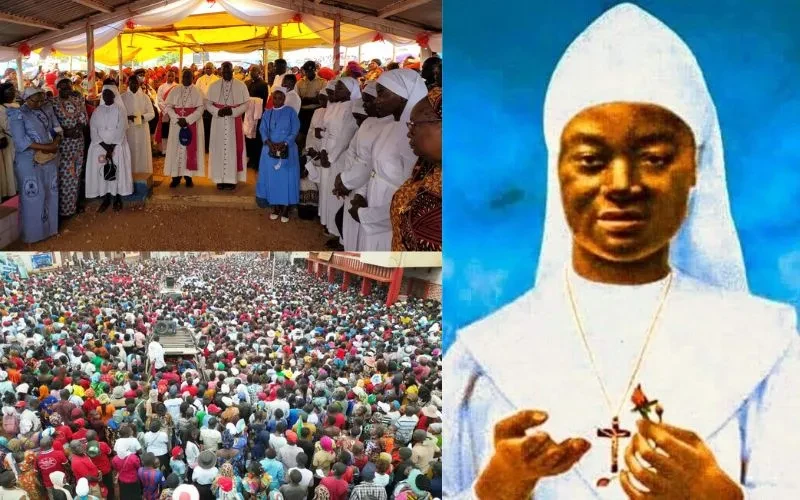
 The president of the National Episcopal Conference of Congo (CENCO) has announced the construction of a national shrine dedicated to Blessed Marie-Clémentine Anuarite Nengapeta, a Congolese sister beatified in August 1985. / Credit: DiaCENCO
ACI Africa, Dec 5, 2025 / 07:00 am (CNA).
The president of the National Episcopal Conference of Congo (CENCO) has announced the construction of a national shrine dedicated to Blessed Marie-Clémentine Anuarite Nengapeta, a Congolese sister beatified in August 1985.
Announcing the launch of construction on Dec. 1, Archbishop Fulgence Muteba Mugalu described Blessed Anuarite as a timeless model of hope for a nation scarred by violence and social injustice.
“I am pleased to address this message to you on the feast of Blessed Anuarite, during which the construction works for the great shrine dedicated to her are being launched,” Muteba said of the construction, which will take place in the Diocese of Isiro-Niangara.
He said the initiative is a “significant moment” for the Church in the Democratic Republic of Congo (DRC) as it nears the end of the Catholic Church’s 2025 Jubilee Year, themed “Pilgrims of Hope.”
The bishop of the Archdiocese of Lubumbashi emphasized that the shrine will serve both as a dignified resting place honoring the martyr’s legacy and as a spiritual wellspring for pilgrims who seek her intercession.
He thanked all individuals who contributed to the construction project.
Muteba described Blessed Anuarite as a symbol of moral courage and unwavering faith and hope whose life was “offered to the Lord.”
“We bless the Lord God for the gift he has given our country in the person of Blessed Anuarite, a courageous witness of faith whose life offered to the Lord — even unto the supreme sacrifice — echoes the words of St. Paul the Apostle: Hope does not disappoint,” the archbishop said.
He added: “Indeed, Blessed Anuarite has been, and will always remain, a bearer of hope in this country where human dignity is violated at various levels and in many forms. She is truly the sign of the grain of wheat that falls to the earth and bears much fruit.”
The CENCO president noted that Blessed Anuarite is a “bearer of hope” for the entire Congolese people.
He said the martyr is especially a bearer of hope for the women and children who are victims of violence and for the Congolese people who suffer in regions devastated by war and recurrent insecurity.
“Her blood is a seed of peace in the Democratic Republic of Congo,” the Congolese Church leader said.
Muteba expressed special gratitude to Prime Minister Judith Suminwa for her personal support and for authorizing the allocation of remaining government funds — initially earmarked for the 2024 60th anniversary pilgrimage — to be redirected toward the shrine’s construction.
While acknowledging the progress made, he noted that “much remains to be done” and appealed for continued support, calling every contribution “a precious and pleasing offering in the eyes of the Lord.”
“May they help us keep hope alive in all circumstances of our lives and obtain for our nation peace and unity,” Muteba implored.
Born on Dec. 29, 1939, the fourth child among six sisters, Anuarite Nengapeta ran away from home, against her mother’s approval, to join the Congregation of the Sisters of the Holy Family of Kisiangani at the age of 20. Upon her profession, she assumed the name Marie-Clementine.
Anuarite became a victim of the 1964 Mulele rebellion across DRC, when Simba rebels, opposed to the westerners in the country and suspicious of the local religious men and women for cooperating with foreigners, kidnapped her alongside 45 other nuns and led them to a rebel camp. Attempts by the rebels’ leader, Col. Pierre Olombe, to rape Anuarite were resisted with success.
Determined to have her by any means, Olombe forced Anuarite and her colleague, Sister Bokuma Jean-Baptiste, into a car before going back to the house for the keys. The two tried to escape but were intercepted and beaten. Sister Bokuma, who suffered multiple fractures, fainted. The rebel leader ordered fellow rebels to stab Anuarite before he shot her in the chest. “I forgive you, for you know not what you are doing,” Anuarite told her attackers. She died on Dec. 1, 1964.
Anuarite’s attackers buried her in a common grave. Eight months later, her remains were exhumed and reburied. Her remains were exhumed again in December 1978 and moved to Isiro Cathedral in northeastern DRC.
Pope John Paul II beatified Anuarite on Aug. 15, 1985, during his visit to the country, an event that was attended by an estimated 60,000 people. Among them were Anuarite’s parents, Olombe — who had become a devout Catholic and sought audience with the pope to express his remorse — among other significant personalities including the then-country’s president Mobutu Sese Seko.
Blessed Anuarite was the first Bantu woman to receive such a rank in the Catholic Church. She is the patron of the African Jesuit AIDS Network.
This story was first published by ACI Africa, CNA’s news partner in Africa, and has been adapted by CNA.
Original Source: