LONDON (RNS) — In the heart of the city, on one of its most iconic streets, the side of a small, Baroque-style church has recently been draped in a shimmering curtain that casts a lavender-like hue at night.
The dramatic installation, titled “Decades,” by the Manchester artist Louise Giovanelli, is intended to draw attention to St Mary le Strand, a 300 year-old church that until a few years ago had been considered moribund.
Like an actor standing behind a curtain, ready to perform, the church is now in the process of revealing its latest act.
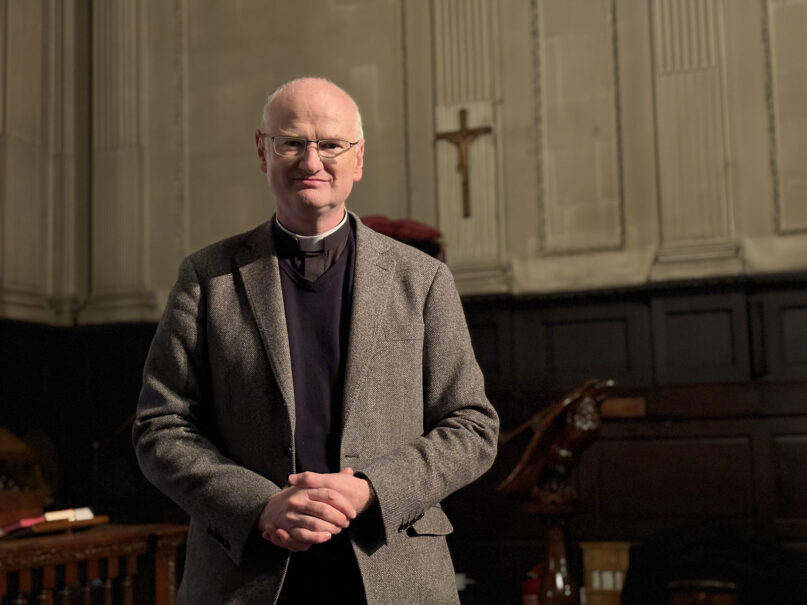
“The reason we wanted to do the artwork is actually just to draw people’s attention to the building and make people look again,” said the Rev. Peter Babington, the priest in charge of St Mary le Strand. “This is not a closed, redundant building, but there’s something exciting and interesting happening, and it’s a way of generating interest.”
For years, the Anglican church had sat on a tiny island in the middle of the Strand between two lanes of traffic. Cab drivers called it “St Mary in the way.” Designed by the renowned Scottish architect James Gibbs, the church had turned ashen from soot and diesel fumes and was dwarfed by the many cultural institutions that had grown up around it: King’s College London, Somerset House, a cultural events space, The Courtauld Gallery and, off a bit, the London School of Economics and Political Science.
Three years ago, a short stretch of the Strand was redeveloped into a pedestrian walkway with benches and patches of grass. It gave the church, where attendance had been falling for decades, a chance at a new start. St Mary le Strand is now in the process of raising 12.6 million pounds (or $16.7 million) to renovate the building, repair the exterior stonework, add an accessible entry and a lower-level community space, install a new heating and cooling system and update the lighting.
The church is also dedicating itself to a new mission: remaining a place of worship, but also introducing itself as a public space for art, culture and creativity.

The church plans to host art installations, concerts and other events to better integrate into the creative environment of which it is a part.
Many of the UK’s 20,000 church buildings have fallen into disrepair, according to a survey by the National Churches Trust, which estimates that 1 in 20 will likely shutter by 2030.
But some have found new life as they reimagine themselves for new missions to meet the needs of the times.
St Martin-in-the-Fields, at the edge of London’s Trafalgar Square was also designed by Gibbs and is now known not only as a Church of England place of worship, but also for its near-daily live music events including classical chamber music, musicals and jazz performances. Additionally, it’s known for its mission of helping unhoused people with grants for housing, health care and mental health support.

The Rev. Sam Wells, vicar of St Martin-in-the-Fields, identified four key areas of the church’s mission: culture, compassion, congregational life and commerce. The focus on culture, he said, is a critical piece where “the church finds God at work,” and he encourages other churches to fully embrace that calling.
“It’s not saying you have to go to church to be touched by the Holy Spirit,” Wells said. “It’s saying that the Holy Spirit is working through the artist or the installation. It’s a mindset that’s infectious. People feel inspired that the Holy Spirit can work through them, too, and that they can be creative, and then they can do something that might end up being exhibited. They start to feel a sense of belonging, as though this is a place that’s honored their work.”
St Mary le Strand is significantly smaller than St Martin-in-the-Fields. It seats only 120 people. But Babington, who was appointed to lead the church shortly before it became part of the pedestrian walkway, said he was excited about its potential.
Last year, the church partnered with King’s College London and The Courtauld art gallery to mount an exhibit of large scale chalk and charcoal portraits of 50 Londoners who were displaced from their homelands. The exhibit, by artist Es Devlin, titled “Congregation,” was a sculptural collective portrait that worked well inside the church and gave the church confidence in its new direction.
“We’ve gone from having 2,000 visitors a year to 43,000,” Babington said.
The church, which lies in Westminster, an area of London, could not pay for the current installation on its own. So when the Westminster City Council approached St Mary le Strand about the artwork, it was delighted to serve as host.
The curtain enveloping the church is made of PVC mesh, a strong, open weave that allows air and light through. It gives it a translucent quality that allows glimmers of the stone work to peek through. The installation is supported by scaffolding, with arched window cutouts of the church windows.
Babington said the installation is a trial run for when renovation begins and the building is scaffolded for an even longer time. (“Decades” will stay up until Jan. 18, 2026.)
The church has secured about half the 12.6 million pounds it needs to begin the restoration, mostly from grants, and has hired a fundraiser to help achieve its goal. It has a small congregation of about 400 people, as few live in the vicinity. Its future lies with the relationships it fosters with the cultural institutions and the people who work there.
“Art doesn’t just have to be a medium for our message, like in a stained-glass window telling a Bible story,” Babington said. “It can actually be a bit more subtle than that, especially in a more secular, multi-faith world, or city, like London. I think it’s quite good for us to be doing something which is just an invitation to look.”
Original Source:
https://religionnews.com/2025/12/05/a-tiny-london-church-offers-passersby-an-invitation-to-look/