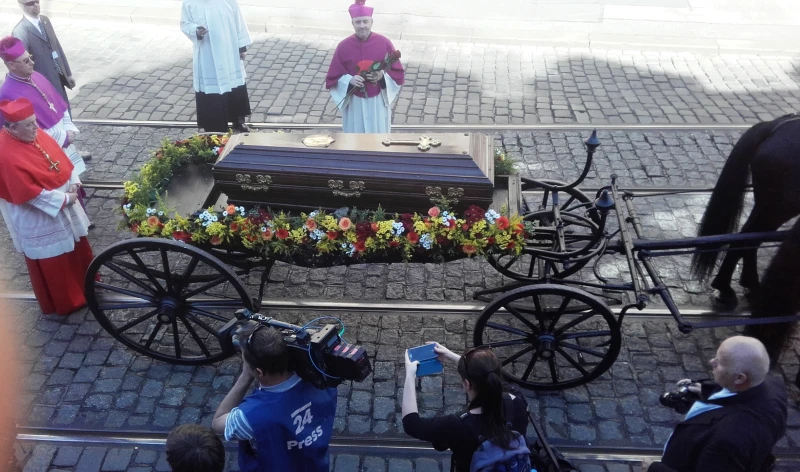
 The coffin of Cardinal Josef Beran is carried by a horse-drawn carriage toward St. Vitus Cathedral in Prague on April 21, 2018. The cardinal’s remains were repatriated to his homeland 49 years after his death in exile in Rome. / Credit: PetrS./Wikimedia (CC BY-SA 4.0)
EWTN News, Dec 15, 2025 / 09:00 am (CNA).
The District Public Prosecutor’s Office for Prague 1 has filed a proposal to judicially rehabilitate Cardinal Josef Beran, the former archbishop of Prague who was persecuted during the communist regime in Czechoslovakia.
The move, confirmed in an official notification dated Dec. 8, follows a monthslong review of archival materials by the police’s Office for the Documentation and the Investigation of the Crimes of Communism. The proposal has now been submitted to the District Court for Prague 1 under the country’s 1990 law on judicial rehabilitation.
Beran’s beatification process is currently underway.
As a priest, Josef Beran (1888–1969) suffered in the Nazi concentration camp at Dachau before becoming archbishop of Prague, the capital of Czechoslovakia, after World War II. When the communists took over, he refused to pledge loyalty to the atheist regime. He was not jailed but was interned in several locations, a confinement that included complete isolation from the outside world and a loss of privacy.
When he was created a cardinal by Pope Paul VI in 1965, he was allowed to travel to Rome. Yet he was unable to return. The prelate spent the rest of his life in exile, visiting compatriots in Europe and the U.S.
“We are very happy for the news but do not have further information,” the press office of the Czech Bishops’ Conference told CNA. Beran’s family also did not have any more information.
“Anyone can submit a motion to the public prosecutor’s office to correct an injustice,” lawyer Lubomír Müller explained to a press agency.
Müller, who has successfully handled similar cases for persecuted clergy, filed the initial motion in May. He acted upon a formal request from Jan Kratochvil, the director of the Museum of Czech, Slovak, and Ruthenian Exile of the 20th Century in Brno. The request specifically cited Beran’s illegal internment from 1951 to 1965.
Last year, the regional court in Hradec Králové rehabilitated priest Josef Toufar for his illegal arrest and prosecution at the beginning of the communist regime. Toufar was tortured to death, and his beatification process is now underway as well. The museum’s request also noted Müller’s work in rehabilitating Jesuit priest Father František Lízna.
Therefore, “the official ruling that the internment of Josef Beran was illegal may also come,” Jaroslav Šebek, a historian at the Czech Academy of Sciences, told CNA.
Beran also spoke at the Second Vatican Council about religious freedom and proposed a new view of Jan Hus, the rector of Charles University in Prague who was burned at the stake in 1415. The communists in Czechoslovakia tried to portray Hus as a rebel and the “first communist.” However, Beran opted for “a more conciliatory view of this personality of ... European spiritual history so that the views of Archbishop Beran and [the late] Pope John Paul II aligned,” Šebek noted at a recent conference in Rome.
He quoted part of the cardinal’s speech in which he lamented that authorities in the past had at times imposed faith: “Secular power, even if it wants to serve the Catholic Church, or at least pretends to do so, in reality, by such acts, causes a permanent, hidden wound in the nation’s heart. This trauma hindered the progress of spiritual life and it provided cheap material for objections to the enemies of the Church.”
Beran is believed to have been the only Czech prelate buried in St. Peter’s Basilica before his body was moved to the Czech Republic in 2018.
Original Source: