(The Conversation) — Manger scenes displayed around Christmastime usually feature an ox and an ass beside the infant Jesus. According to the Gospel of Luke, Mary placed her child in a manger – an animal feeding bin – “because there was no room for them in the inn.”
No mere babysitters, the ox and ass harken back to the Book of Isaiah 1:3, a verse early Christians interpreted as a prophecy of the birth of Christ. In some early artwork, these beasts of burden kneel to show their reverence – recognizing this swaddled babe, who entered the world in humble circumstances, as lordly.
The canonical Gospels, the accounts of Jesus’ life included in the Bible’s New Testament, make no mention of those animals welcoming the newborn. Yet the motif was already seen in art from the fourth century. It was further popularized by the Gospel of Pseudo-Matthew, an apocryphal text – that is, one not included in the canon of Scripture. Pseudo-Matthew was composed by an anonymous monk, probably in the seventh century, and includes many tales about Jesus growing up.

After its account of Jesus’ birth, the Bible is almost entirely silent on his childhood. Yet legends about Jesus’ early years circulated widely in the Middle Ages – the focus of my 2017 book. While the detail of the ox and ass is quite familiar to many Christians today, few are aware of the other striking tales transmitted by the apocrypha.
Wonder-worker
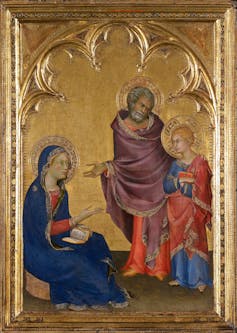
‘Christ Discovered in the Temple,’ by Simone Martini (1342).
Google Cultural Institute/Walker Art Gallery via Wikimedia Commons

The Bible does include one famous scene from Jesus’ youth: the incident when 12-year-old Jesus stayed behind at the Jewish temple in Jerusalem, unbeknownst to his parents. Searching for him with great anxiety, they find him conversing with religious teachers, both asking questions and astounding them with his answers. Fourteenth-century painter Simone Martini’s “Christ Discovered in the Temple” portrays him standing before his parents with crossed arms – a stubborn youth, apparently unapologetic about making them worry for days.
The apocryphal Gospel of Pseudo-Matthew – especially versions that incorporate material from an even earlier apocryphal gospel, the Infancy Gospel of Thomas – focuses on the years of Jesus’ childhood. Like the temple story, they show the boy Jesus as sometimes difficult and having preternatural wisdom that amazes and even offends his would-be teachers. More dramatically, the apocryphal legends depict Jesus exercising divine power from a very young age.

A 14th-century Italian manuscript shows Jesus fending off dragons to protect his parents.
© Bodleian Libraries, University of Oxford, CC BY-NC
Like the adult Jesus of the New Testament, this apocryphal Christ child often works wonders to help others in need. According to the biblical Gospel of Matthew, Mary and Joseph take the infant Jesus to Egypt after an angel warns in a dream that Herod, King of Judea, would kill the child. In Pseudo-Matthew’s elaboration of this episode, we see Jesus, not yet 2 years old, bravely stand on his feet before dragons emanating from a cave, where his family has stopped to rest.
The terrifying dragons worship him and then depart, while Jesus boldly assures those around him that he is the “perfect man” and can “tame every kind of wild beast.” He later commands a palm tree to bend down so that a weary Mary can partake of its fruits, and he miraculously shortens their journey in the desert.
At times, the Jesus of these legends is largely to blame for the troubles around him. The 14th-century Tring Tiles, now in the British Museum, depict one of Jesus’ friends imprisoned by his father in a tower. Christ pulls him out of a tiny hole, like a gallant medieval knight rescuing a maiden in distress. The father had tried to insulate his son from Jesus’ influence – understandable, considering that many legends show Jesus causing the death of his playmates or other boys who somehow irked him.
In a story summarized by one scholar as “death for a bump,” a boy runs into Jesus. He curses the child, who instantly drops down dead – though Jesus brings him back to life after a brief reprimand from Joseph.
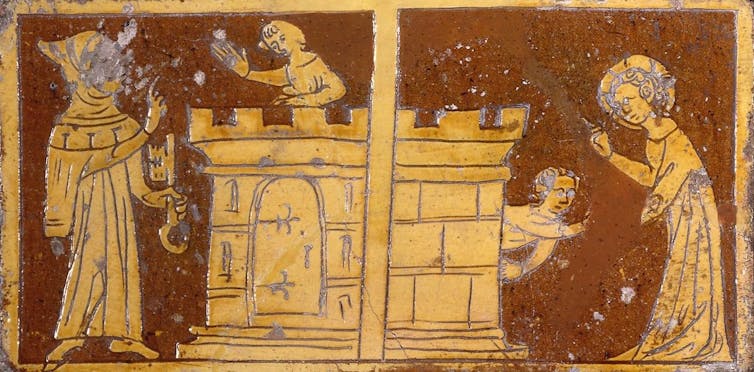
One section of the Tring Tiles, created in the 14th century, shows Jesus removing his friend from a tower.
© The Trustees of the British Museum, CC BY-NC-SA
In another tale, included in an Anglo-Norman narrative that survives in an illustrated manuscript, Jesus takes off his coat, places it upon a sunbeam and sits upon it. When the other children see this, they “thought they would do the same …. But they were too eager, and they all fell down at once. One and another jumped up quickly onto the sunbeam, but it turned out badly for them, since each one broke his neck.” Jesus heals the boys at his parents’ prompting.
Joseph admits to his neighbors that Jesus “was indeed too wild” and sends him away. The 7-year-old Jesus becomes apprenticed to a dyer, who gives him very precise directions about dyeing three pieces of cloth in three different vats. Once his master has left, Jesus ignores his instructions, throwing all the cloth into one vat – yet still achieves the desired outcome. When the master returns, he at first thinks he has been “ruined by this little rascal,” but then realizes that a wonder has occurred.

Jesus seated on a sunbeam, while other boys attempt to do so, in a miniature from the Selden Supra 38 manuscript, created in the early 14th century.
© Bodleian Libraries, University of Oxford, CC BY-NC-SA
Bond with animals
These apocryphal legends also show the boy Jesus having power over the animal world. When he enters a dreaded lion’s cave, cubs “ran about around his feet, fawning and playing with him,” while “the older lions … stood at a distance and worshipped him, and wagged their tails before him.” Jesus tells bystanders that the beasts are better than they are, because the animals “recognize and glorify their Lord.”
Indeed, these tales characterize Jesus as a rather haughty boy, conscious of his divinity and not happy with those who treat him as a mere child. At the same time, they depict him as a real child who likes to play. The boy Jesus is childlike in the way he often acts on impulse, not paying much attention to the admonitions of his elders.

A 14th-century manuscript, the ‘Klosterneuburger Evangelienwerk,’ shows the young Jesus playing with lions.
Schaffhausen City Library via Wikimedia Commons
His affinity for animals, too, makes him seem childlike. Strikingly, beasts in the apocrypha, beginning with the ox and ass, often seem to realize that Jesus is no ordinary child before human characters do.
The legends’ insidious insinuation that many of the Jews around Jesus were not as perceptive as the animals is part of medieval Europe’s widespread antisemitism. In one fifth-century sermon, Quodvultdeus, the bishop of Carthage, asks why the animals’ recognition of Jesus in the manger was not a sufficient sign for the Jews.

The 14th-century Holkham Bible picture book depicts Jesus performing chores at home (London, British Library, Additional MS 47682, fol. 18).
Courtesy British Library
In the Bible, Jesus works his first miracle as an adult, at a wedding feast in Cana. The apocryphal tales, however, toy with the idea of the God-man revealing his power early on. The legends suggest that the childishness of Christ distracted many of those around him, preventing them from concluding that he was the Messiah. This allows the apocrypha to avoid contradicting the Bible’s reference to Jesus as simply “the carpenter’s son,” the opposite of a wonder child.
Each Christmas, modern Christians in the Western world tend to celebrate Jesus’ birthday, then quickly drop the theme of the Christ child. Medieval Christians, in contrast, were fascinated by tales about the Son of God growing up. Despite acting as a dragon tamer, physician and magician, the young Jesus of the apocrypha largely flies under the radar, cloaking his divinity with “little rascal” boyishness.
(Mary Dzon, Associate Professor of English, University of Tennessee. The views expressed in this commentary do not necessarily reflect those of Religion News Service.)

Original Source: