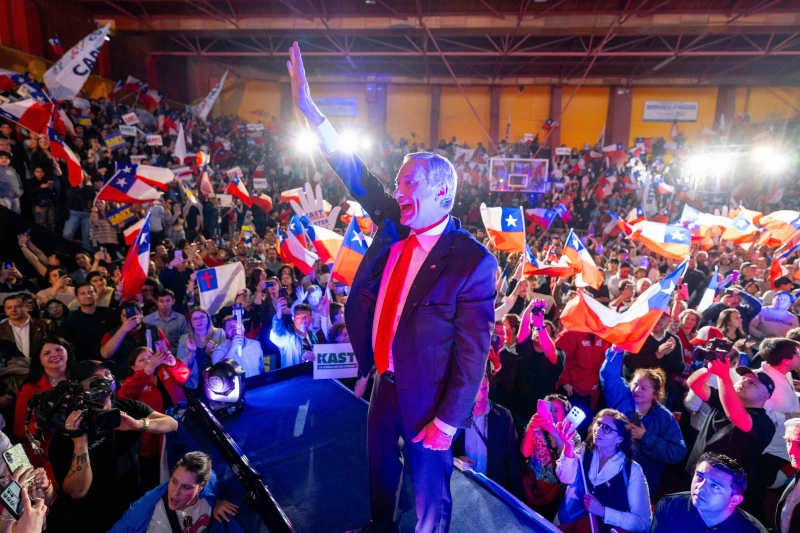
 Chilean president-elect José Antonio Kast. / Credit: Equipo Kast vía Flickr (CC BY 4.0)
ACI Prensa Staff, Dec 15, 2025 / 18:31 pm (CNA).
After being edged out by 2.9% in the Nov. 16 general election by his Communist Party opponent Jeannette Jara, Republican Party candidate José Antonio Kast reversed the result in the Dec. 14 runoff vote to become the new president-elect of Chile.
With 58% of the vote, and in line with the polls that predicted him as the winner with more than 55%, Kast prevailed over Jara, who obtained 42%.
With 99.97% of the ballots counted, showing a difference of more than 2 million valid votes, the runoff election marks a change of political direction for the country, currently led by President Gabriel Boric of the political left.
Kast is slated to take office as president of Chile on March 11, 2026. On the same day, the legislators elected in November will also take office.
“Democracy has spoken loud and clear. I have just spoken with president-elect Kast to wish him success for the good of Chile,” Jara wrote on X, acknowledging her defeat.
“To those who supported us and were mobilized by our campaign, rest assured that we will continue working to advance toward a better life in our country. Together and standing strong, as we have always done,” she added.
Kast’s victory speech
“It’s a special day. It’s a day that stays with us, a day that stands out among the different days when things happen. And this is a day of joy,” Kast said to thousands of his supporters in Santiago, referring to Gaudate (Rejoice) Sunday, which coincided with election day.
The president-elect thanked his wife, María Pía, “who will be a tremendous first lady,” and commented that what he does in politics is not a sacrifice but a privilege that he experiences “with a joy, a passion, that you can’t even imagine, and that we want to take together to La Moneda [the presidential palace] and bring about that very important change.”
“But nothing would be possible if we didn’t have God. And that’s something we can’t fail to acknowledge,” he continued, and prayed that the Lord would give him “wisdom, temperance, and strength, to always be up to this challenge.”
“Here, a person didn’t win, a political party didn’t win; Chile won. The hope of living without fear won. That fear that causes so much anguish to families. The Chile that works, the Chile that gets up early, the Chile that raises its families and its children with great sacrifice — that Chile won.”
After stating that he wants the government to regain a sense of responsibility for others, Kast announced that “we will restore respect for the law in all regions, without exceptions and without privileges” of any kind.
The president-elect also thanked other candidates who publicly expressed their support for him, such as Johannes Kaiser, and referred to the Communist Party candidate: “A government has supporters and it has opponents. And that’s normal. And it’s legitimate. And clearly, we have profound differences with Janeth Jara,” he said, and encouraged respect in order to overcome division.
“And we have to burn that into our minds. Someone may have a different ideology, but he or she is a person just like us,” he emphasized.
Comments from the bishops of Chile
The bishops of the standing committee of the Chilean Bishops’ Conference congratulated the president-elect and noted that, upon his election, the country “entrusts him with the task of leading the nation in times that demand clarity, generosity, and a profound commitment to the common good.”
After noting some of the challenging situations in Chile, the bishops emphasized that “the presidential election renews the hope of moving toward a more just, fraternal, and supportive country, where the power of reason always prevails over the rationale of force.”
The prelates encouraged Kast to “promote an environment of dialogue, encounter, and respect, which is essential for rebuilding social trust. As pastors of the Catholic Church on pilgrimage in Chile, we reaffirm our vocation to contribute to the common good through the mission that the Gospel entrusts to us.”
After expressing their concern about “the growing denigration of migrants and vulnerable people,” the Chilean bishops expressed their willingness to collaborate with their prayers and efforts for the common good of the country, and then entrusted Kast to the protection of Our Lady of Mount Carmel, patroness of Chile.
Who is José Antonio Kast?
Born in Santiago in 1966, Kast is a lawyer and a seasoned politician. The leader of the Republican Party served as a city councilor, a member of the Chamber of Deputies (lower house) for four consecutive terms, and ran for president three times.
Kast is a practicing Catholic and belongs to the Schönstatt Apostolic Movement. He has been married since 1991 to María Pía Adriasola Barroilhet, with whom he has nine children.
Kast defines himself as “simply on the right” of the political spectrum. Historically, he was a member of the Independent Democratic Union, but he ran for president in 2017 as an independent candidate. After his defeat, he led the Republican Action movement. The current Republican Party was founded by him in 2019, and in 2021 he ran for president as the representative of that party.
New government’s approach to abortion, migration crisis
The president-elect has expressed his support for “life from conception to natural death.” However, although the Boric government threatened to introduce legislation to eliminate the three grounds under which abortion is permitted in the country, making it legal for any reason up to 14 weeks, Kast’s campaign set aside the “values agenda” to focus on the crime and violence crisis and the large influx of unauthorized immigrants that the country is experiencing.
In his latest campaign, Kast hardened his stance against migrants residing illegally in the country. His proposal is that the 336,000 migrants who lack legal status in Chile return voluntarily to their countries of origin and contribute to the cost of their return ticket.
If they do not leave voluntarily before his term begins, the president-elect has warned that he will impose penalties: “If someone doesn’t leave voluntarily and we have to find them and deport them, they will never be allowed to enter Chilean territory again,” he stated, according to the Spanish news outlet El País.
His “countdown” to expel illegal unauthorized immigrants was criticized by the archbishop of Concepción, Sergio Pérez de Arce, who considered that “the response to migrants in an irregular situation (not legally present) in the country cannot be simply ‘you leave now, voluntarily, or we will expel you with nothing but the clothes on your back’ in 100 days.”
“I share your concern,” Kast said in the last debate, moderating the tone that had characterized his campaign, and regretted that the migration situation in Chile had been aggravated by the actions of criminal gangs. “Children have been abused, people have been exploited and forced to pay others to bring them into Chile,” he stated.
He also indicated that while the Church plays a role of “welcoming, solidarity, and charity,” the state “must enforce the law,” and he insisted on his promise that those who violate immigration laws will face penalties: “If someone is going to break the law, they must be apprehended if they have committed a crime.”
This story was first published by ACI Prensa, CNA’s Spanish-language news partner. It has been translated and adapted by CNA.
Original Source: