(RNS) — Would you buy a house where you knew there had been a murder?
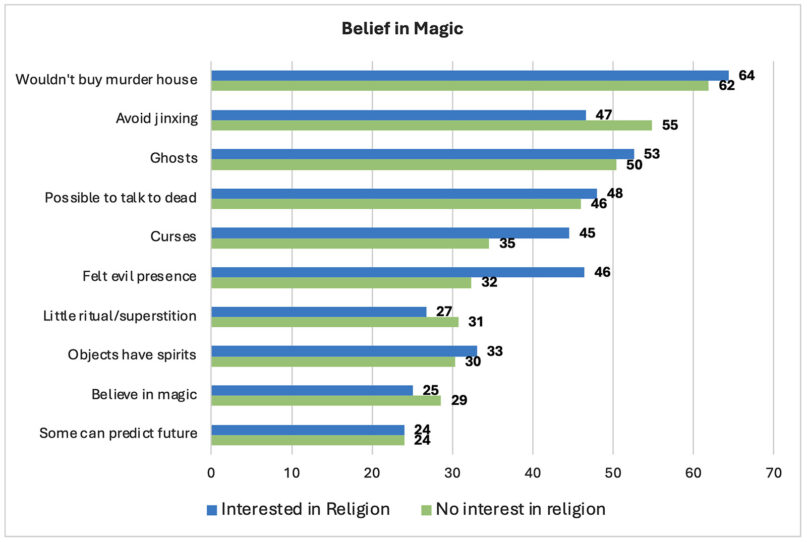
Researchers asked that question and found that 64% of Americans would be disinclined to take such a step. That discomfort held whether respondents were interested in religion (64%) or not (62%), according to the latest findings from the Baylor Religion Surveys.
It’s one example of what scholars are calling “secular supernaturalism,” as more people move away from regular attendance in religious institutions and toward individual spiritual explorations that don’t involve God or gods but could involve anything from internet rituals to palm reading — activities researchers are categorizing as “magic.”
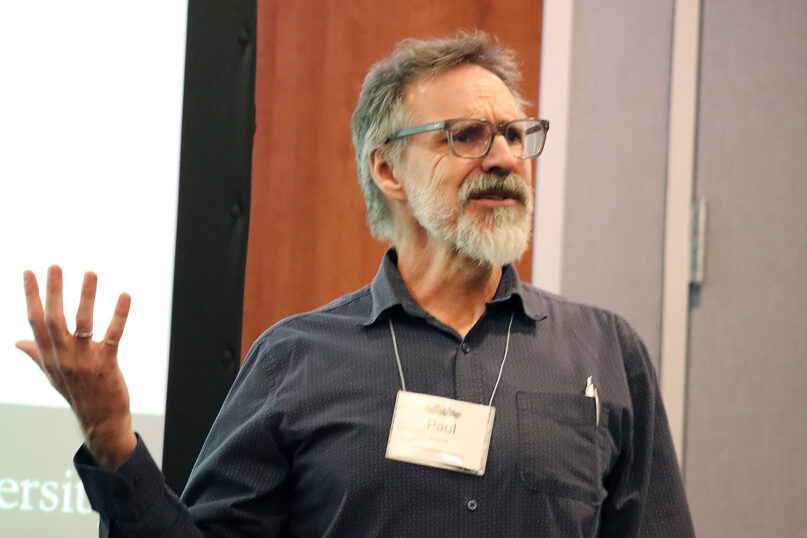
“In general, we conceptualize secularity and religiosity as separate spheres. Now, in reality, of course, that’s not true,” said Baylor sociology professor Paul Froese, who gave a presentation titled “Who Believes in Magic? The Relationship between Magical Beliefs, Traditional Religion, and Science” on Halloween at the annual meeting of the Society for the Scientific Study of Religion and the Religious Research Association in Minneapolis.
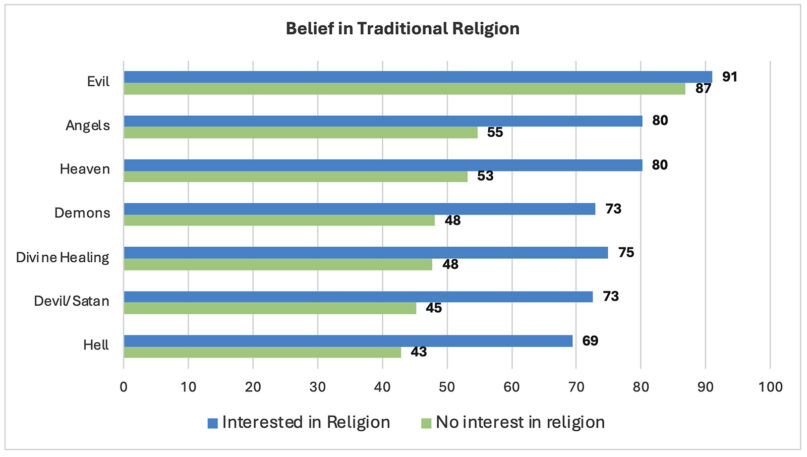
The Baylor findings from the survey of 1,812 American adults in early 2025 show significant differences between the religiously interested and the religiously indifferent, especially around more traditional beliefs. For example, 80% of respondents who were interested in religion believe in angels and in heaven, compared with 55% and 53% of those not interested in religion. Almost 7 in 10 (69%) of those interested in religion believe in hell, compared with 43% of the religiously uninterested.
But similar percentages of both groups believe in ghosts (53% of religion-interested and 50% of religiously indifferent) and the possibility of talking to the dead (48% of religion-interested and 46% of religiously indifferent).
RELATED: Secularism is not atheism. A new book explains why the distinction is so critical.
Jen Buzzelli, 57, a former Catholic who describes herself as “nonreligious and agnostic,” said in an interview that the Baylor findings resonate with her.
“There must be a section of overlap where we share beliefs in our different camps,” she said, adding that she has “a little bit of an open heart” to the inexplicable.
Buzzelli believes in evil and divine healing, and the ability to communicate with the dead, but not in heaven, angels, demons, Satan or hell — all part of the inquiry in the Baylor study, whose survey was written by the university’s scholars and administered by Gallup.
The film and television executive in Brooklyn, New York, describes herself as being fascinated by the 1988 bestseller “Many Lives, Many Masters,” a book by a psychiatrist about past-life therapy, which she read as she grieved her father’s sudden death almost two decades ago.
“It gave me hope to think that his spirit was still alive out there somewhere, and that maybe we will meet again,” said Buzzelli, who also recalled lights flickering or exploding shortly after the time of his death.
“Even though that book wasn’t about heaven or hell or the afterlife, it just showed there’s a whole ’nother realm out there that we don’t know about.”
Lila Wilson, also 57, was baptized Catholic but grew up in an agnostic household and attends an Episcopal church service when she visits her mother. Never a Bible reader, Wilson said she gained her understanding of Christianity by reading “The Chronicles of Narnia” as a child.
“My understanding of anything beyond the Earth is sort of amorphous,” said the data analyst from Texas. “So to think we’re putting these structures on that — that seems a little bit off to me.”
Like Buzzelli, Wilson said she began a journey after the loss of a close relative — in her case, her mother-in-law.
“I just was like, where did she go? And I was looking for any way to figure it out,” said Wilson, who met with psychic mediums and has read about and watched documentaries on near-death experiences. Now, she wonders if learning about ghosts and near-death experiences may be a different avenue to achieve what one might through attending church.
“I believe in energy that we don’t understand yet,” Wilson said, noting other people may label that as belief in the paranormal. “That’s my belief system.”
Both Buzzelli and Wilson said they’d have some discomfort buying a house where someone had been murdered.
In a November interview, Froese, director of the Baylor Religion Surveys, said popular characters from the past, such as the 1960s depiction of Mr. Spock on the original “Star Trek” series, may have given the impression that secularity is purely rational and has nothing to do with the supernatural.
“Most people have some sense of some supernatural stuff going on: Superstitions are very routine,” he said. “It’s a continuum. You’re either kind of closer to this secular ideal, or you’re closer … to a religious ideal.”
Froese said the findings may reflect a greater interest in the pursuit of secular, seemingly magical thinking as some move away from traditional religious beliefs around the supernatural. What may have once been labeled “paranormal” by some could become normalized.
“As we see a decline in church membership, we see a decline in trust of church organizations; then we’re seeing a rise of magic,” he said. “And I think part of that has to do with the internet and just, essentially, it’s a much more individualistic, transactional kind of thing. And so, I think that the future is maybe we’re going to have more magic belief and less traditional religious belief.”
RELATED: Survey: Trump voters ‘anti-Islam, anti-feminist, anti-globalist’
Original Source: