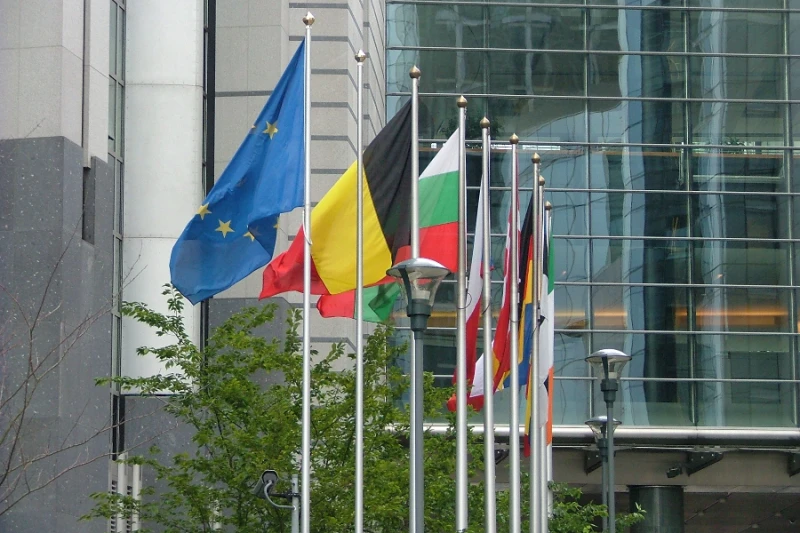
 The European Parliament building in Brussels, Belgium. / Credit: Ala z via Wikimedia (CC BY-SA 3.0)
EWTN News, Dec 17, 2025 / 04:00 am (CNA).
In a strongly secular European Union, the Balkans’ complex religious reality plays an important role as officials and diplomats gather on Wednesday to discuss the membership plans for six nations.
The EU-Western Balkans summit on Dec. 17 brings together European Union representatives and their counterparts from six Western Balkan nations: Albania, Bosnia and Herzegovina, Kosovo, Montenegro, North Macedonia, and Serbia.
As officials discuss EU enlargement and current challenges, religious leaders and analysts underscore that the churches — deeply woven into the region’s national identities, geopolitics, and social fabric — will be crucial to the success of both European integration and regional stability.
The EU considers itself the main trading partner, investor, and donor for the Western Balkans and provides substantial assistance and financial support to the region. However, the religious landscape — marked by Orthodox majorities, significant Muslim populations, and Catholic minorities — reflects complex historical, ethnic, and political tensions that shape the region’s future.
“We hope that the trend of the enlargement is still serious and that it will be confirmed,” Serbia’s ambassador to the Holy See, Sima Avramović, told CNA.
Currently, there is a concern about “Russian influence, especially in Serbia, so the EU will try to discuss how to stabilize this area,” Lucio Caracciolo, founder and director of the Italian geopolitical magazine Limes, said in a conversation with CNA. At the same time, he warned of “the lack of the political will and funds to support” these countries before they are accepted to the 27-member EU.
Religious landscape
There are many ethnic groups and three main religious communities in the Western Balkans: Orthodox, Muslim, and Catholic. Albania and Kosovo are mostly Muslim, with the latter at more than 90%. Half of Bosnia and Herzegovina is Muslim. Almost three-quarters of the population in Montenegro belong to the Orthodox Church.
On the contrary, around half of the population in North Macedonia is Orthodox, followed by Muslims and other Christians. The biggest country in terms of inhabitants and area is Serbia, with more than 80% Orthodox believers, followed by other minorities.
The “Religious Freedom in the World Report 2025” by the pontifical foundation Aid to the Church in Need (ACN) appreciated positive prospects for religious freedom in Albania and North Macedonia. It sees mostly difficulties in others; for instance, “the promotion and protection of religious freedom in Kosovo is fragile,” whereas in Montenegro, “persistent ethno-religious tensions typical of the Balkans are felt,” but ACN recognized efforts made to overcome them.
While Albania was an isolationist communist nation, the other Balkan states were part of the more liberal communist country of Yugoslavia. After the federation’s collapse in 1991, Slovenia and Croatia proceeded toward European integration, becoming EU and NATO members.
Relations among the churches and religions
The Orthodox churches are important in the countries where they represent a majority religion also for their role “in the nation-building process and in the consolidation of the local nation-states,” expert on Orthodox Christianity Daniela Kalkandjieva from the Sofia University of St. Kliment Ohridski in Bulgaria told CNA.
At times, they are unable “to exert significant influence on their local society.”
Recently, the Orthodox churches have diverged in opinions “to such political and socio-economic challenges as the refugee crisis, the anti-COVID vaccination, and the Russian invasion of Ukraine,” she explained.
The spread of the “Russian World” concept and “holy war” are “new challenges to the very ethos of Eastern Orthodoxy as a Christian denomination and provoked tensions and disunity among the adherents of this religious tradition.”
On this note, Caracciolo said that some of these churches are “certainly connected to some powers in Russia and also in the Balkans, which are often in conflict with each other.”
However, the secretary of the Holy Synod of the Macedonian Orthodox Church — Archdiocese of Ohrid (MOC-AO), Bishop Kliment, said that they “cultivate sisterly relations” with the churches of “closest neighboring peoples.”
In a statement sent to CNA, the bishop emphasized that we “build bridges of trust among us, prioritizing solidarity and unity in faith” through Eucharistic communion, mutual visits and joint services, cooperation in education, and the like.
Catholic-Orthodox relations are also complex. Though “there is always a room for more cooperation,” with Catholics, there are “good relations, mutual support, and understanding.” He mentioned the traditional annual meeting held for more than half a century in Rome in honor of Sts. Cyril and Methodius and Pope Francis’ visit to North Macedonia in 2019.
Whereas some Orthodox churches collaborate and pray with Catholic representatives, “others find such interactions incompatible with the Orthodox doctrine and maintain mostly diplomatic relations with the Holy See,” explained Kalkandjieva, who also lectures at the Pontifical Oriental Institute in Rome.
Along the same line, Avramović underscored that the religious leaders in Serbia “meet on different occasions and discuss important social, religious, and other significant issues.”
There are seven traditional churches and religious communities in his homeland, including the Slovak Evangelical Church, the Jewish community, and the Muslim community.
View of the EU
When it comes to the EU, the local Orthodox churches perceive the Union “as an important factor in the lives of their believers” and some have representation offices in Brussels, where many EU institutions are based. Nonetheless, this official dialogue and collaboration are little known in their home countries, Kalkandjieva stressed.
The MOC-AO, which represents the largest religious institution and community in North Macedonia, respects the will of the majority of its citizens and its faithful, who support European integration, Kliment underscored. We “attentively follow the complex internal challenges of the EU,” he added. The Orthodox bishop underlined that it should be “a platform for political and economic stability, fully respecting religious freedoms and the rule of law.”
A few months ago, Croatian Member of the European Parliament Tonino Picula caused a controversy as he posted an old picture of himself on X, posing with a gun commemorating Operation Storm. It occurred in 1995 as Croatia took control of what it considered the occupied territories in the south, which was a self-proclaimed republic. As the Croatian army came, thousands of Serbs fled to Serbia.
The social media post sparked backlash not only from Serbia but also from European politicians who called Picula’s statement disturbing and highly politically dangerous.
Original Source: