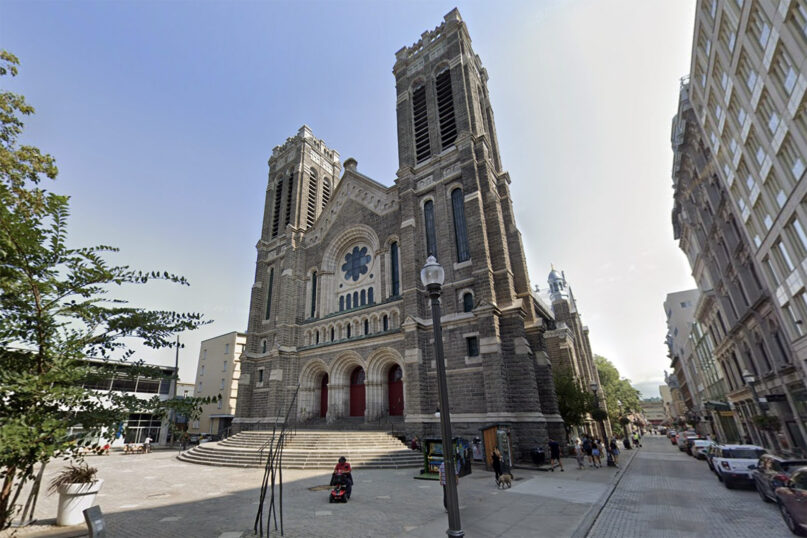
(RNS) — The largest church in Quebec City, Saint-Roch, gives its name to a hip neighborhood on the St. Lawrence River where shipyards once drew a population of working-class Catholics. The church, the fourth to occupy the site, was built on medieval architectural lines in 1811, and the vast stone structure is still grand, though it now houses a homeless shelter in its basement where several community organizations also find shelter. St. Roch’s last full-time priest left 30 years ago.
For the last few years, Saint-Roch had been open for just one Mass a week, drawing complaints on tourist websites from visitors. “I came on a Wednesday and was disappointed that it was only open a few hours on Sunday,” wrote one, “so missed my chance of seeing inside the church where my ancestors worshipped.”
But lately, hope has arrived in the form of a group of priests and brothers from a faraway mission field that has little to do with Saint-Roch’s gentrified cafes and bars.
On Wednesday (Dec. 17), Cardinal Gérald Cyprien Lacroix, archbishop of Quebec, will announce that the church’s new custodians will be the Missionaries of Africa, a 157-year-old Catholic order dedicated to planting peace and church communities in undeveloped places. Though its first recruits came from Europe, beginning in 1901 its ranks were filled by Quebecois. “Hundreds of vocations came from Quebec to serve in Africa. Some are still living, although older now and most retired,” Lacroix told Religion News Service.
In thanks for the city’s dedication, the cardinal explained, “the Missionaries of Africa’s international office (in Rome) offered to come back and establish themselves here in Quebec,” saying, according to Lacroix, “You helped us so much. You helped us train priests, form priests, work with the poor, establish parishes in many countries of Africa. Now we know you need help, and we want to come and work with you. Whatever you need, wherever you need us, we are available.”
Founded by French Cardinal Charles Lavigerie in 1868 while he was serving as bishop of Algiers, Missionaries of Africa were among the first Catholics to systematically evangelize east and west Africa. The cardinal was a huge personality of his time, adviser to Napoleon III, then emperor of France, and Popes Pius IX and Leo XIII. Lavigerie was passionate about evangelizing Africa while ending the slave trade, buying freedom for untold thousands while lobbying the Vatican for increased anti-slavery commitment.
Lavigerie dressed his priests in white robes, similar to kaftans worn by Muslim imams in North Africa. A black and white rosary worn around their necks signaled Catholic identity. The missionaries were known as les pères blancs (the white fathers) and most were, indeed, white.
Today, the majority of active white fathers are Black, serving across Africa as well as in Mexico and Asia. While seminaries in France and Canada have closed, in countries such as Burkina-Faso, Ghana and Kenya their classes are full. In Uganda, in 1911, the missionaries established the first modern Catholic seminary south of the Sahara, which continues today.
The Rev. Barthélémy Bazemo, provincial of the Americas for the Missionaries of Africa, based in Washington, D.C., who helped shepherd the Saint-Roch project, explained that the order is also responsible for two other churches, in Brooklyn, New York, and Queretaro, Mexico.
Staffing up at Saint-Roch is especially important because Quebec’s Catholic community is experiencing a resurgence in faith: Between 2023 and 2025, the number of baptisms in the archdiocese increased more than 500%, mainly of adults under age 30. The majority of those baptized were born in Africa or Latin America.
“We have a lot of migrants, a lot of people from different countries, and among them many Africans from different countries,” explained Lacroix, who served as a missionary to Colombia for eight years as a young priest. He calls the rash of baptisms one of the city’s “signs of hope” because “many newcomers are fervent, giving a good witness and helping us.”
Immigration is a major demographic driver in the province of Quebec. Permanent immigration increased in 2024 over 2023, with more than 15% of new permanent residents last year coming from the central African nation of Cameroon, according to the Institut de la Statistique du Québec.
“What gives me a lot of hope is to see what the Lord is doing, through the work of the Holy Spirit, in different areas of our diocese,” said Lacroix. “We have some parishes that are growing. Young people are discovering the faith. We are seeing more youth groups. This year we had more than double the number of catechumens, during the Easter season.” Currently, 17 seminarians are studying for the priesthood in Quebec City.
“We crossed some very difficult years. There are still many challenges, but I see hope, I see hope. We also have more seminarians than we have had in the last decade,” the cardinal said.
Just as Lavigerie sent missionaries in groups of three, a team of three Francophone missionaries, Lacroix said, “will be a pastoral and compassionate presence at Saint-Roch for the people in Quebec City’s Lower Town, a historic area where there is a lot of need. So, we are very, very happy. We’ve been wanting to do this for a long time, but we just didn’t have the personnel.”
Two of the three are Canadian-born and currently based in Montreal: the Rev. Serge St-Arneault and Brother Dennis Walsh. The third, the Rev. Jean Paul Guibila, served as a missionary in Congo and is currently working at the Missionaries of Africa headquarters in Rome. He’s expected to arrive in Quebec City early next month.
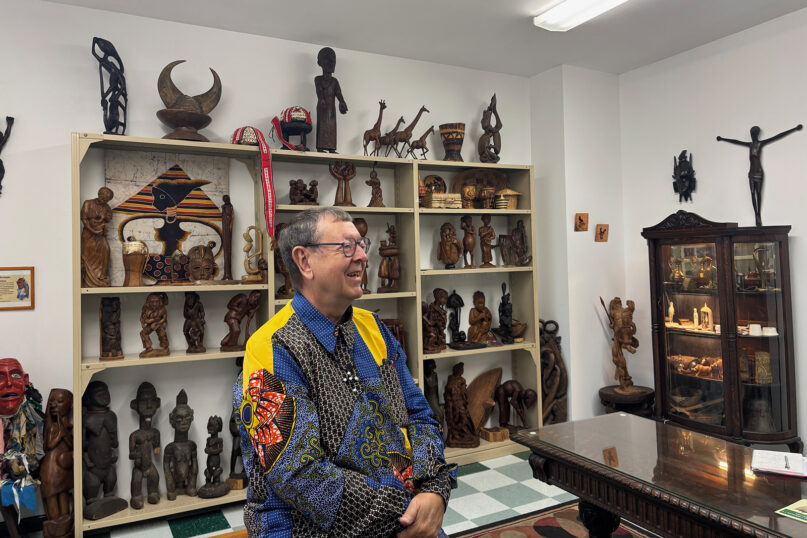
St-Arneault helps lead Montreal’s Centre Afrika, which provides support ranging from employment advice to choir practice space for diverse African communities. He said he and his confreres have minimal material needs. In terms of housing, he said, “Whatever the diocese provides is fine for us.” (Saint-Roch’s rectory was sold off years ago.) “We will feel at home as long as we are able to serve the church and the pastoral needs of the community.”
Bazemo, born in Burkina-Faso, explained to RNS: “We feel strongly that we must open up to ministry in the Global North. In the past we were geared toward Africa but now the African world has gone beyond. There’s a need for our charism worldwide.”
But St-Arneault, who served in Congo, Malawi and Zambia for 25 years, said the team’s approach won’t change. They will do, he said, “exactly the same as we usually do in Africa.”
(Victor Gaetan, a senior correspondent for the National Catholic Register, is the author of “God’s Diplomats: Pope Francis, Vatican Diplomacy, and America’s Armageddon” and a contributor to Foreign Affairs magazine. The views expressed in this commentary do not necessarily reflect those of RNS.)
Original Source: