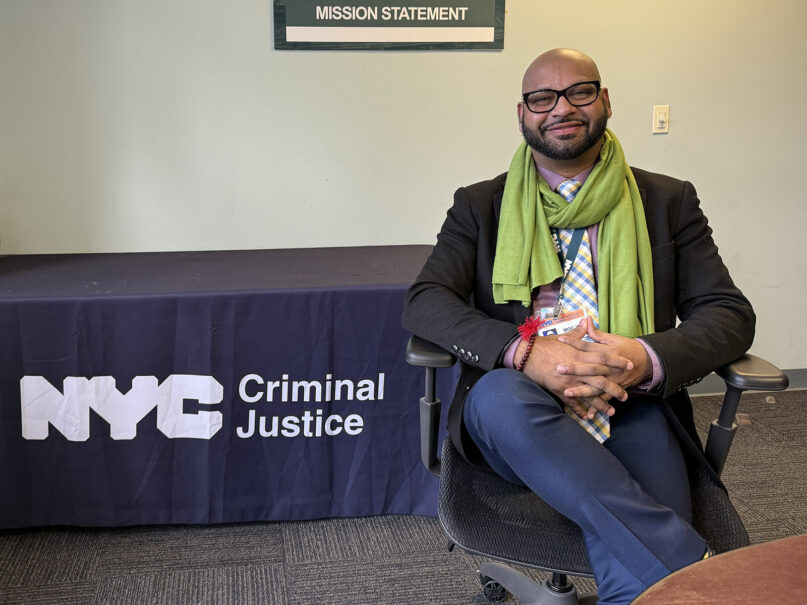
NEW YORK (RNS) — After one year as executive director of the New York City Office for the Prevention of Hate Crimes, Queens native and Hindu Vijah Ramjattan feels hopeful. At a time of rising hate incidents against some religious and ethnic communities, Ramjattan’s aim has been to build relationships and education from the bottom up, long before harm occurs.
Through bread-breaking initiatives — such as the Interfaith Council for Symbols and Words of Peace and Hate, which launched earlier this year — Ramjattan wants to combat ignorance and show that shared knowledge is the city’s greatest strength. He credits his approach, in part, for a recent decrease in hate crimes in the city.
“The perception that New Yorkers from diverse groups don’t want to speak with each other, don’t want to connect, don’t want to exchange ideas or find places of commonality, that’s not true,” he told RNS in an interview Wednesday (Dec. 17). “We just have to provide the space and the context for diverse New Yorkers to connect and build bridges.”
The conversation has been edited for length and clarity.
How has the Interfaith Council for Symbols and Words of Peace and Hate initiative been going?
This program was designed to bring together over 30 faith leaders who would not ordinarily be in the same room, or who might otherwise stay in their own corners because of differences. We’ve been meeting every three months to talk about words and symbols that represent hate and those that represent peace. We saw that when we brought them together, they connected on a different level. We know that dialogue does not erase differences, but it does create understanding. And when that happens, fear gives way to shared values like dignity and safety for all.
Oftentimes, when a person wants to express hate toward a group, they go to places where people find community, where they find peace, where they gather. Many times, those places are houses of worship. People use and twist symbols and narratives to carry emotions of hate toward different groups. And when that happens, it doesn’t just affect one house of worship — it affects the entire community.
The first gathering took place at a Buddhist temple in Chinatown. We chose that location because one of the symbols in the Buddhist community is the manji sign, which looks like a swastika but faces the opposite direction. We also know that the symbol represents power, purity and energy for Hindus. At the same time, we recognize that symbols can be twisted to represent hate in other contexts, which is a misrepresentation. This gathering became a way to share knowledge, bringing diverse community leaders and faith leaders together to discuss these symbols, how different communities understand and celebrate them, and how we can remain open to learning from one another. The second gathering was held at The Village Temple in Manhattan, where we continued those conversations. And the most recent gathering was last week at The Bhakti Center in Manhattan.
How does this initiative reach communities?
We know we can’t speak to every single New Yorker — 8.5 million people — every day or all at once. But when we connect with faith leaders, professors and organization heads from different faiths, when we speak with them and educate them about how we are trying to solve, curb and prevent hate crimes in New York City, they take that knowledge back to their communities. We’re able to reach hundreds of thousands of people across New York City by educating a smaller group.
What’s also important is that they value the fact that allyship is being built before an incident happens. Historically, when an incident occurs, we then look for our allies who can stand with us and say, “We denounce this act. We stand with the affected community.” Sometimes we don’t find people, and our neighbors aren’t there for us. But if we build this allyship, this understanding and this network of community ahead of time, then when one of us is harmed or targeted, we can all stand together and say, “No, that’s wrong.”
The point of this whole effort is that when we can all agree that one symbol represents peace and another represents hate, then we have consensus. And when those symbols or words are used, we can all stand together and say, “No, we all agree this is an act of hate, bias or discrimination.”
How does what’s going on in New York represent a larger picture?
What we’ve shown in New York City is that we can stand in solidarity with each other when we celebrate Hanukkah, when we celebrate Eid, when we celebrate Diwali, and still be who we are authentically. I can show up without having to travel to Mecca, Israel (or) India to experience these traditions. We can experience them right here. We can simply go to each other, to our neighbors, in our buildings, on our blocks, in our churches or community spaces, and ask questions.
We see symbols and signs everywhere. Our office here has learned through our various programs that if we just take two seconds to understand someone, we can appreciate them. We have so many opportunities to do that. We just have to provide the spaces and the resources for communities to come together, build understanding and appreciation, and celebrate our diversity.

Can you talk about the current climate in New York, where antisemitic and Islamophobic hate incidents continue to rise?
New York City has provided an opportunity for communities to be authentic. I can walk down Liberty Avenue, I can walk in Manhattan, with my tilak, my kurta, my scarf, and be me, and it’s welcomed, right? A Jewish person can wear their religious garments and be their authentic self. That is beautiful. But then there are those who find ways to express whatever emotional things they’re going through because it’s an easy target.
To me, it’s unfortunate that the numbers (of incidents) are what they are for the Jewish community, but we are doing so much programming to prevent the next victim. Over the years, we’ve seen a consistent trend: The majority of reported hate crimes are antisemitic and target the Jewish community. We have to learn something from that.
I always tell people: if I’m doing my job well, hate crime numbers will go up because we’re educating people about what a hate crime is, and then they’ll know to report it. So when I see the numbers, yes, it’s sad, but at least now people know. Back in the day, people didn’t report because they didn’t know what a hate crime was. The Jewish community has done a great job in terms of reporting.
We lead, we react and we respond to preventing hate crimes every day, every second. We also know that Islamophobia, Hinduphobia, Sikhphobia, antisemitism and other phobias and “isms” are reasons why hate crimes happen. What we’ve been doing is providing deep, in-depth education across New York City through programming.
We go to schools and speak to young people in elementary school, middle school, high school to educate them on these differences, how to identify them and how to report them. We cannot arrest our way out of hate crimes. We have to educate our way forward. We have to invest in healing.
What are you looking forward to with the transition to the new mayor?
We are here to serve New Yorkers and we are here to fulfill their needs and to make sure that New Yorkers feel safe so that everyone can coexist in New York City. We welcome Mayor Mamdani, his leadership and his guidance, and we look forward to following his initiatives. Diversity in leadership is beautiful. It’s also beautiful to have his perspective and his lens of how he wants the city to respond to hate crimes, and how we here can make the adjustments needed to meet his goals, his vision, and to mirror that.
We know that New Yorkers want to collaborate, and we want to continue doing that. That was important for us this past year: letting people know there’s an office of this kind for this purpose, but also being aware that that’s not enough. We have to turn it into action. And the action is one person at a time, one community at a time, one neighborhood at a time. We are looking forward to doing this next year under a new administration.
Original Source: