VATICAN CITY (RNS) — Po-Shen Loh, a U.S.-born mathematician and inventor, didn’t have the leader of the world’s 1.4 billion Catholics weighing in on the future of artificial intelligence on his 2025 bingo card. Nor did he think that a new pope would be involved in a meme war with a Silicon Valley investor.
A Catholic and the father of three, Loh, 43, has watched the development of AI with concern for its profound impact on society, especially on young people. Since the launch of ChatGPT in 2022, Loh has traveled around the country trying to prepare the next generation. The Vatican is his latest stop.
“I’m here because I’ve been running around the world trying to figure out how to help humanity survive AI,” said Loh, a professor at Carnegie Mellon University in Pittsburgh.
Loh is among a growing number of mathematicians, tech experts and entrepreneurs who have expressed interest in the Catholic Church’s moral leadership on AI. With the new pope’s vocal interest in the subject, Loh hopes the church can use its resources to promote a model of critical thinking and kindness.
In a November post on X, Pope Leo XIV urged the builders of AI to “cultivate moral discernment as a fundamental part of their work — to develop systems that reflect justice, solidarity, and a genuine reverence for life.” That post brought on the meme war Loh referred to, when billionaire and AI enthusiast Marc Andreessen reacted to the pope’s appeals for an ethical approach to AI with apparent skepticism. Andreessen, in a since-deleted post, replied to Leo’s post with an image of a seemingly confused journalist interviewing actress Sydney Sweeney about her controversial American Eagle advertisement.
Loh will be at the Vatican until Saturday (Dec. 27), meeting with people with ties to the Vatican and concerned with AI. He hopes to collaborate with the Catholic Church on its related efforts.
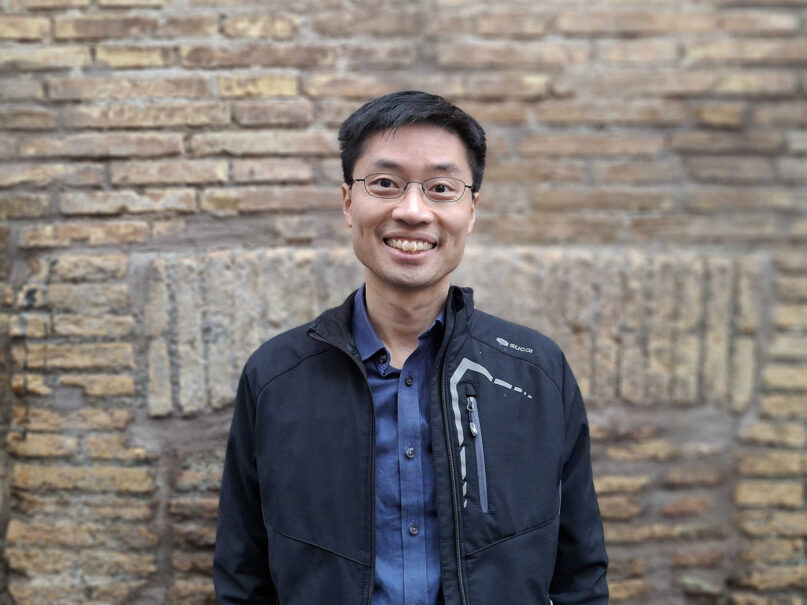
Especially struck by Leo’s degree in mathematics from Villanova University in Pennsylvania, Loh said, “It occurred to me, maybe this pope’s background is making him see the future and see the big danger in artificial intelligence in a way that’s making him take action.”
Loh won a silver medal at the International Math Olympiad for Team USA in 1999 and went on to be the team’s coach for 10 years between 2014 and 2023. In December 2021, he launched his Live program, where gifted high schoolers or “math streamers” livestream to teach younger students.
Meanwhile, his experience teaching in K-12 classrooms led Loh to realize that young people today care a lot about their phones and social media. “I looked at this and I saw, oh boy, this is creating a whole generation of people who are pretty self-absorbed,” he said.
And in the tech world, Loh said he found that ruthless development of AI risked shattering the job market.
“If AI can make every worker able to do even 50% more work, then you only need two-thirds as many people,” he said. “The worldwide labor market is not prepared for a shock of laying off one-third of the people.”

Loh’s solution to these issues is rooted in his Catholic faith, he said, but aimed at helping people from all faith backgrounds. He calls his approach “Thought + Full,” and he intends to inspire a new generation to delight in making others happy and to become independent, critical thinkers ready to face the challenges of the future. His livestreamed math classes have talented high-school students sit on gaming chairs with colorful lights in the background, resembling Twitch gaming streams.
“The only way to become one of these high schoolers is to not only be good at mathematics, you also have to care about other people, like being a nice person — you have to want to make other people’s lives brighter,” he said.
In exchange for teaching math, the student teachers get paid and the chance to be coached in “charisma” — such as learning public speaking skills or how to ask someone on a date — by paid professional actors and improvisers. “You stream math, we teach rizz,” he said, using the Generation Z shorthand for charisma.
Four years in, the project counts roughly 200 high schoolers involved and about 2,000 middle schoolers learning from the live videos. But Loh hopes that the ecosystem he created will expand and promote a renewed interest for math and critical thinking in the world.
The issues Loh considers in his teaching models seem to be reflected by the pope’s interests, too.
“The advent of artificial intelligence is accompanied by rapid and profound changes in society, which affects essential dimensions of the human person, such as critical thinking, discernment, learning and interpersonal relationships,” Leo told participants of a Vatican-sponsored conference called “Artificial Intelligence and the Care of Our Common Home” on Dec. 5.
And when the cardinals elected him in May, the pope said he chose the name Leo to honor the legacy of his predecessor Pope Leo XIII, best known for his encyclical “Rerum Novarum” (“On Revolutions”), which tackled transformations and challenges associated with the Industrial Revolution in the 1800s. “Today, the church offers to all her treasure of social teaching in response to another industrial revolution and the developments in the field of artificial intelligence that pose new challenges for the defense of human dignity, justice and labor,” Leo said.
Original Source:
https://religionnews.com/2025/12/23/an-american-mathematician-is-looking-to-the-vatican-on-ai/