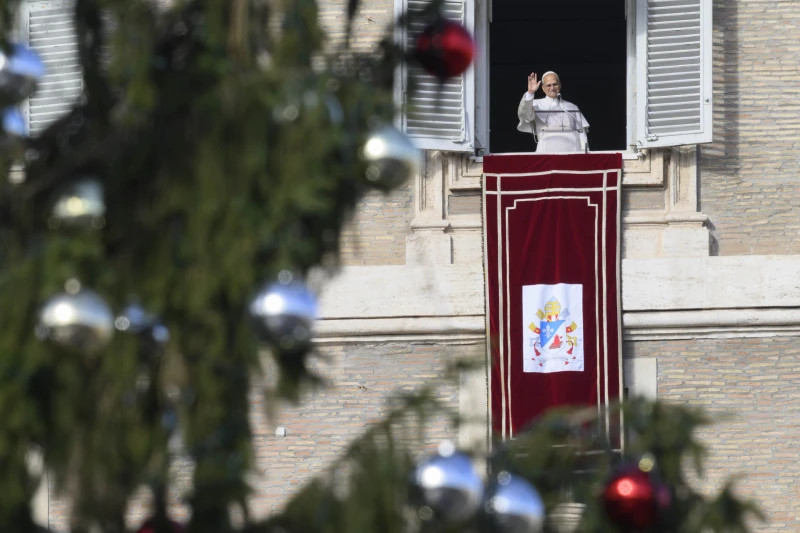
 Pope Leo XIV greets pilgrims gathered in St. Peter’s Square at the Vatican for the recitation of the Angelus on Dec. 21, 2025. / Credit: Vatican Media
Vatican City, Dec 24, 2025 / 06:00 am (CNA).
Pope Leo XIV will celebrate his first Christmas at the Vatican by reviving the tradition of offering Christmas Mass on Dec. 25 in St. Peter’s Basilica, something no pope has done since 1994.
The Christmas celebrations — which will be marked by the closing of the Holy Doors — will begin on the evening of Dec. 24, when the pontiff will celebrate Christmas Eve Mass at 10 p.m. local time in St. Peter’s Basilica.
The schedule represents a change from recent years, when during the COVID-19 pandemic, the Christmas vigil Mass was moved to 7 p.m. Before 2009, it took place at midnight, until Benedict XVI decided to move it to an earlier time.
Tradition of Christmas Mass restored
On Dec. 25 at 10 a.m., Leo XIV will also celebrate the Christmas Day Mass in the Vatican basilica, a custom that has not been observed since the pontificate of St. John Paul II. Afterward, at noon, he will impart the traditional “urbi et orbi” (“to the city and the world”) blessing from the central balcony.
On Dec. 31, the pope will preside at 5 p.m. in St. Peter’s Basilica over first vespers and the Te Deum in thanksgiving for the year that is ending. On Jan. 1, 2026, the solemnity of Mary, Mother of God, and the 59th World Day of Peace, he will celebrate Mass at 10 a.m.
The message for this World Day of Peace, titled “Peace Be with You All: Towards an Unarmed and Disarming Peace,” proposes a vision that rejects fear, threats, violence, and weapons, and advocates for a peace capable of generating trust, empathy, and hope.
One of the most significant moments of the Christmas season will take place on Jan. 6, the solemnity of the Epiphany of the Lord. At 9:30 a.m., Pope Leo XIV will close the Holy Door of St. Peter’s Basilica and celebrate the closing Mass of the Ordinary Jubilee of 2025. In the preceding days, the Holy Doors of the other papal basilicas — St. Mary Major, St. John Lateran, and St. Paul Outside the Walls — will also have been closed.
This will be the second time in history that a jubilee year is closed by a different pope than the one who inaugurated it, as happened in 1700, when Innocent XII opened the holy year and Clement XI closed it.
The Christmas celebrations will conclude liturgically on Jan. 11, the feast of the Baptism of the Lord. On that day, the pope will celebrate Mass and the baptism of several children of Vatican employees in the Sistine Chapel at 9:30 a.m., following a tradition established by St. John Paul II.
A pro-life Nativity scene
The Christmas spirit is already palpable in the Vatican after the Dec. 15 lighting of the Christmas tree and the inauguration of the Nativity scene in St. Peter’s Square, events presided over by Sister Raffaella Petrini, president of the Governorate of Vatican City State. That same day, Leo received the donors of the tree and the Nativity scenes that were also set up in the Paul VI Audience Hall.
The Nativity scene in that space, called “Nacimiento Gaudium,” (“The birth that brings joy”) from Costa Rica, has attracted particular attention. Until Dec. 25, it depicts the Virgin Mary as pregnant, symbolizing anticipation and hope.
The figures rest on 28,000 white ribbons bearing the names or pseudonyms of children saved from abortion, while in the manger, 420 yellow ribbons display messages from hospitalized sick children.
Taking a break at Castel Gandolfo
After Christmas, the pope is scheduled to travel to Castel Gandolfo on Dec. 26 for a few days of rest, without, however, giving up presiding over the main liturgical events or meeting with the faithful on major feast days. In addition, on Jan. 7–8, he will gather all the cardinals of the world in Rome for his first ordinary consistory since the conclave that elected him.
This story was first published by ACI Prensa, CNA’s Spanish-language news partner. It has been translated and adapted by CNA.
Original Source: