(RNS) — What began as a Tumblr account in 2009, reposting grainy clips of 1990s televangelists, has grown into Christian Nightmares, a multiplatform account with more than 220,000 followers that curates short, viral videos documenting contemporary evangelical Christianity at its most bizarre and politically charged.
The account describes itself as “a satirical look at the world of evangelical Christianity and its effect on current politics,” though its posts rarely rely on overt commentary. The content speaks for itself.
Across several social media platforms, Christian Nightmares routinely goes viral by reposting unedited sermons, political speeches and worship moments. One post on X shows a group of young children appearing to be overcome by the Holy Spirit and is captioned “This is what indoctrination looks like,” with over 65 million views. Another post, reading simply “The Charlie Kirk memorial is a Christian nationalist political rally,” was viewed more than 430,000 times
Videos on Christian Nightmares’ YouTube channel open with a figure wearing a chrome silver mask and looking silently at the camera. He wears a white T-shirt, sometimes scrawled with black Sharpie, sometimes blank, and a long gray wig that moves slightly as he raises a hand in an eerie wave. “Hi, I am Christian Nightmares,” on-screen text announces. Then the videos begin.
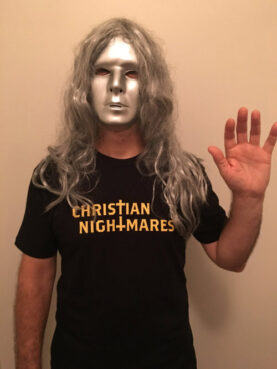
The man behind the account, who was raised fundamentalist Christian and now can’t seem to stop posting about it, guards his anonymity, he said, to keep the focus on the content, and the readers’ responses. “I’m anonymous, I’m ageless,” he said in an interview. “I’d much rather be somebody that people can project their experiences onto than just be this guy who talks about this stuff.”
RELATED: Jimmy Swaggart, controversial televangelist and Southern gospel legend, dies at 90
Altogether, Christian Nightmares functions as an archive of evangelical spectacle, depicting old-fashioned religious fervor, Christian nationalism and celebrity culture. The characters in his posts all seem to exist in a reality keenly defined by a posture of moral certainty and a waning degree of restraint.
Christian Nightmares’ most popular posts often feature people claiming authority over emotion, weather, women, politics and history. With minimal captions, a recurring cast of characters and settings such as a pulpit, a podium or the White House lawn become the stars of a particularly modern spectacle.
In one clip with 100,000 views, Christian nationalist pastor Josh McPherson during a podcast warns that empathy is “dangerous” and “toxic” and says that it can “align believers with hell.” Women, McPherson said, are especially vulnerable because they have a greater capacity to “let the sinners in” and should therefore have their friendships closely controlled by their husbands.
In another post on X with over 400,000 views, U.S. Rep. Mary Miller, an Illinois Republican, dismisses climate change as a “sham” and explains that God controls the sun, and the sun “controls the weather primarily,” concluding that green deal policies go against “God’s design.”
Another post documents a three-piece Christian worship band leading a group of well-dressed attendees inside the White House, their eyes lifted toward the ceiling and their hands raised. A video that has drawn nearly a million views shows a pastor standing in what seems to be their backyard passionately “rebuking” a tornado that can be seen brewing up in the distance.
After initially simply finding preachers, televangelists and religious TV programs via Google, the author of Christian Nightmares said he now relies on his audience, which sends hundreds of submissions for the account. But its growth stalled in 2023, he said, about the time his following had reached about 175,000, when his account was deleted by Instagram. (He suspects Instagram was accommodating objections from a pastor whose sermon he had clipped and reposted for its homophobic language.) As when it had happened previously, he simply made a new page and continued.
What stands out about Christian Nightmares is not the drama of the clips but how seamlessly they fit into a contemporary American news feed. The people in his videos aren’t reliably fringe characters speaking from the margins, but elected officials, pastors of large congregations and popular influencers. “The kind of the things that people were saying in videos that I made 15 years ago, those are things we hear all the time now,” said Christian Nightmares.
Very often, Christian Nightmares’ posts depict the persistence of the tradition of the Christian revival. On X, Christian Nightmares reposted a video captioned “PASTORS LOUNGE ERUPTS WITH HOLY GHOST POWER,” showing three pastors rolling on the floor, shouting and appearing to writhe in pain as they are overtaken by the Holy Spirit. The scene shows a defining feature of revivalism: a bodily emotional experience of conversion or faith, one that is timelessly striking to watch.
RELATED: Nick Fuentes and the Groyper challenge to Catholicism
Christian Nightmares’ early focus was on televangelists of the 1980 and ’90s, when the revival format migrated to television, and preachers such as Jimmy Swaggart reached into living rooms with the emotional cadence and theatrical intensity of their preaching. The account traces this line in American evangelicalism, and how little its rhetoric has changed.
What distinguishes the present moment in Christian Nightmares’ clips is the spectacle’s proximity to political and cultural power. In a post on TikTok, U.S. Rep. Troy Nehls, a Texas Republican, declares that if conservative activist Charlie Kirk had lived in biblical times, he would have been “the 13th disciple.” Nehls’ colleague Miller introduces legislation declaring June “Family Month,” positioning it as a spiritual response to policy.
But Christian Nightmares captures the way faith pops up everywhere across the American landscape. In one post on X that has collected more than 5 million views, Gwen Stefani, formerly of the pop band No Doubt, promotes the Hallow app, a digital prayer guide that has enlisted several high-profile celebrities to discuss how the platform has shaped their spiritual lives. “Join me and the millions of other Christians as we celebrate together the truth that God so loved the world that he gave us his only son,” Stefani says, dressed in a Christmas outfit and standing before a decorated tree. The caption gets to the heart of things: “Gwen Stefani?! Jesus Christ … ”
Another post features actress and Christian Candace Cameron Bure explaining on a podcast why she won’t allow scary movies to be viewed in her house, describing them as a “portal” for “something demonic.” She then calls out the podcast host for posting a photo with the popular water brand called “Liquid Death.” “Do you want to buy a product that is literally being cursed?” Bure said.
Since returning to Instagram, Christian Nightmares’ curator said, the growth of his following has stalled, a slowdown he attributes to what he believes is shadow-banning — limits on the visibility of posts for users who do not already follow an account. He said he has seen a similar decline in engagement on X after Elon Musk acquired the platform in 2022.
“It’s frustrating,” he said, while adding that wide popularity is not his primary goal. Rather, he hopes the account introduces a measure of accountability for rhetoric he views as harmful or hateful. “There is some power,” he said, “in being able to hold people accountable.”
Original Source: