(RNS) — Since the Dec. 14 attack that killed 15 people at a Chabad Hanukkah event at Sydney’s Bondi Beach, Australian Prime Minister Anthony Albanese has been criticized for what was considered his weak approach to antisemitic incidents in the months before the shooting.
Far from Sydney, the criticism has taken a local spin and shape. Barely had the news of the shooting broken when Israeli Prime Minister Benjamin Netanyahu linked the Bondi Beach attack to Australia’s recent decision to recognize the state of Palestine, which it did in September, a day after the United Kingdom did the same. “Your call for a Palestinian state pours fuel on the antisemitic fire,” said Netanyahu.
The day of the shooting, Bret Stephens, a columnist for The New York Times, held up the massacre in Sydney as a warning to those who voted for New York Mayor-elect Zohran Mamdani, the first Muslim to lead the city, in a column titled, “Bondi Beach is What ‘Globalize the Intifada’ Looks Like.” In an interview during the mayoral campaign, Mamdani had declined to condemn the phrase, leading to accusations of promoting violence.
Intifada — which means “shaking off” in Arabic — refers to the Palestinian people’s resistance to the Israeli military occupation of their land. It has nothing to do with racist-based violence against people of a different religion.
The attack on Jewish worshippers gathered to celebrate the first night of Hanukkah at Sydney’s Bondi Beach is a grave violation of the sanctity of life and of the right to worship freely. Any assault on people because of their faith must be condemned unequivocally and without qualification. Such violence is a sin against God and a wound to the conscience of humanity and should not be used to score political points.
All people, but especially people of faith, mourn the victims in Australia and stand with the Jewish community. All people are also called to resist the misuse of religious suffering for political ends.
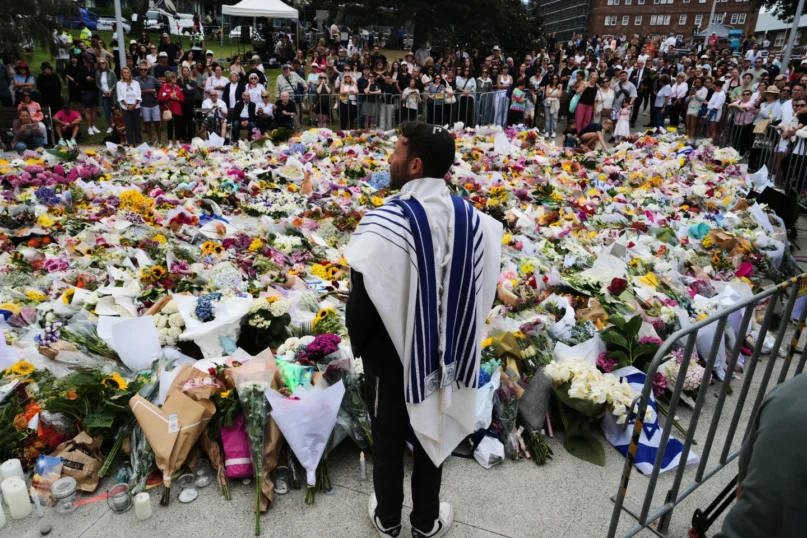
Christian leaders in Jerusalem joined the global moral outcry against the killing of the innocent Australian Jews holding a religious ceremony. The Council of Patriarchs and Heads of Churches strongly condemned the attack, describing it as an assault on innocent life and a desecration of a sacred religious celebration. “Our hearts break for the victims and for the Jewish community in New South Wales,” they said, lamenting that a festival of light was overshadowed by violence.
Rooting their response in shared faith, church leaders reminded believers that reverence for human life lies at the core of Judaism, Christianity and Islam alike. “God commands us to respect all innocent human beings — this is a belief shared by all the children of Abraham,” the statement said. That calling was powerfully embodied by Ahmed al Ahmed, a Muslim man who intervened during the Sydney attack, tackling one of the assailants and likely saving many lives. His actions stand as a testament to faith lived out through courage and solidarity.
The Rev. Jack Sara, president of Bethlehem Bible College, likewise denounced the attack, saying the sad act contradicts God’s will. “This should not be. This is not God’s will for humanity. God’s will for every human being is life — and life in its abundance.” He called on believers worldwide to mourn with the bereaved and pray for healing.
Jerusalem Orthodox Archbishop Atallah Hanna echoed this consistent moral position: “Regardless of the identity of the perpetrator or the victims, the killing of civilians must always be denounced.” He noted that the Palestinian leadership condemned it and he cautioned against turning this tragedy into a political instrument, warning that doing so dishonors the victims and deepens division.
In light of this response, it is completely inappropriate and utterly unfair to combine recognition of Palestine with the rejection of the scourge of antisemitism.
The moral call for a Palestinian state has hardly been limited to Australia. More than 80% of United Nations member states and 4 out of 5 permanent members of the U.N. Security Council have done so. Albanese pointed out as much when asked whether he thought there was any connection between recognizing Palestine and the Bondi Beach attack. “No, I don’t,” he said. “Overwhelmingly, most of the world recognizes a two-state solution as being the way forward in the Middle East.”
Rather, many Christian leaders see the recognition of a Palestinian state as consistent with international law and with biblical principles of justice, equality and the inherent dignity of all peoples.
In their Christmas message this year, church leaders in Jerusalem again called for peace and justice, saying: “Despite the difficulties and condemnations, we nevertheless pay heed to the Prophet Jeremiah’s warning against those saying, ‘Peace, peace,’ when there is no peace. For we are fully aware that, despite a declared cessation of hostilities, hundreds have continued to be killed or suffer grievous injury.”
(Daoud Kuttab is the publisher of Milhilard.org, a news site focused on Christians in Palestine, Israel and Jordan. The views expressed in this commentary do not necessarily reflect those of Religion News Service.)
Original Source:
https://religionnews.com/2025/12/24/recognizing-a-palestinian-state-isnt-an-antisemitic-act/