Religions Around The World

In the early morning hours, monks can be seen walking on their alms round in Kanchanaburi, Thailand
Showing humility and detachment from worldly goods, the monk walks slowly and only stops if he is called. Standing quietly, with his bowl open, the local Buddhists give him rice, or flowers, or an envelope containing money.  In return, the monks bless the local Buddhists and wish them a long and fruitful life.
Christians Celebrate Good Friday
Enacting the crucifixion of Jesus Christ in St. Mary's Church in Secunderabad, India. Only 2.3% of India's population is Christian. 
Ancient interior mosaic in the Church of the Holy Saviour in Chora
The Church of the Holy Saviour in Istanbul, Turkey is a medieval Byzantine Greek Orthodox church.
Dome of the Rock located in the Old City of Jerusalem
The site's great significance for Muslims derives from traditions connecting it to the creation of the world and to the belief that the Prophet Muhammad's Night Journey to heaven started from the rock at the center of the structure.
Holi Festival in Mathura, India
Holi is a Hindu festival that marks the end of winter. Also known as the “festival of colors”,  Holi is primarily observed in South Asia but has spread across the world in celebration of love and the changing of the seasons.
Jewish father and daughter pray at the Wailing Wall in Jerusalem, Israel.
Known in Hebrew as the Western Wall, it is one of the holiest sites in the world. The description, "place of weeping", originated from the Jewish practice of mourning the destruction of the Temple and praying for its rebuilding at the site of the Western Wall.
People praying in Mengjia Longshan Temple in Taipei, Taiwan
The temple is dedicated to both Taoism and Buddhism.
People praying in the Grand Mosque in Ulu Cami
This is the most important mosque in Bursa, Turkey and a landmark of early Ottoman architecture built in 1399.
Savior Transfiguration Cathedral of the Savior Monastery of St. Euthymius
Located in Suzdal, Russia, this is a church rite of sanctification of apples and grapes in honor of the Feast of the Transfiguration of the Lord.
Fushimi Inari Shrine is located in Kyoto, Japan
It is famous for its thousands of vermilion torii gates, which straddle a network of trails behind its main buildings. Fushimi Inari is the most important Shinto shrine dedicated to Inari, the Shinto god of rice.
Ladles at the purification fountain in the Hakone Shrine
Located in Hakone, Japan, this shrine is a Japanese Shinto shrine.  At the purification fountain, ritual washings are performed by individuals when they visit a shrine. This ritual symbolizes the inner purity necessary for a truly human and spiritual life.
Hanging Gardens of Haifa are garden terraces around the Shrine of the Báb on Mount Carmel in Haifa, Israel
They are one of the most visited tourist attractions in Israel. The Shrine of the Báb is where the remains of the Báb, founder of the Bábí Faith and forerunner of Bahá'u'lláh in the Bahá'í Faith, have been buried; it is considered to be the second holiest place on Earth for Bahá'ís.
Pilgrims praying at the Pool of the Nectar of Immortality and Golden Temple
Located in Amritsar, India, the Golden Temple is one of the most revered spiritual sites of Sikhism. It is a place of worship for men and women from all walks of life and all religions to worship God equally. Over 100,000 people visit the shrine daily.
Entrance gateway of Sik Sik Yuen Wong Tai Sin Temple Kowloon
Located in Hong Kong, China, the temple is dedicated to Wong Tai Sin, or the Great Immortal Wong. The Taoist temple is famed for the many prayers answered: "What you request is what you get" via a practice called kau cim.
Christian women worship at a church in Bois Neus, Haiti.
Haiti's population is 94.8 percent Christian, primarily Catholic. This makes them one of the most heavily Christian countries in the world.

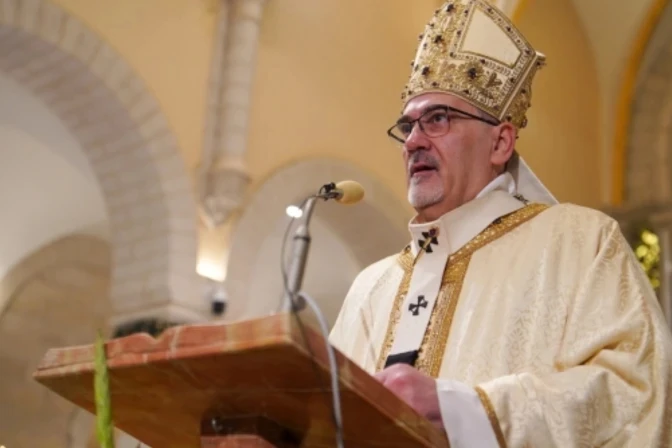
Latin Patriarch of Jerusalem: ‘God does not wait for history to improve before entering into it’

Cardinal Pierbattista Pizzaballa is the Latin Patriarch of Jerusalem / Credit: Courtesy of the Latin Patriarchate of Jerusalem

ACI Prensa Staff, Dec 25, 2025 / 16:07 pm (CNA).

At the Christmas Eve Mass celebrated in Bethlehem, the Latin Patriarch of Jerusalem, Cardinal Pierbattista Pizzaballa, affirmed that “one of the great messages of Christmas” is that God “does not wait for history to improve before entering into it,” but rather embraces human reality.

During his homily, the Cardinal explained that the birth of Jesus does not occur outside of time or apart from political events, but within concrete history. “God does not create a parallel history. He does not enter the world when everything is finally ordered and peaceful,” but rather “enters into real, concrete, sometimes harsh history.”

Commenting on the beginning of the Gospel of Saint Luke, which places the birth of Christ in the context of a decree by Emperor Augustus, the Patriarch indicated that this detail has profound theological significance. “The very history that claims to be self-sufficient becomes the place where God fulfills his promise,” he affirmed, adding that “no time is ever truly lost, and no situation is too dark for God to dwell in it.”

Cardinal Pizzaballa emphasized that, although the Emperor's decree seems to dominate the scene, “unbeknownst to him, it becomes an instrument of a greater plan.”  Faced with the logic of power that “counts, registers, and governs,” God responds with the logic of the gift, giving his Son in the fragility of “a child born without power.”

In this context, he recalled that Christmas is not an escape from the world's problems. “Christmas is not a refuge that removes us from the tension of the present time,” he warned, but rather “a school of responsibility,” because Christ “does not wait for circumstances to be favorable: he inhabits them and transforms them.”

The Patriarch also referred to the announcement of peace on the night of Jesus Christ’s birth in Bethlehem, clarifying that it is not a superficial peace.  “It is not a mere balance of power nor the result of fragile agreements,” he explained, but rather “the fruit of God's presence in history.” However, he added that this peace “is given, but also entrusted,” and only becomes real when it finds “hearts willing to receive it and hands ready to protect it.”

Speaking from the Holy Land, Cardinal Pizzaballa acknowledged that the current reality remains marked by deep wounds. “We come from years of great suffering, in which war, violence, hunger, and destruction have marked the lives of many, especially children,” he stated.  Nevertheless, he emphasized that it is precisely in this context that the Christmas message resonates most powerfully.

Finally, the Patriarch urged people not to remain neutral in the face of the complexities of history. “The darkness of the world may be profound, but it is not definitive,” he said, reminding everyone that “the light of Bethlehem does not blind, but illuminates the path,” and is transmitted “from heart to heart, through humble gestures, words of reconciliation, and daily decisions for peace.”

Original Source:

https://www.catholicnewsagency.com/news/268687/latin-patriarch-of-jerusalem-god-does-not-wait-for-history-to-improve-before-entering-into-it