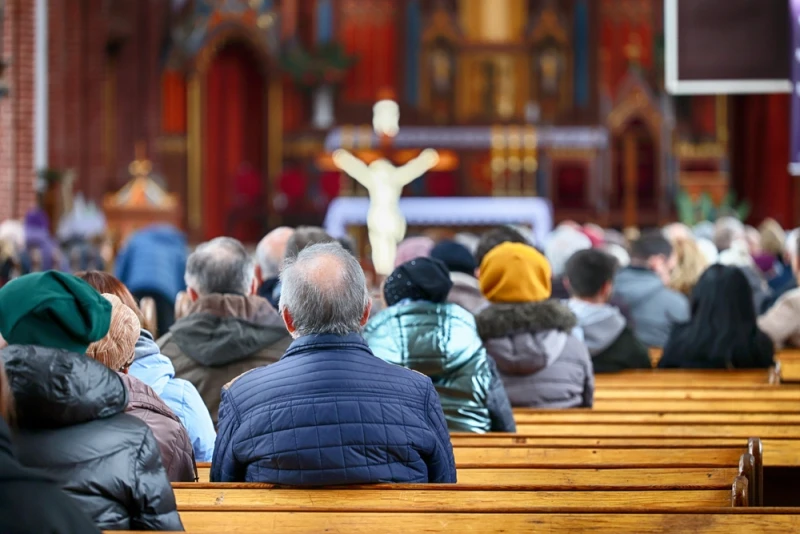
 null / Credit: FotoDax/Shutterstock
CNA Staff, Dec 26, 2025 / 06:00 am (CNA).
Amid heavy immigration enforcement by the Trump administration, several bishops in the U.S. have recently issued broad dispensations to Catholics in their dioceses, allowing them to refrain from attending Mass on Sundays if they fear arrest or deportation from federal officials.
Bishops in North Carolina, California, and elsewhere have issued such dispensations, stating that those with legitimate concerns of being detained by immigration agents are free from the usual Sunday obligation.
The Church’s canon law dictates that Sunday is considered the “primordial holy day of obligation,” one on which all Catholics are “obliged to participate in the Mass.” Several other holy days of obligation exist throughout the liturgical year, though Sunday (or the Saturday evening prior) is always considered obligatory for Mass attendance.
The numerous dispensations issued recently in dioceses around the country have underscored, however, that bishops have some discretion in allowing Catholics to stay home from Mass for legitimate reasons.
Dispensation must be ‘just,’ ‘reasonable’
David Long, an assistant professor in the school of canon law at The Catholic University of America as well as the director of the school’s Institute for Policy Research and Catholic Studies, told CNA that bishops have the authority to dispense the faithful in their diocese with, as the Code of Canon Law puts it, a “just and reasonable cause.”
“This generally applies when a holy day of obligation falls on a Saturday or Monday, during severe weather events (snowstorms, hurricanes, floods, etc.), when there is no reasonable access to Mass, or during public emergencies such as pandemics or plagues,” he said. Once such circumstances end, he noted, the dispensation itself would cease.
By virtue of their office, diocesan administrators, vicars general, and episcopal vicars also have the power to issue dispensations, Long said.
Priests, however, normally do not have that authority “unless expressly granted by a higher authority, such as their diocesan bishop,” he said.
Canon law, he said, dictates that a dispensation can only be granted when a bishop “judges that it contributes to [the] spiritual good” of his flock, for a just cause, and “after taking into account the circumstances of the case and the gravity of the law from which dispensation is given.”
The lay faithful themselves can determine, in some cases, when they can refrain from going to Mass, though Long stressed that such instances do not constitute “dispensation,” as the laity “does not have the power to dispense at any time” that authority being tied to “executive power in the Church” via ordination.
Canon law dictates, however, that Catholics are not bound to attend Mass when “participation in the Eucharistic celebration becomes impossible.”
Long said such scenarios include “when [the faithful] are sick, contagious, or housebound, when they are the primary caregiver for someone else and cannot arrange coverage for that person, when traveling to Mass is dangerous, when there is no realistic access to Mass, or for some other grave cause.”
“This is not a dispensation,” he said, “but instead is a legal recognition of moral and physical impossibility at times.”
The recent immigration-related controversy isn’t the only large-scale dispensation in recent memory. Virtually every Catholic in the world was dispensed from Mass in the earliest days of the COVID-19 crisis, when government authorities sharply limited public gatherings, including religious gatherings, all over the world.
In 2024, on the other hand, the Vatican said that Catholics in the United States must still attend Mass on holy days of obligation even when they are transferred to Mondays or Saturdays, correcting a long-standing practice in the U.S. Church and ending a dispensation with which many Catholics were familiar.
‘The most incredible privilege we could possibly imagine’
Though the obligation to attend Mass is a major aspect of Church canon law, Father Daniel Brandenburg, LC, cautioned against interpreting it uncharitably.
“This ‘obligation’ is sort of like the obligation of eating,” he said. “If you don’t eat, you’ll die. Similarly, the Church simply recognizes that if we don’t nourish our soul, it withers away and dies. The bare minimum to survive is Mass once a week on Sundays.”
“Most people find the ‘obligation’ of eating to be quite pleasurable,” he continued, “and I think anyone with a modicum of spiritual awareness finds deep joy in attending Mass and receiving the Creator of the universe into their soul. At least I do.”
Like Long, Brandenburg stressed that the lay faithful lack the authority to “dispense” themselves from Mass. Instead, they are directed to follow their consciences when determining if they are incapable of attending Mass, particularly by applying the principle of moral theology “ad impossibilia, nemo tenetur” “(no one is obliged to do what is impossible”).
Being too sick, facing dangerous inclement weather, or lacking the ability to transport themselves are among the reasons the faithful might determine they are unable to attend Mass, he said.
“Here, beware the lax conscience which gives easy excuses,” Brandenburg warned, “and remember that the saints became holy not through excuses, but through heroic love.”
Original Source: