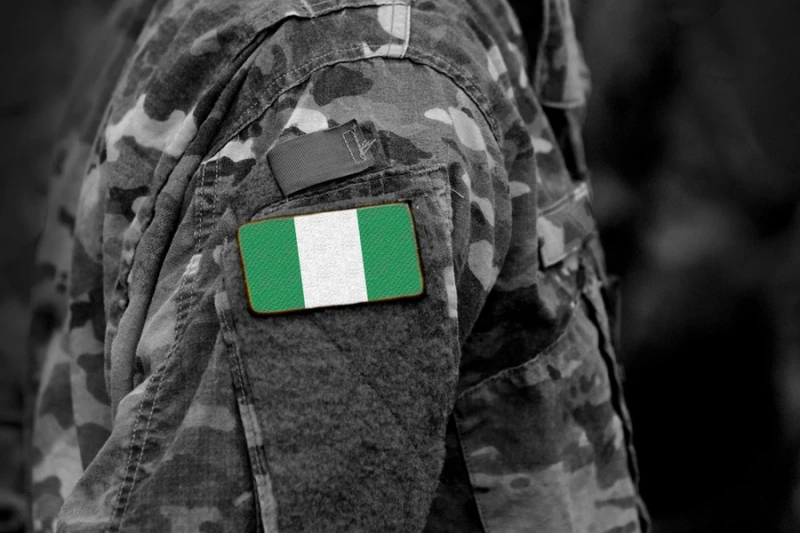
 Flag of Nigeria on soldiers arm. / Credit: Bumble Dee/Shutterstock
Washington, D.C. Newsroom, Dec 26, 2025 / 18:22 pm (CNA).
After launching an attack on ISIS militants in Nigeria, President Donald Trump vowed that the United States would wage more military strikes if the ongoing persecution of Christians persists in the country.
The U.S. military coordinated with the Nigerian government in the joint operation, which targeted camps in the Sokoto state, where military officials said ISIS militants were based. The state is a predominantly Sunni Muslim region in the northwestern corner of Nigeria, bordering Niger.
Gen. Dagvin Anderson of the U.S. Africa Command (AFRICOM) said in a statement that U.S. forces are “working with Nigerian and regional partners to increase counterterrorism cooperation efforts related to ongoing violence and threats against innocent lives.”
“Our goal is to protect Americans and to disrupt violent extremist organizations wherever they are,” he said.
The Nigerian Ministry of Foreign Affairs confirmed that Nigerian authorities cooperated with U.S. military, adding: “Terrorist violence in any form whether directed at Christians, Muslims, or other communities remains an affront to Nigeria’s values and to international peace and security.”
Trump began to publicly express concern about the persecution of Nigerian Christians in October and redesignated the country as a country of particular concern, which is reserved for countries with “particularly severe violations of religious freedom.” The president threatened military action in November.
Following the Dec. 25 strike, Trump said in a statement that he “warned these terrorists that if they did not stop the slaughtering of Christians, there would be hell to pay, and tonight, there was.”
“May God bless our military, and MERRY CHRISTMAS to all, including the dead terrorists, of which there will be many more if their slaughter of Christians continues,” the president said.
Nigeria is the most dangerous country in the world to be Christian, according to International Society for Civil Liberties and Rule of Law reporting that more than 7,000 Christians were killed and another 7,800 were abducted for their religious faith in the first seven months of 2025 alone.
The Observatory for Religious Freedom in Africa reported that from October 2019 to September 2023, nearly 56,000 people died from broader ethnic and religious violence, with the violence disproportionately affecting Christians.
AFRICOM reported that, based on its initial assessment, “multiple ISIS terrorists” were killed in the attack. However, local Nigerian officials, according to the Nigeria-based Vanguard News, did not find any evidence of injuries or deaths caused by the attack.
Douglas Burton, managing editor of Truth Nigeria, expressed doubt there were any casualties, based on the local reporting, and told CNA the military should “show us the photographs [and] show us the bodies” if anyone was injured or killed.
He said the attack may be “a warning shot” to demonstrate the ability of the United States to launch attacks inside Nigeria “if the Nigerian military establishment doesn’t start protecting … Christians.”
He noted the Nigerian government faces several Islamic insurgencies, which include affiliates of al-Qaeda and ISIS that desire to “usurp or replace the existing elected government with caliphates.” However, he accused the Nigerian military of turning a blind eye to Fulani militias — a separate force in Nigeria — which he said is responsible for “two-thirds of all the Christians that get killed every year.”
“The U.S. government — if it is serious about ending the genocidal attacks — it must target the Fulani ethnic militia that are concentrated in the north-central states,” Burton said.
He said the Fulani attacks are primarily in three states: Plateau, Benue, and Taraba, and said the militias are “wiping out Christian villages and forcing tens of thousands, maybe hundreds of thousands, of people into [internally displaced persons] camps.”
According to the 2024 report from the Observatory for Religious Freedom in Africa, about 81% of civilians killed in Nigeria’s ethnic and religious violence died in land-based community attacks. At least 42% of those attacks were carried out by Fulani herdsmen, but another 41% of those attacks fell into the “other terrorist groups” category, which mostly comprise Fulani bandits.
Nina Shea, the director of the Hudson Institute’s Center for Religious Freedom, told CNA that Fulani militias “pose the greatest threat to Nigerian Christians” but that “they are no doubt influenced, emboldened, and maybe armed in their jihad by their Muslim brothers who’ve joined Islamic State, JNIM, Boko Haram, and other Islamist terrorists operating in Nigeria’s north.”
“This Islamist ideology is the biggest root cause for their murderous acts, not climate change as we’ve long been told,” she added. “Hopefully, the Nigerian government is feeling the pressure and will be spurred to do the necessary police work to curb the anti-Christian violence. It must disarm and prosecute the Fulani jihadis.”
Original Source: