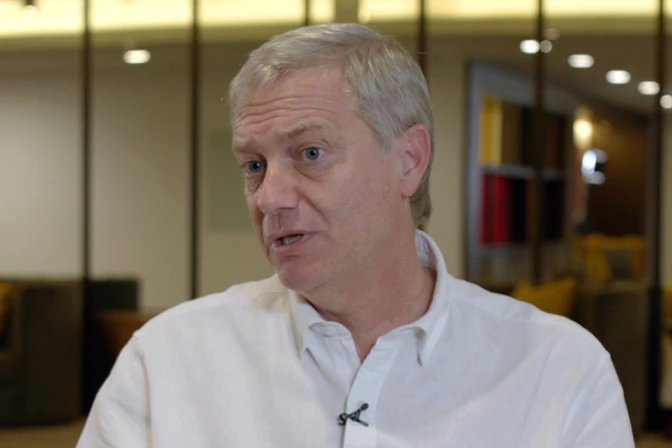
 José Antonio Kast | Credit: Photo courtesy of Goya Productions
Dec 27, 2025 / 08:00 am (CNA).
In an exclusive 2024 interview with Goya Producciones for the documentary “ Valientes” (Brave Ones), the now president-elect of Chile, José Antonio Kast, addressed topics such as defending life, his family history, and the problem of leftist ideological imposition on society.
Discussing both his personal background and political career, Kast asserted that young people “have the power to bring about change” and put an end to individualistic societies that lead to loneliness.
The decision that allowed him to be born
A staunch defender of life from conception, Kast — the youngest of 10 siblings — shared a “very important” personal story that shaped his family’s future: “When my mother had her second child, she suffered from eclampsia [a serious pregnancy complication], and they raised the possibility that she wouldn’t be able to have any more children,” he recounted.
His father believed that wasn’t right, and despite the risk to his wife’s life, he told her: “I believe God doesn’t want that for us.” That determination allowed them to have eight more children, including Kast. Without that decision, “I wouldn’t have been born,” he noted.
“My parents are German immigrants, and we have an extended family of almost 200 people. My mother’s first two children passed away. Therefore, none of this would have been possible, and that leaves a lasting impression on you from a young age,” he emphasized.
“Thanks to that decision, I’m here; thanks to that decision, I met my wife. Thanks to that decision, we were able to have nine children. Thanks to that, today we are expecting our third grandchild,” he commented.
“It’s amazing how one decision can affect the lives of so many,” he reflected.
With his wife, María Pía Adriasola, he has nine children, born from the conviction of “being open to life.”
“God accompanied us in that decision, and today we are happy parents of nine children,” he said, “and we couldn’t imagine life without any of them.”
Political trajectory
In his early days in politics, he recalled, he wasn’t “a great communicator,” but through hard work he became a congressman, a party leader, and a presidential candidate, “always being very clear about things, never deceiving people, never falsifying my position,” and with the purpose of “winning people’s hearts, whatever the result may be.”
His continued involvement in politics was a family decision that he discussed with his wife and children, based on the premise that “he who has a mission must fulfill it.”
Analyzing Chile’s sociopolitical landscape at the time (prior to the 2025 elections) Kast pointed out that “leftist ideology has been gaining increasing influence in governments, promoting laws that go against life and against the family as constituted by a man and a woman.”
He warned about the imposition of an agenda that, in the case of Chile, legalized abortion on three grounds and “seeks to change the constitution” by decriminalizing abortion up to the ninth month, based on a misinterpretation of the concept of a woman’s autonomy over her own body. “She is not the owner of the body of another being that is inside her,” Kast explained.
“Generally, I don’t use religious arguments to defend the pro-life stance, because there is ample evidence from the nature of human beings, from science, and from the fact that life begins at conception,” he stated, expressing hope that “the future depends on us” because “the nature of human beings is on our side.”
In this context, Kast has faced violence, intolerance, and the cancellation by those who think differently. “As a politician in my early years, it was mostly verbal violence from those who thought differently,” he recalled.
“Some people mixed things up because they would say, ‘No, you’re speaking from a religious perspective.’ And I would tell them, ‘I’m not speaking from a religious perspective; I’m speaking from a scientific perspective, from the nature of the human being, because the moment you were conceived, at that very moment, the characteristics you exhibit to society today were already present.’” That, he recalled, “was met with verbal violence in Parliament.”
“Later, they began influencing other environments. And on some occasions, I have experienced severe physical violence,” he recounted, detailing situations in which he suffered fractures and needed police protection. “You always feel fear, but I have never had the intention of backing down.”
Kast lamented that the young people who commit these acts of aggression “are instruments in the hands of an ideologue.” Therefore, he said, “I don’t feel resentment, I don’t feel hatred; I sometimes feel frustration at not being able to be with these people individually to explain to them the joy one feels when giving of oneself to save another, and they would feel the same way if they had the opportunity to experience the richness that exists in human nature.“
Recognizing the struggle between good and evil
Kast then proceeded to speak out against “a kind of empire that is beginning to dominate the actions of society,” coordinated with vast financial resources, so that “violence is being used to create a new kind of human being.”
Although he has seen “an ideological totalitarianism” that aims at canceling the individual, Kast noted that ideology “will never be able to overcome the nature of the human being, which seeks freedom, transcendence, the preservation of life, and love between people.”
“We don’t have the resources, but we do have a voice, we do have heart ... and that strength is more powerful than money,” he emphasized, really wishing that people would wake up and “realize that we must occupy all the spaces we have to act in, that with the power of the Spirit one can defeat the spirit of evil, because ultimately this is a struggle between good and evil.”
Evidence much stronger than ideology
“There is no good value that seeks the death of another. There is no good value that seeks the disintegration of the family, which is the fundamental nucleus of society,” Kast emphasized. “Two women can love each other. Two women can live together. Two women can work together. But two women by themselves cannot procreate. The same is true for two men,” he explained.
“What I always propose and try to promote is that people consider the evidence. And that evidence is much stronger than ideology,” he indicated.
Left has been ‘very clever’ at appropriating causes
Kast acknowledged that the left has been “very clever” because it has appropriated causes such as the environment, women’s rights, and health, and used them to its advantage. However, he asked: “Who cares more about the environment? The leftist ideology or those of us who believe in life? We do.”
“Who defends people with disabilities more? Who truly cares about them? Those of us who believe in life. The others use their suffering to say, ‘They are discriminated against,’” he stated.
“The Indigenous cause is used by the ideological left to claim that they have been oppressed and repressed, which may have been true 100, 200, or 300 years ago, but today we are all part of the same nation. We have equal value. Today, there are more slaves in the world than when slavery was legal. Who is fighting against this slavery of children whose rights are violated? Who is fighting against the slavery of women who are victims of human trafficking? We are, because we believe in life and in freedom.”
‘Don’t wait for someone else to do what you can do’
To those who from the comfort of their homes declare “Someone has to do something,” the Chilean leader responded: “Don’t wait for someone else to do what you can do. What are you doing with your children? Do you dedicate time to them, or are you always busy? Because the root of this problem lies in the family,” he pointed out, urging people to set aside time exclusively for their spouses and children.
In this context, he highlighted a Chilean tradition called “dating Tuesdays,” which he himself practices with his wife every week, and which consists of “two hours a week of direct, face-to-face conversation, looking each other in the eyes, with no one else around.”
In this way, “a solid foundation is built for what is the core of the family, the union of the couple. If the couple is doing well, it’s more likely that the children and their environment will also be doing well,” he summarized. “And then it’s easier to go out and motivate others, because I can’t give what I don’t have,” he added.
‘Abortion is murdering an innocent person’
“You can see in Chile that what I was saying 20 years ago was the same as today,” Kast said. “I still say the same thing. And that’s why I'm closer to convincing people today.”
“In the coming years, how many people will realize that abortion is murdering an innocent person? How many people in 20 years will say, ‘What did we do to these children, giving them up for adoption to same-sex couples?’ Those children have the right to know their identity.”
“Just as the radical left, through its ideology, often captures the hearts and minds of young people, we, without trying to control them, but appealing to their freedom, are certain that they will be the force for change. Because these individualistic societies lead to loneliness. And man is a social being who seeks connection, who seeks joy,” Kast pointed out.
“It is young people who are the first to rebel against state totalitarianism. It is young people who are the first to realize that modern welfare systems, those governments that are gradually seizing complete power, turn their citizens into slaves of the welfare state,” he maintained. Therefore, he expressed his hope “that it will be young people who reverse the situation we are experiencing today.”
This story was first published by ACI Prensa, CNA’s Spanish-language news partner. It has been translated and adapted by CNA.
Original Source:
https://www.catholicnewsagency.com/news/268701/president-elect-chile-pro-life-and-family