Religions Around The World

In the early morning hours, monks can be seen walking on their alms round in Kanchanaburi, Thailand
Showing humility and detachment from worldly goods, the monk walks slowly and only stops if he is called. Standing quietly, with his bowl open, the local Buddhists give him rice, or flowers, or an envelope containing money.  In return, the monks bless the local Buddhists and wish them a long and fruitful life.
Christians Celebrate Good Friday
Enacting the crucifixion of Jesus Christ in St. Mary's Church in Secunderabad, India. Only 2.3% of India's population is Christian. 
Ancient interior mosaic in the Church of the Holy Saviour in Chora
The Church of the Holy Saviour in Istanbul, Turkey is a medieval Byzantine Greek Orthodox church.
Dome of the Rock located in the Old City of Jerusalem
The site's great significance for Muslims derives from traditions connecting it to the creation of the world and to the belief that the Prophet Muhammad's Night Journey to heaven started from the rock at the center of the structure.
Holi Festival in Mathura, India
Holi is a Hindu festival that marks the end of winter. Also known as the “festival of colors”,  Holi is primarily observed in South Asia but has spread across the world in celebration of love and the changing of the seasons.
Jewish father and daughter pray at the Wailing Wall in Jerusalem, Israel.
Known in Hebrew as the Western Wall, it is one of the holiest sites in the world. The description, "place of weeping", originated from the Jewish practice of mourning the destruction of the Temple and praying for its rebuilding at the site of the Western Wall.
People praying in Mengjia Longshan Temple in Taipei, Taiwan
The temple is dedicated to both Taoism and Buddhism.
People praying in the Grand Mosque in Ulu Cami
This is the most important mosque in Bursa, Turkey and a landmark of early Ottoman architecture built in 1399.
Savior Transfiguration Cathedral of the Savior Monastery of St. Euthymius
Located in Suzdal, Russia, this is a church rite of sanctification of apples and grapes in honor of the Feast of the Transfiguration of the Lord.
Fushimi Inari Shrine is located in Kyoto, Japan
It is famous for its thousands of vermilion torii gates, which straddle a network of trails behind its main buildings. Fushimi Inari is the most important Shinto shrine dedicated to Inari, the Shinto god of rice.
Ladles at the purification fountain in the Hakone Shrine
Located in Hakone, Japan, this shrine is a Japanese Shinto shrine.  At the purification fountain, ritual washings are performed by individuals when they visit a shrine. This ritual symbolizes the inner purity necessary for a truly human and spiritual life.
Hanging Gardens of Haifa are garden terraces around the Shrine of the Báb on Mount Carmel in Haifa, Israel
They are one of the most visited tourist attractions in Israel. The Shrine of the Báb is where the remains of the Báb, founder of the Bábí Faith and forerunner of Bahá'u'lláh in the Bahá'í Faith, have been buried; it is considered to be the second holiest place on Earth for Bahá'ís.
Pilgrims praying at the Pool of the Nectar of Immortality and Golden Temple
Located in Amritsar, India, the Golden Temple is one of the most revered spiritual sites of Sikhism. It is a place of worship for men and women from all walks of life and all religions to worship God equally. Over 100,000 people visit the shrine daily.
Entrance gateway of Sik Sik Yuen Wong Tai Sin Temple Kowloon
Located in Hong Kong, China, the temple is dedicated to Wong Tai Sin, or the Great Immortal Wong. The Taoist temple is famed for the many prayers answered: "What you request is what you get" via a practice called kau cim.
Christian women worship at a church in Bois Neus, Haiti.
Haiti's population is 94.8 percent Christian, primarily Catholic. This makes them one of the most heavily Christian countries in the world.

Swiss non-profit tackles a common church problem: Scripture memorization that fizzles out


New group feature in Remember Me app lets congregations memorize together — and see if anyone’s actually doing it

ZURICH — Anyone who has tried to lead a congregation through a Scripture memorization program knows the pattern: enthusiastic sign-ups in week one, scattered participation by week three, and awkward silence when the pastor asks how it’s going.

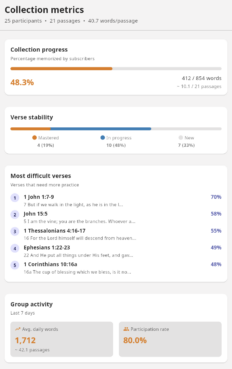
Poimena, a Swiss non-profit, is attempting to address this with version 6.8 of Remember Me, a Bible memorization app that has accumulated over two million downloads since its launch. The update introduces what the organization calls “campaigns” — a system that lets church leaders, small group facilitators, or parents publish verse collections that others can subscribe to, with aggregate progress visible to anyone.

The approach threads a needle between accountability and privacy. The metrics page shows group-level statistics — how many subscribers have started, completion percentages, which verses are proving difficult — but no individual performance data is exposed. A youth pastor knows whether the group is on track; a teenager’s struggles remain their own.
The Retention Problem

Bible memorization apps are not new, but most focus on the initial learning phase. Remember Me has built its following around a different emphasis: preventing forgotten verses. The app uses spaced repetition, combining graduated-interval recall from linguist Paul Pimsleur’s language courses with the ’learning box’ method published by German science journalist Sebastian Leitner. Fail a review, and the verse resets to more frequent practice.

Users see their verses categorized as NEW, DUE, or KNOWN — a simple dashboard that answers the question most memorizers eventually ask: “Am I actually retaining any of this?”

The group campaigns extend this logic. When a leader adds new verses or corrects a typo, subscribers receive the update automatically while keeping their personal progress intact.

A Multilingual User Base

The app’s reach extends beyond English-speaking churches. It supports 44 languages, with features like audio playback and typing practice functional in each. Users memorize in Greek and Hebrew originals, in minority languages like Telugu and Swahili, and in the language of their missionary context. It even serves across denominational lines, respecting Protestant, Catholic, Lutheran, and Orthodox canonical book orderings — a quiet ecumenism in a memorization app.

The Open-Source Angle

Unlike most apps in the category, Remember Me operates without advertisements, premium tiers, or user data collection. The code is MIT-licensed and available on GitLab, a transparency measure that the organization says reflects its non-profit mission.

The app runs on Android, iOS, web browsers, and desktop systems (macOS and Windows), with progress syncing across devices. An offline-first architecture means the mobile apps function without internet access — relevant for users in areas with unreliable connectivity.

Availability

Remember Me 6.8 is available now on Google Play, the Apple App Store, and at web.remem.me. The campaigns feature documentation is at remem.me/docs/guides/campaigns.

###

About Poimena: A Switzerland-based non-profit providing free resources for spiritual growth. More at remem.me.

Contact:
Rev. Peter Schafflutzel
Poimena
This email address is being protected from spambots. You need JavaScript enabled to view it.

Disclaimer: The views and opinions expressed in this article are those of the authors and do not necessarily reflect the official policy or position of RNS or Religion News Foundation.

Original Source:

https://religionnews.com/2025/12/29/swiss-non-profit-tackles-a-common-church-problem-scripture-memorization-that-fizzles-out/