Imagine a conversation in a household during this season.
A husband asks his wife: “Must we go to the holiday concert at school tonight? You know how much I dislike Christmas songs.”
The wife pauses. Then she asks, “’Must?’ As in, is there a law? A state statute requiring parents to attend school concerts?”
“Well…no,” he says. “That’s not what I meant.”
“Then,” she says, her voice sharpening just a bit, “we must go. Because we love our daughter. And she is singing in the concert.”
End of conversation.
We replay this exchange all the time, whether we notice it or not.
Must a mother go to her child’s soccer game? Must we attend that birthday party? Must a wife get her husband a birthday gift?
There are no laws that make any of these things necessary.
So, why do we do them?
Because the relationship creates the obligation.
That is one of the most important questions facing Jews today — why do Jewish?
That came up in my recent conversation (and podcast) with Rabbi Rick Jacobs, president of the Union for Reform Judaism. He reminded me of the New Yorker cartoon in which kids in a progressive early childhood program ask their teacher: “Do we still have to do what we want to do?”
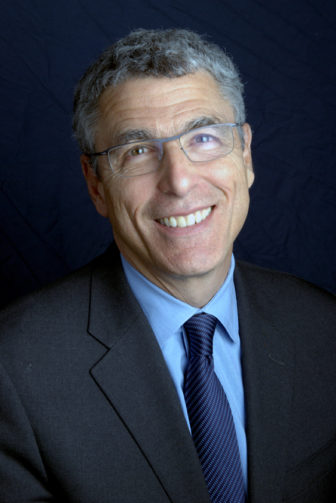
“Why do Jewish?” I know what the answer would be for traditional Jews. Cue the opening song of “Fiddler on the Roof”: tradition. What are the rules for those traditions? Halacha — Jewish law.
What is Reform Judaism’s relationship with Jewish law? To quote the cliche: “It’s complicated.” Reform Judaism has a robust relationship with Jewish law through its response process. But, at the end of the day, Jewish law has, to quote Mordecai Kaplan, a “vote, but not a veto.”
Rabbi Rick Jacobs and I are old friends and colleagues. We are precisely the same age. We attended Hebrew Union College-Jewish Institute of Religion together. We read the same books, and the same thinkers and teachers influenced us. Three of those teachers — Martin Buber, Franz Rosenzweig (through their writings) and Eugene Borowitz (in person, through his teaching and through his writings) said it in different ways, but they all said the same thing: our Jewish obligations grow out of relationship.
So, let’s revisit those old teachers.
For Martin Buber, religious life does not begin with Jewish law. It begins with the fact that God addresses each one of us. We listen. We feel summoned. We feel claimed. Something happens to us.
Buber did not want to reduce Judaism to a collection of mitzvot that require mechanical obedience. Rather, he sensed that when Jews perform mitzvot as responses to a personal encounter with God, those mitzvot come alive. I have a relationship with God; that is why I do what I do.
Franz Rosenzweig goes even further. It starts with love. We respond to God’s love, and we do the mitzvot.
In The Star of Redemption (1921), he writes: “The commandment does not precede the relationship; it follows it.” Rosenzweig never claims that Jews can discard tradition at will. He insists that the community preserves mitzvot and hands them down. But each Jew must hear those mitzvot as living words spoken in love, not frozen instructions from the past.
Or, to get back to that whole going to your child’s play thing. Why do you go? Not because you signed a contract with your child, years ago. You go because you love your child, and that love keeps calling, and you keep answering.
Rosenzweig also reminds us that obligation binds Jews to each other across time. Jews do not belong only to themselves. Jews belong to a people. Obligation flows from belonging.
That insight leads directly to the man who was my greatest teacher: the late Reform thinker, Dr. Eugene Borowitz, who taught for more than five decades at the Hebrew Union College-Jewish Institute of Religion in New York.
In 1976, as part of the “Centenary Perspective” of Reform Judaism, Borowitz wrote: “Reform Jews are called upon to confront the claims of Jewish tradition, however differently perceived, and to exercise their individual autonomy, choosing and creating on the basis of commitment and knowledge.”
In our final conversation, I suggested to my aging, frail teacher that contemporary Reform Jews had fully heard and internalized the second clause of his last sentence in the “Centenary Perspective.” They were clearly “exercising their individual autonomy.”
But, as for the first part — “confronting the claims of Jewish tradition…” — was that really working out the way we would have wanted?
Borowitz told me that he understood my concern. He would have wanted Jews to understand that we live in a relationship with the tradition, with God and with each other. Obligation does not descend from above. Obligation rises from commitment. Rabbi Rachel Sabath Beit-Halachmi puts it this way: we are “radically free and radically claimed.”
Back to that concert. You attend the concert because you love your child. You also attend because you committed yourself to being that kind of parent. Covenant works the same way. Love does not weaken obligation. Love deepens it.
That is how Mara H. Benjamin puts it in “The Obligated Self: Maternal Subjectivity and Jewish Thought.” The moral life arises out of inescapable responsibilities that emerge from relationships — most clearly in caring for dependents such as children.
So, for me, and for many Reform Jews, it is about relationship:
- With the Jewish past, present and future.
- With the Jewish people — past, present and future and in all places.
- With God, as refracted through Torah.
Not because the rules demand it. But because I want to respond to that web of relationships.
How will my more traditional Jewish friends respond to this? They will see it as being far too little and far too weak. Relationship, sure: but what if you are not feeling it? And do you really expect God to address you, personally, and that encounter will inspire you to live Jewishly?
My less traditional Jewish friends will see it as too much. Relationship, sure — but why should I feel those relationships in the first place?
But, as for me, I live my Jewish life as a response to that web of relationships in which I find myself. The truth is: I love my people, my tradition and God.
And, as every parent already knows, love creates the strongest obligation of all.
Original Source:
https://religionnews.com/2025/12/29/why-i-am-a-reform-jew-rabbi-rick-jacobs/