VATICAN CITY (RNS) — In 2025, the Catholic Church and the Vatican witnessed the death of Pope Francis and the election of the first pope born in the United States, Leo XIV.
While the year was marked by profound change, the new pope emphasized his intention to lead the world’s 1.4 billion Catholics in a spirit of continuity with his predecessor. Leo has already embraced Francis’ financial, structural and spiritual reforms as well as many of his causes, such as care for the environment and the welcoming of migrants and refugees.
What the two popes don’t share is style. In his first months Leo has been more restrained and reflective than Francis, who from the start of his papacy broke with tradition in his dress and where he lived, and never shied from addressing divisions in the church. Leo has restored the practice of retreating to the papal estate at Castel Gandolfo, away from the concerns of the Roman Curia and the chaos of Rome.
On a deeper level, Leo has spent this transition year watching and listening, meeting with the prominent voices in the church to gauge their hopes and concerns, even as the Vatican and the church await the result of Leo’s reflections on where the church needs to go in the new year.
The death and funeral of Pope Francis
On Easter Monday, April 21, Pope Francis died at the Domus Sancta Marta where he lived at the Vatican, following months of medical ailments and hospital admissions. For 12 years, Francis had shepherded the Catholic Church through internal divisions, an unprecedented trial of a cardinal and nine other defendants on corruption charges, the COVID-19 pandemic and wars in Ukraine and Gaza.
According to the Vatican, a quarter of a million people came to pay their last respects to the Argentine pontiff, who was widely recognized as a reformer and disrupter within the church. In one last break with tradition, Francis was buried in the Roman Basilica of St. Mary Major, instead of St. Peter’s Basilica.
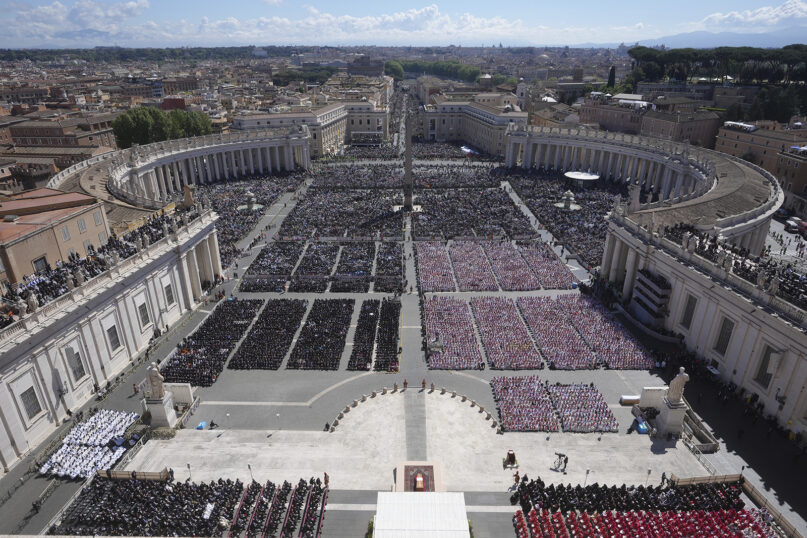
Francis left behind his major project of injecting “synodality” — a spirit of dialogue, welcoming and transparency — into the church at all levels. Hoping to ensure that his vision would be realized, Francis established checks and controls on the Roman Curia so that church leaders would continue his work after his death.
Francis’ charismatic leadership and his major gestures have already ensured that his papacy will be remembered. “He was a pope who opened doors, leaving behind a church that speaks to all without fear,” said Massimo Borghesi, a philosophy professor at the University of Perugia and author of “The Mind of Pope Francis: Jorge Mario Bergoglio’s Intellectual Journey.”
The conclave and the election of Pope Leo XIV
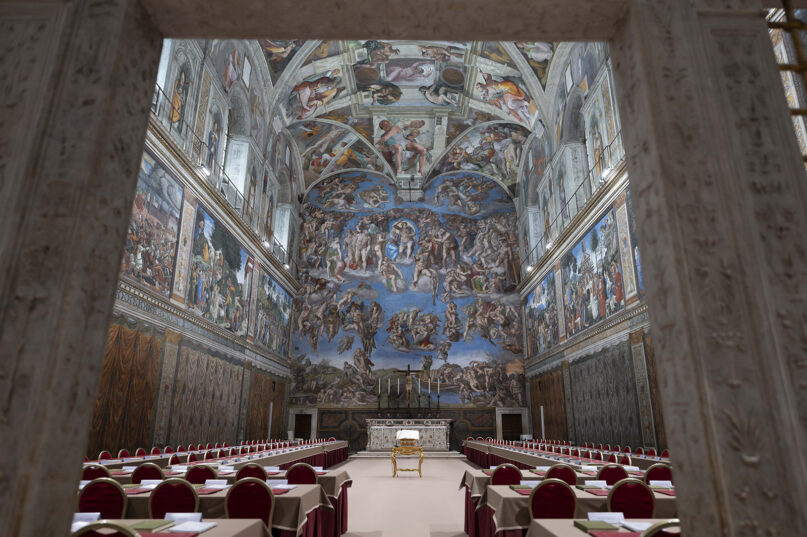
In the wake of Francis’ death, 133 cardinals gathered at the Vatican to elect his successor. Thanks to Francis’ insistence on elevating cardinals in far-flung corners of the globe, many of the electors had never met one another. And Italian, long the language of consistories, was not widely spoken, as critically, debates over the restrictions on the celebration of the Old Latin Rite, over the welcoming of LGBTQ+ Catholics, relations with China and female ordination divided the cardinals.
But the cardinals surprised the world by electing a moderate and an American with the heart of a missionary, taking only two days and four ballots to do so. “We have someone who knows us and is aware of our challenges, knows our possibilities and potential. I think the church can advance under him in communion and unity,” said Cardinal Jaime Spengler, archbishop of Porto Alegre in Brazil, after the election.
One jubilee year, two popes
On Christmas Eve 2024, Francis opened the Holy Doors of St. Peter’s Basilica, signaling the start of a Jubilee Year celebration centered on the theme of hope.
In a Jubilee Year, Catholics are invited to come to Rome to pass through the Holy Doors, located in the major churches of the city, and obtain plenary indulgence of their sins or those of a loved one. Francis placed a Holy Door in Rebibbia, a prison in Rome, as a symbol of redemption for all.
About 30 million pilgrims came to Rome during the Jubilee celebrations, according to the Vatican. Some came during major events, some visits were organized around a profession or theme: artists, medical personnel, even social media influencers.
On this year’s Christmas Day, Leo began the ceremonial closing of the Holy Doors; the last will be closed in St. Peter’s Basilica on the feast of the Epiphany (Jan. 6). “The Jubilee is drawing to a close,” Leo told those gathered for the last Jubilee audience on Dec. 20, “but the hope that this year has given us does not end: We will remain pilgrims of hope.”
Shared papal priorities
While a gentler public presence than Francis, Leo has taken on his predecessor’s work as his own. In his first address to the crowd gathered in St. Peter’s Square, Leo used the word peace roughly 10 times. Elected in a year that saw a ceasefire in Gaza and the first serious efforts to find peace in Ukraine, Leo held himself out as a mediator, meeting with Ukrainian President Volodymyr Zelenskyy several times, calling for a just peace and defending Ukraine’s right to self defense.
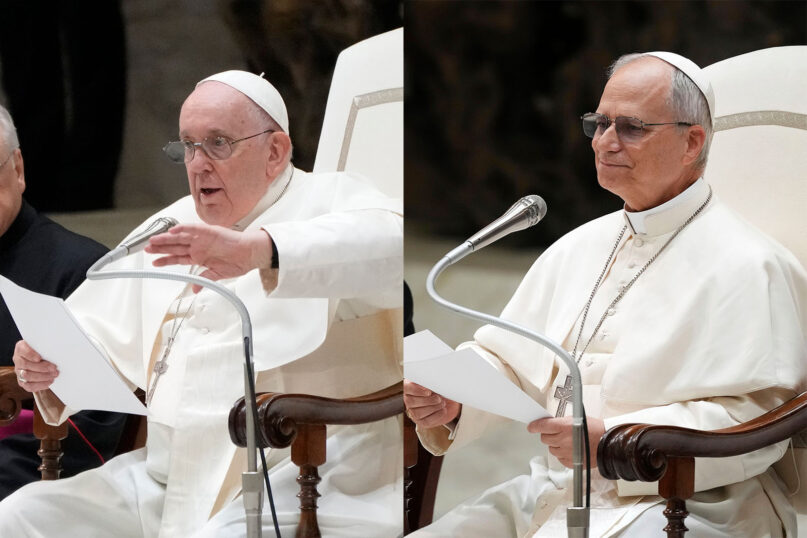
Many of his early actions as pope have completed or honored work begun by Francis. In July, Leo celebrated the first Mass for Creation in the Borgo Laudato Si, once a papal garden and now an eco-village named for Francis’ encyclical on promoting sustainability and care for the environment.
Like his predecessor, Leo has criticized Trump’s policies on migration, describing it as “inhumane,” and voiced concern over his isolationist tendencies and separation from Europe. But his emphasis on human rights and social justice comes with Francis’ steadfast positions on Catholic teaching. The new pope has drawn firm lines on abortion, gay marriage and the ordination of women to the permanent diaconate.
Both Leo’s first apostolic trip, to Turkey and Lebanon, on which he marked the 1700th anniversary of the First EcumenicalCouncil of Nicaea, and his historic moment of prayer in the Sistine Chapel with King Charles III, were events that were planned under Francis, who had met with Charles, alone or with Queen Camilla, repeatedly since 2017.
Leo has also made his concerns known about the development of artificial intelligence and its consequences for regular people and their lives. “Do not let the algorithm write your story! Be the authors yourselves; use technology wisely, but do not let technology use you,” Leo told students during the Jubilee of the World of Education in October.
The first Millennial saint
In 2025, the Catholic Church saw the recognition of the first Millennial saint, Carlo Acutis. Leo canonized the young man, who died of leukemia at 15 years old in 2006, in a solemn ceremony at the Vatican in September. Also known as “God’s Influencer” for his use of technology to build a website to track Eucharistic miracles, Acutis has garnered a large following among many young Catholics.
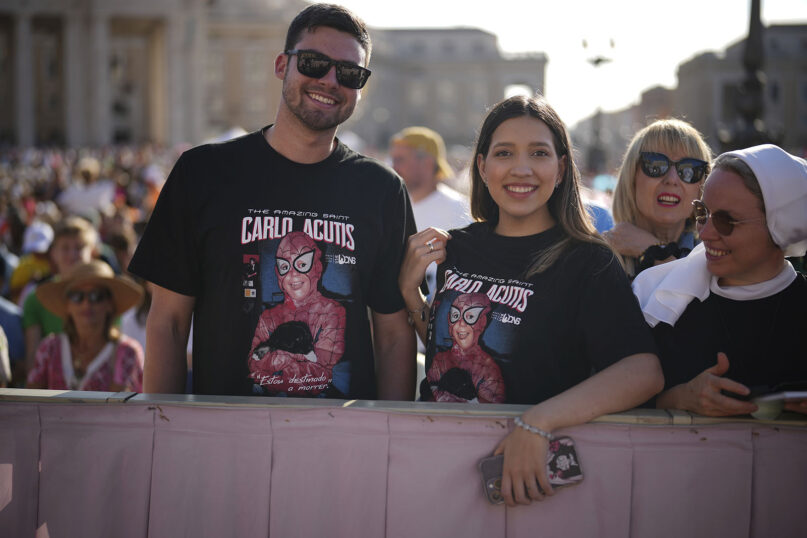
His remains are located in Assisi, the birthplace of St. Francis, where pilgrims of all ages come to pay their respects.
Pier Giorgio Frassati, who lived in the early 1900s and died at the age of 24, was canonized on the same day as Acutis as symbols of the church’s desire to engage young generations through relatable figures that can be of inspiration. The new saints and the largely attended Jubilee of youth in July and August were welcomed as hopeful signs of interest in the Catholic faith following years of declining church attendance and vocations, especially in the West.
Original Source: