(The Conversation) — One of Japan’s most recognizable cultural practices – the Japanese tea ceremony, known as chanoyu, or chadō – is being reshaped by tourism, wellness culture and social media.
Matcha, the Japanese powdered green tea that is used during the ceremony, has entered the global marketplace. Influencers post highly curated tearoom photos, wellness brands market matcha as a “superfood,” and cafés worldwide present whisked green tea as a symbol of mindful living.
The Japanese tea ceremony is deeply rooted in the ideals of Zen Buddhism, but the current matcha hype has little to do with the tea ceremony. Green tea has become part of the on-the-go coffee culture. On social media, a centuries-old spiritual practice is compressed into a 15-second reel.
As a scholar of premodern Japanese literature and culture, I know that this commercialization is not without tension. The reflective values of the Japanese tea ceremony trace their origins to a monastic routine.
History of the Japanese tea
Tea arrived in Japan from China in the eighth century. Emperor Shōmu served powdered tea, an ancestor to what we today know as matcha, to Buddhist monks in 729 C.E.
Around the end of the 12th century, the practice of serving tea became more widespread after the Zen monk Eisai returned from China with matcha tea seeds from the plant that was to become the source of much of the tea grown in Japan today. He also brought with him the knowledge of how tea rituals were practiced in Chinese Buddhist temples.
Wild tea grew in Japan, but the tea grown from Eisai’s seeds became known as “honcha” or true tea. Matcha soon spread through Zen monasteries, where it was believed to generate greater enlightenment than long hours of meditation.
As Zen Buddhism gained influence among the warrior class in the 13th century, monks carried tea culture beyond temple walls. In 1483, Ashikaga Yoshimasa – Japan’s military ruler, or shogun, who was also a patron of the arts, constructed one of the earliest tearooms. The tearoom was inside his villa in Kyoto, later known as the Temple of the Silver Pavilion or Ginkakuji. There, the tea ceremony was both a contemplative act and an occasion to display Chinese calligraphy, paintings and ceramics.
What matters is the moment
The most transformative figure in the history of the Japanese tea ceremony was a 16th-century tea master, Sen no Rikyū. Rejecting ostentation, he favored locally made utensils, rough ceramics, and small, rustic spaces designed to quiet the senses.
Westerners hated matcha when they first tried it.
This aesthetic and moral principle – known as “wabi” – valued imperfection, humility and mindful presence. Grounded in simplicity, wabi guided everything from the size of the room to the angle of a flower stem.
Serving as tea master to military leaders, or shoguns, who supported his activities, Rikyū transformed the tea ceremony to reflect ideals of wabi.
A poem by Rikyū captures his philosophy:
cha no yu to wa
tada yu o wakashi
cha o tatete
nomu bakari naru
koto to shiru beshi
To understand the tea ceremony
Is simply this:
Heat the water,
Whisk the tea,
And drink.
The poem’s clarity echoes a foundational sensibility of the tea ceremony: what matters is the moment itself.
Rikyū’s grandson Sōtan and his three sons carried on the traditions of tea ceremony. Their three schools – Ura Senke, Omote Senke and Mushanokōji Senke – differ in tea whisking styles, utensils they use and levels of formality, yet continue to preserve Rikyū’s principles to date. All three schools have headquarters in Kyoto.
The ritual of impermanence
The manner of preparing powdered green tea depends on the techniques and practices of the various schools. The following description is based on the Ura Senke way of preparation.
A full tea gathering, or “chaji,” may last several hours. Every choice – from utensils to food to flowers – reflects the season, time of day and purpose of the occasion, whether welcoming guests, marking a farewell or observing a celebration.
A Japanese tea ceremony and the power of simplicity.
The ceremony takes place in a tearoom or “chashitsu,” decorated only with a hanging scroll and a single flower – both selected to set the gathering’s spiritual tone.
Guests assemble in a waiting room and taste the hot water used for tea. They then proceed along a water-sprinkled garden path meant to wash away the “dust” of the outside world.
After greeting the host, they cleanse their hands and mouths and enter the tearoom through a small door, the “nijiriguchi.” The passage from the ordinary way of the world to the contemplative way of tea symbolizes humility.
Inside, they admire the scroll, kettle and hearth before taking their seats.
In the guests’ presence, the host builds the charcoal fire and serves a carefully prepared seasonal meal: rice, soup, seafood or vegetables, pickles, sake and a principal sweet.
When the meal ends, the host briefly re-enters alone to replace the scroll with flowers, sweep the room and arrange the utensils for “koicha,” the thick tea that forms the heart of the gathering. At that time the guests have been asked to leave the room. They re-enter once the bell or gong is run. The host reenters the room as well with chawan – the whisk – and all the utensils; the tea is served.
A jar of fresh water representing yin is paired with the fire’s yang. Yin (feminine) and yang (masculine) are two opposing yet complementary forces in Chinese philosophy that represent the duality and balance found in the universe. The tea jar or “chaire,” wrapped in silk, is set out on a stand chosen for the occasion. A gong or bell summons the guests to return.
The host enters with the tea bowl or “chawan,” a white linen cloth, a whisk and a bamboo scoop. Each utensil is cleaned, and the bowl is warmed, dried and filled with three scoops of powdered tea before hot water is added and kneaded with the whisk into a smooth, thick mixture. The single bowl is shared among all guests, then returned to the host. The tea jar and scoop are cleaned and presented for close viewing.
The charcoal fire is built again for “usucha,” or thin tea, which gently prepares guests to return to everyday life. Thin tea is prepared in a way similar to that of thick tea, except that less tea powder, and of a lower quality, is used. Dry sweets accompany this lighter, frothier tea, served in individual bowls. When the final cup is finished, guests express their gratitude, depart along the garden path and leave the host watching quietly from the tearoom door.
Underlying the entire ritual is the principle of “ichigo ichie” – “one time, one meeting.” No gathering can ever be repeated. Every season, every person, every breath is singular.
The tea ceremony, often translated in English as “the Way of Tea,” trains participants to feel that fleetingness, to hold the moment warmly and attentively before it dissolves.
The rise of global matcha culture
Today, the tea ceremony lives a double life. While traditional schools continue to teach Rikyū’s disciplined aesthetics, matcha has entered its global afterlife of commercialization and popular culture.
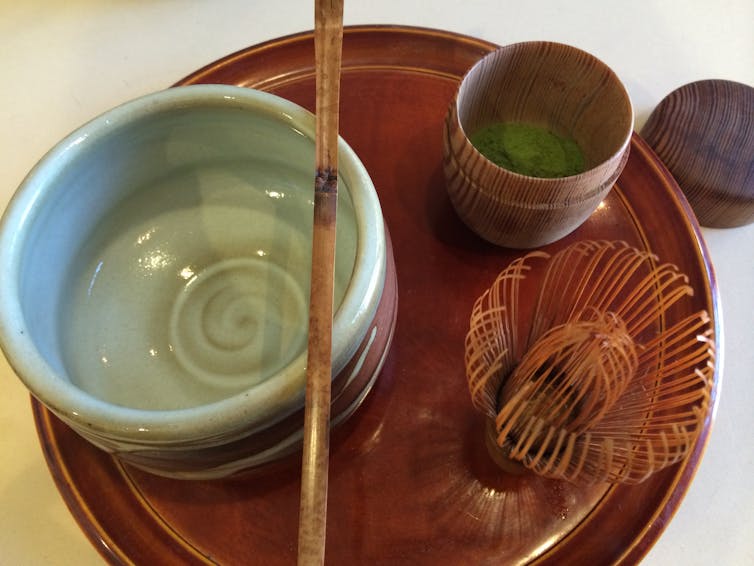
A traditional Japanese tea set for making matcha green tea.
AP Photo
The explosion of matcha consumption has led to a high demand. Prices for high-grade ceremonial matcha have risen dramatically, and producers struggle to meet demand. Japan now exports far more matcha than ever before.
Many people encounter matcha not through Zen teachings or formal tea ceremonies but through lifestyle trends and the contemporary fascination with “calming rituals.” On social media, matcha is promoted as a wellness routine and lifestyle aesthetic.
In this new landscape, the Japanese “Way of Tea” exists both as a revered cultural practice and as a global commodity – its spiritual heart intact but circulating in forms its earliest practitioners could scarcely have imagined.
(Małgorzata (Gosia) K. Citko-DuPlantis, Assistant Professor in Japanese Literature and Culture, University of Tennessee. The views expressed in this commentary do not necessarily reflect those of Religion News Service.)

Original Source: