VATICAN CITY (RNS) — In his first major act of governance, Pope Leo XIV welcomed about 170 cardinals this week at the Vatican for an extraordinary consistory, a gathering aimed at addressing the most pressing issues facing the church.
While the meeting on Wednesday and Thursday (Jan. 7-8) takes place behind closed doors, the message Leo is sending is clear: He intends to lead the world’s 1.4 billion Catholics not as a solitary decision-maker but in close consultation with the church’s senior leadership.
“I am here to listen,” the pope said in his opening remarks before cardinals in the Synod Hall at the Vatican on Wednesday. “This day and a half together will point the way for our path ahead.”
It is the first consistory of Leo’s papacy and the first time the cardinals have convened since his election in May. Shortly after his inauguration, Leo expressed his desire to lead the church alongside his fellow cardinals. His predecessor, Pope Francis, only held one extraordinary consistory during his 12-year papacy, choosing to rely on a small council of cardinals known as the C9. His most adamant conservative critics would often accuse him of being too authoritarian.
Leo acknowledged that he inherited a deeply divided church that in many ways reflects the polarization in society. “While unity attracts, division scatters,” he said, while thanking cardinals for taking part in this “collegial journey.”
Underscoring the pope’s desire to include cardinals in the decision-making process, Leo asked that they select two topics for discussion from the four he suggested: the mission of the church today, as described in Pope Francis’ 2013 apostolic exhortation “Evangelii Gaudium” (the Joy of the Gospel); the reform of the Roman curia, especially in assisting churches around the globe; the Synod on Synodality as a tool and style of dialogue and cooperation; and the highly debated topic of liturgy.
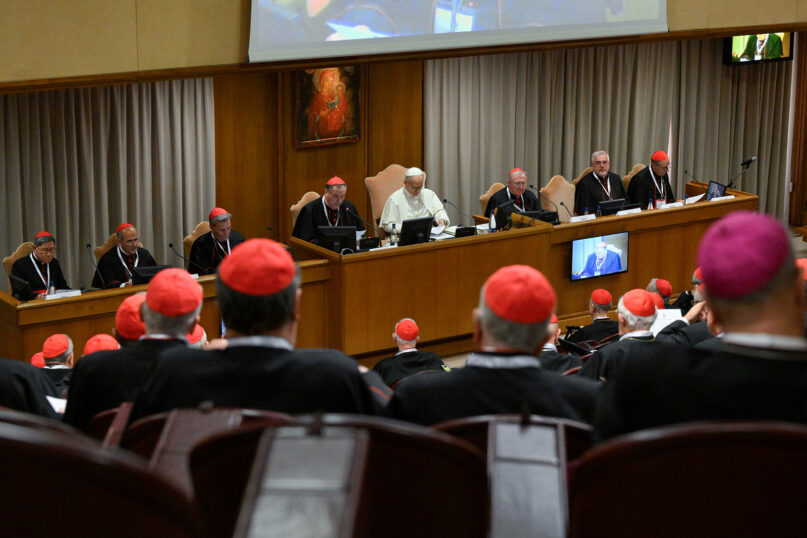
The cardinals moved to the Paul VI Hall to make the decision and Leo listened to the final reports at the end of the day. Only a representative of the first nine groups, made up of cardinals who live in Rome and work in the Roman curia, had a chance to present their thought process to the pontiff, while the others only wrote their preferred topics. Leo explained that due to time constraints, it would be better if he heard directly from those he will work with in the coming months.
A “clear majority” of the cardinals voted to address the themes of the Synod on Synodality and the evangelization and mission of the church as set forth in “Evangelii Gaudium,” said Vatican spokesperson Matteo Bruni in a briefing with Vatican reporters on Wednesday evening.
The Synod on Synodality, launched by Pope Francis, was meant to encourage a culture of dialogue, inclusion and listening in the historically hierarchical structure of the church. It translates into the inclusion of laypeople to the life of the church and making decisions more “democratically.” But it also means a style of listening centered on “conversations in the Spirit,” where people are invited to speak briefly and listen deeply.
Leo’s first consistory has been deeply “synodal,” with the cardinals divided into 21 language-based groups where they can speak freely, but for no longer than 10 minutes each to allow everyone their say. Francis was the first to adopt this method, whereas previous synods often included hourlong speeches by prelates.
Francis’ “Evangelii Gaudium” encouraged the church to use the power of attraction to bring people to the faith, by being first of all joyful, but also among the people and their concerns, especially the poor. “Having the smell of the sheep,” as Francis put it, allows pastors to have a more pragmatic approach to church teaching.

The remaining topics of the liturgy and curial reform have not been completely sidelined, Bruni said, but will be folded into the broader discussions.
There will be no final document issued after the gathering, as the meeting is meant to serve as a guide for the pope and the Roman curia until the cardinals are able to meet for the next extraordinary consistory.
“Even the way in which we learn to work together, with fraternity and sincere friendship, can give rise to something new, something that brings both the present and the future into focus,” Leo said.
Before the meeting on Wednesday, the cardinals also had the chance to listen to a brief introduction by the dean of the College of Cardinals, Cardinal Giovanni Battista Re, and a meditation by Cardinal Timothy Radcliffe, who reminded the prelates of their duty to be loyal to the pope.
Drawing from the day’s biblical reading about Christ walking on water during a storm, Radcliffe recognized that “we live in a time of terrible storms too, of growing violence, from knife crime to war. The chasm between the rich and the poor is ever wider. The world order which came into being after the last world war is breaking down. We have no idea of what artificial intelligence will yield.”
“If we are not nervous, we ought to be,” he said.
He acknowledged that the church too is rocked by the storms of “sexual abuse and ideological division,” but he urged cardinals to follow Christ’s command to “sail out into these storms, and face them truthfully, not timidly waiting on the beach.”
Pope Leo spoke to the cardinals informally at the end of the day. “I truly think this is an important moment for me as well, even if we have a very short time, because I feel the need to be able to count on you: You are ones who called this servant to this mission!” Leo said, according to the Vatican.
He stressed that the reason behind the consistory is to preach the gospel, and urged cardinals to come to speak to him directly the following day about their concerns.
On Thursday morning, Leo celebrated Mass in St. Peter’s Basilica with the prelates. During the homily, he underscored the importance of unity in a church that has many different forms and urged cardinals to work for peace in a world overcome by both political and existential struggles.
The cardinals are “not called, first of all, to be a team of experts, but a community of faith,” he said, inviting them to experience the consistory “with a humble and generous heart,” beyond partisan interests.
Original Source: