VATICAN CITY (RNS) — Pope Leo XIV unveiled his first crèches, or Nativity scenes, as pope on Monday (Dec. 15), a longtime tradition signaling the start of Christmas festivities at the Vatican.
The crèche in St. Peter’s Square, visible to tourists and pilgrims visiting the Vatican, was made by the artists of the diocese of Nocera Inferiore-Sarno, not far from the Italian city of Naples, known for its vibrant Nativity scenes. Beside it stands an 88-foot-tall spruce tree from the northern Italian Veneto region.
In his speech on Monday to a delegation of almost 4,000 people from the dioceses that donated the tree and crèches, Leo said the tree was meant to symbolize “a sign of life and evokes a hope that does not fade, even in the cold of winter,” and the tree’s lights point to “Christ the light of the world.”
Nativity scenes, Leo said, hold an invitation for reflection.
“Before every Nativity scene, including those set up in our homes, we relive the birth of Jesus. We rediscover the need to seek moments of silence and prayer in our lives, in order to find ourselves and enter into communion with God,” Leo said.
Traditionally, dioceses from all over the world donate Nativity scenes to the pope, and they come with layers of symbolism, sometimes religious and sometimes political. These messages are not always welcomed by all. In 2020, a modern rendition of the birth of Jesus in St. Peter’s Square was criticized as “grotesque” and even “demonic.” Last year, the last-minute decision by Palestinian artists to place a black-and-white checkered keffiyeh on the manger of the crèche in the Paul VI hall at the Vatican made global headlines.
The Nativity scene in the Paul VI hall this year, designed by Costa Rican artist Paula Sáenz Soto, celebrates the Church’s anti-abortion efforts. It featured an image of a pregnant Virgin Mary surrounded by 28,000 ribbons meant to symbolize the abortions that didn’t happen because of prayer and advocacy efforts.
The Nativity scene in the square this year is meant to promote a message of peace, according to its sculptor, Federico Iaccaruino. He said he made sure to include two statues of a wolf and a lamb huddled together to underscore the importance of reconciliation and peace.
Pope Leo used the unveiling of the crèche as an opportunity to make his own appeal for peace and to voice his sadness over Sunday’s mass shooting at a Jewish gathering at Bondi Beach in Sydney, Australia, which claimed the lives of 15 people and wounded 27 others.
“Enough with these antisemitic acts of violence. We must eliminate hatred from our hearts!” Leo said in an unscripted remark.
The crèche also makes a nod to the Jubilee year of hope, the anniversary celebration of the Catholic Church this year, with a fisherman (often seen in Neapolitan Nativity scenes), holding an anchor, the symbol of the Jubilee, and pointing toward the Holy Door of St. Peter’s Basilica, which pilgrims crossed this year to ask for the forgiveness of sins.
The Jubilee will end on Jan. 6, the feast of the Epiphany, in a year that will mark the 800th anniversary of the death of St. Francis of Assisi, who is credited with having invented the crèche in Greccio in 1223.
Iaccaruino also pointed to the shepherd standing before the manger, describing the traditional Nativity character as an invitation to believers to stand in awe before Christ.
“We are trying to inspire awe, but especially to bring back this feeling that nowadays, especially among adults, we are losing a bit,” said Iaccaruino.
The crèche spans more than 650 square feet and stands 30 feet tall. It showcases some of the most recognizable places in the Nocera region. The dome over the Nativity is a replica of the Baptistry of Saint Mary Major in Minciola Superiore, surrounded by a landscape of a typical historic home and the ancient font of Helvius. Inside the home, there is a statue representing St. Alphonsus Maria de Liguori, an 18th century artist and doctor of the Church, playing the harpsichord.
Liguori is also credited with writing the famous Italian Christmas carol “Tu Scendi dalle Stelle” (“From Starry Skies Thou Comest”).
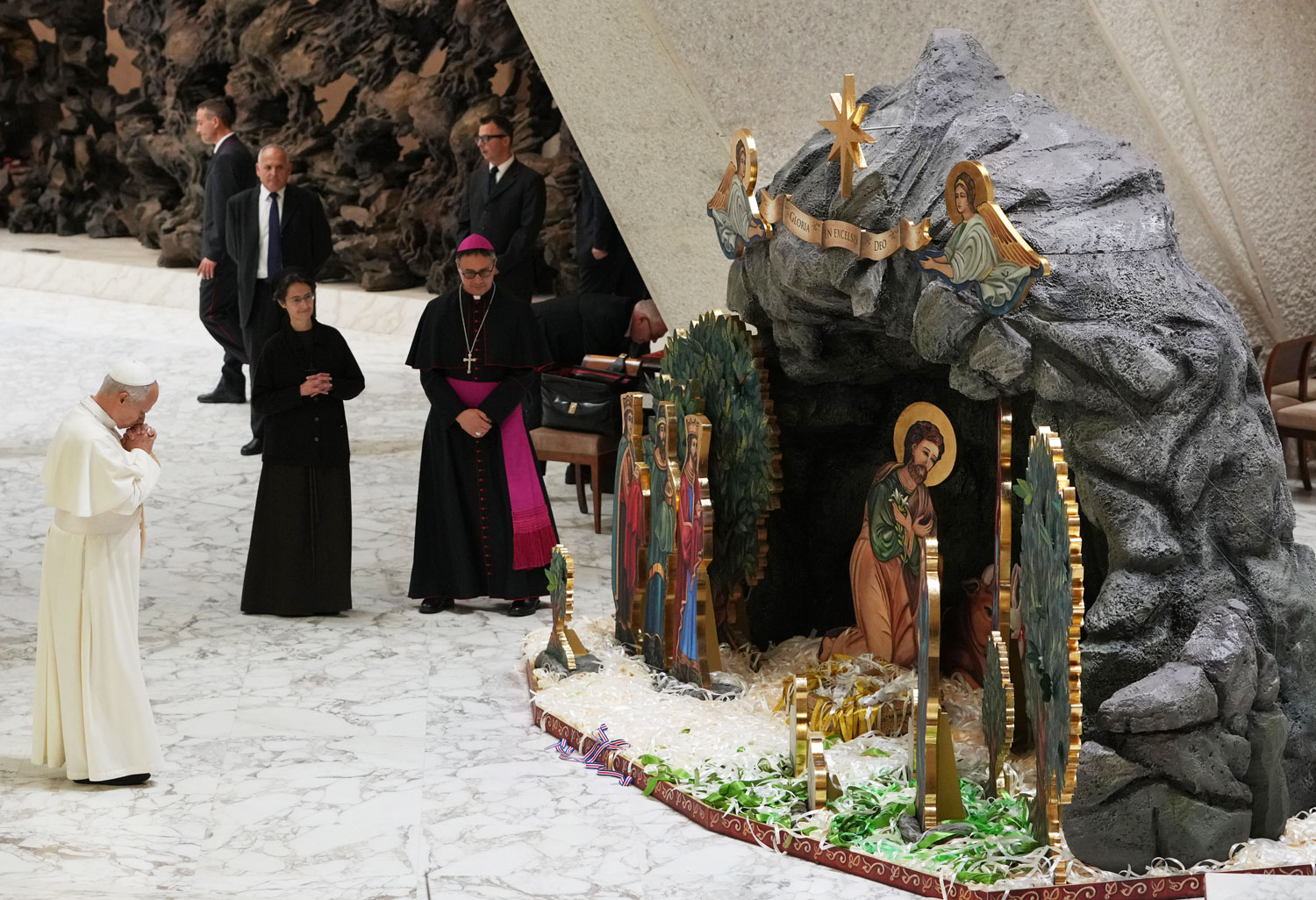
The Nativity took the better part of the past year, according to its creators, and came with the added pressure of being for a new pope’s first Christmas.
“Initially there was a great deal of fear, because for us it was an enormous challenge,” said Alfonso Maria Pagliuca, who oversaw the construction of the crèche. “We reflected on the Jubilee year, on the new pope, on the first Nativity scene for the new pope, so it was a mix of emotions that accompanied us in a very significant way throughout these eight months.”
For Bishop Giuseppe Giudice of the Diocese of Nocera Inferiore-Sarno, the Nativity scene this year also sends a message about the importance of infusing the Nativity scene with different cultures and regions because it can be a way “to open the Gospel to the entire world.”
“The Nativity can be a clue, or an invitation, to restore hope,” he said.
Original Source: