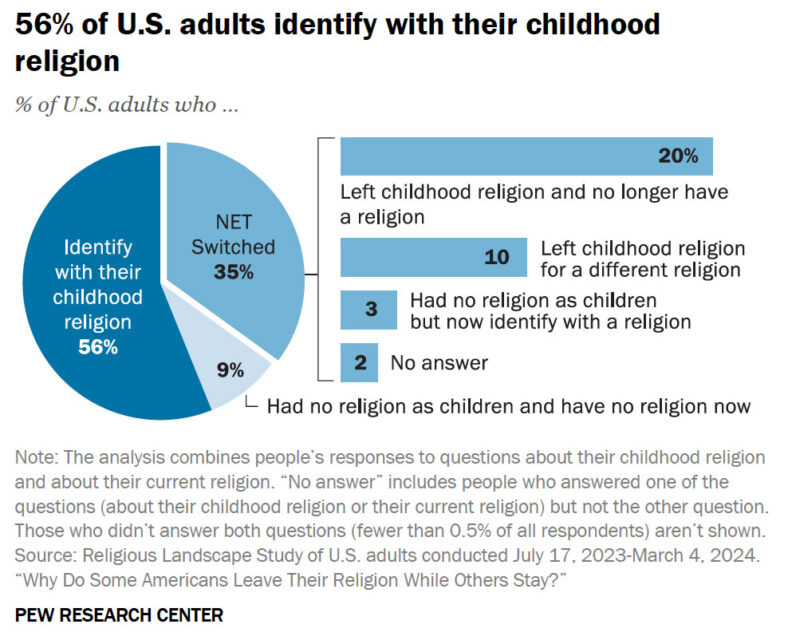
(RNS) — Americans who had a positive religious experience as kids are most likely to keep the same faith as adults. Those who had negative experiences are most likely to change faiths or give up on religion. And while a majority (56%) of Americans still identify with their childhood faith, a third (35%) have switched — including 20% who now say they have no religion.
Those are among the findings of a new report from Pew Research Center, based on data from Pew’s 2023-24 U.S. Religious Landscape Study and a survey of 8,937 American adults conducted between May 5 and May 11.
Researchers asked Americans what religion they’d been raised in as well as their current religion, then asked those who switched or left their childhood faith about why things changed. They also asked Americans who are religious why they remain part of that faith.
Nine percent indicated they weren’t raised in a religion and don’t have one today either.
For this study, released Monday (Dec. 15), changing from one brand of Protestantism to another did not count as switching faiths.
The study found that 86% of Americans were raised in a religion, but those who stayed tended to have a different experience from those who left.
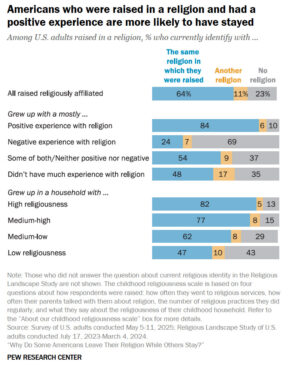
“Our data shows that the nature of their religious experiences as children — that is, whether they were mostly positive or negative — plays a significant role in whether they stay in their childhood religion as adults,” the study’s authors wrote.
Eighty-four percent of those who had a positive experience as children stayed in the same faith when they became adults, while 69% of those who had a negative experience now have no religion, according to the report.
Americans who grew up in what Pew called “highly religious” homes were more likely to keep their childhood faith (82%) than those raised in homes with “low levels of religiosity” (47%). Those most likely to keep their childhood faith were Hindus (82%), followed by Muslims (77%), Jews (76%), those with no religion (73%), Protestants (70%), Catholics (57%), Latter-day Saints (54%) and Buddhists (45%).
Most switching between faiths comes before people turn 30 years old, according to the report. Of those who switched religion, 85% percent did so before age 30, including 46% who switched as teenagers or children.
About half of Americans (53%) who no longer claim a religion, known as nones, after growing up religious did so by age 18. Of those who switched religions, about 3 in 10 did so as teenagers.
Americans who stick with their childhood faith do so because it works for them, according to the report.
Many cited their faith’s beliefs (64%) as the top reason they retained their faith, along with having their spiritual needs met (61%) or finding meaning in life (51%) through faith. Only about a third (32%) said the faith’s social or political teachings are important reasons to keep their faith.
Protestants (70%) and Catholics (53%) were more likely to indicate their faith’s teachings were an important reason to stay compared to Jews (45%). Protestants (65%) and Catholics (54%) were also most likely to say their faith fulfills their spiritual needs. Jews were more likely to cite a sense of community (57%) or their faith’s traditions (60%) as why they stay with their religion.
Few Americans say they stay in their childhood faith out of a sense of religious obligation, including 33% of Jews, 30% of Catholics and 24% of Protestants.
Many of those who left their childhood faith and now have no religion say they don’t need religion and don’t believe, the survey suggests. Among the most important factors were that they stopped believing their faith’s teachings (51%), that religion was no longer important to them (44%) and that they gradually drifted away (42%). Scandals involving religious leaders (34%), unhappiness about social and political teachings (38%) or the way that the religion treats women (29%) were also factors.
Researchers also asked those who have no religion about why they are not affiliated with a faith. Among the most important reasons were that they feel they can be moral without a religion (78%), that they question religious teaching (64%) and that they don’t need religion to be spiritual (54%). About half said they don’t trust religious organizations (50%) or religious leaders (49%).
About 30% of Americans say they have no religion — a figure that has remained constant since 2020.
The report found that about 3% of Americans who were raised without any religion now identify with a faith — largely for the same reasons as religious Americans. They embrace their new faith’s beliefs (61%), say the faith meets their spiritual needs (60%) and say the faith gives their life meaning (55%), they indicated.
As part of the study, researchers also looked at the religious practices of children in the U.S. from the viewpoint of their parents. Just under half of parents with kids under 18 said their children say prayers at night (46%), say grace at meals (43%), read religious stories (43%) or attend services at least monthly (43%).
Protestant parents (61%) were most likely to say their children attend services monthly. They are also most likely (35%) to say their children are being raised in a highly religious household. Nones are least likely to say their children attend services monthly (7%) or are being raised in a highly religious household (1%).
Mothers (39%) are about twice as likely as fathers (17%) to say they play the primary role in teaching their kids about religion, according to the study.
Original Source: