NEW YORK (RNS) — Walking along Steinway Street, the busy commercial stretch of the Queens neighborhood of Astoria, one can hardly miss the bright blue-and-purple campaign posters for Rana Abdelhamid plastered on the windows of many cafes and halal supermarkets.
In November, the Muslim community organizer launched her campaign and filed with the state Board of Elections to run for New York’s 36th State Assembly District — a seat currently held by Zohran Mamdani, who will vacate the role when he takes office as New York’s mayor on Jan. 1.
Mamdani has held the Assembly seat for the district, which spans Astoria, Ditmars-Steinway and Jackson Heights, since 2019. Earlier this year, Abdelhamid canvassed for his mayoral campaign, reaching out to Middle Eastern and North African voters in the district. And on election night, she hosted one of Astoria’s largest watch parties to celebrate the election of the city’s first Muslim mayor.
Now, she hopes to build on the momentum that his affordability-focused campaign generated among New Yorkers. Like Mamdani, Abdelhamid, 32, is part of a generation of young Muslim progressives who have sought to invest in the city’s halls of power in recent years. If elected, the daughter of Egyptian immigrants would become the first Muslim woman elected to the New York State Assembly, further enshrining the growing political power of New York’s Muslim community.
“I’m the daughter of the community, and I’m running to represent them so personally, and that gives me so much hope,” Abdelhamid told Religion News Service during a late November interview in Astoria.
Members of Astoria’s predominantly immigrant communities have offered support, she said. In a campaign video on Instagram, a middle-aged Astoria resident tells viewers, “We need one of us to be in the government.”
Over the past few weeks, older women in her community have spontaneously canvassed in the neighborhood, sticking her campaign flyers on business windows, she said. Recently, she was endorsed by Bangladeshi Americans for Political Progress and Africans for Political Progress, two grassroots political organizing groups.
At her campaign launch party at an Egyptian restaurant in Astoria, Abdelhamid told the Queens Eagle that although she would respect the Democratic Socialists of America’s likely endorsement of one of her two opponents, Diana Moreno, she counted on her ties within the district’s Muslim, Middle Eastern and North African communities to win the seat in a special election in early 2026.
The mayor-elect hasn’t weighed in on the race playing out in his district, where all three candidates are DSA-affiliated and two are Muslim.
A former co-chair of the DSA’s Queens chapter, Moreno has said she is running to deliver on Mamdani’s affordability agenda. The race’s third candidate, Mary Jobaida, is a former kindergarten teacher and worked for state Sen. Jessica Ramos. A Bangladeshi-born Muslim community organizer, Jobaida has said she is running to “help create an inclusive state.”
Husein Yatabarry, the executive director of the Muslim Community Network of New York, said that if Abdelhamid wins the seat, it would further enshrine New York’s Muslim and Arab community as a growing political force.
“You have a seat that will become empty from Zohran Mamdani, who is going to become the mayor — a Muslim that was at State Assembly — and that will be, hopefully, after this special election is over, taken over by Rana Abdelhamid, the first Arab Muslim woman in the State Assembly,” Yatabarry said.
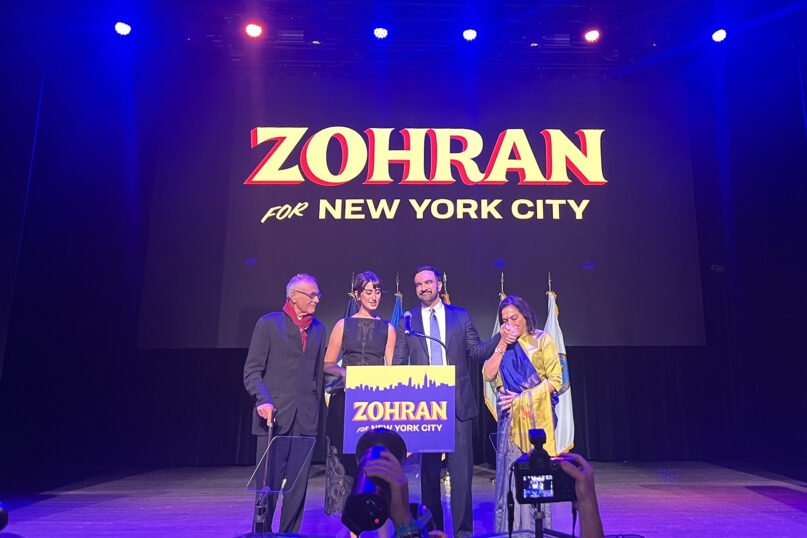
In the mayoral election, Mamdani received overwhelming support in predominantly Muslim and Arab American neighborhoods. But Abdelhamid said the strength of Mamdani’s campaign was its ability to affirm that marginalized communities had a right to “not just survive in New York, but thrive.” She said she would continue that effort in Albany if elected.
Abdelhamid grew up in a one-bedroom apartment in the Little Egypt neighborhood of Queens. After graduating from Vermont’s Middlebury College with a bachelor’s degree in political science and economics and from Harvard Kennedy School with a master’s degree in public policy, Abdelhamid worked for Google. She also served as a board member of Amnesty International USA for six years.
A karate black belt who first learned the discipline at her local mosque, in 2010, she launched a series of self-defense classes after a man attacked her in an attempt to grab off her hijab. The class series, the Women’s Initiative for Self-Empowerment, was her first foray into organized community engagement.

“It was one part of my own healing process to feel safe in my skin and to reclaim my body and create space where I can talk about my experience and feel safe,” she said.
In 2014, WISE became Malikah, a nonprofit that in addition to self-defense classes offers emotional healing tools, anti-hate crime advocacy, shelter to domestic violence victims and other services to help relocate victims of domestic abuse.
In workshops at Malikah, Abdelhamid heard stories that she said changed her vision of safety and inspired her to have a broader impact.
“Safety isn’t just physical,” she said. “Safety is a mother not being able to provide food for her children. Safety is a survivor not knowing that she could leave an abusive home because she doesn’t have a shelter to go to. … Safety is being afraid to go to your job because ICE might show up.”
From there, the young organizer began advocating for migrant rights, particularly for those who are Muslim, at the height of the city’s migrant crisis in 2022. She also campaigned for the passage of the so-called MENA bill at the state Senate, which established separate data collection categories for white, Middle Eastern and North African groups. The bill, which aimed to improve the accuracy of demographic data to better address challenges faced by specific groups, was signed into state law in December 2024.
Her years of engagement earned her a status as a trusted activist within the local Muslim community, Yatabarry said.
“She is Astoria,” he said. “She’s somebody that grew up within this community. She’s somebody that faced hate in this community, and that drove her to start her own program and turn that into triumph, and turn it into a moment of resilience.”
During the COVID-19 pandemic, Abdelhamid said she realized problems her community faced were tied to disinvestment in public services. There was a disconnect, she said, between the reality Astoria residents lived and that of the state government’s sanitary safety guidances. “A lot of my work and a lot of the challenges I saw was … pressing against the system,” she said. “This required the system.”
Coming out of the pandemic, in 2022, she ran for New York’s 12th Congressional District but dropped out after a redistricting plan kicked Astoria out of the electoral district.
Now, witnessing the “triple ways” her community is being “crushed” — by immigration policy, the affordability crisis and rising Islamophobia — and seeing the hope Mamdani’s election prompted among the city’s Muslim and immigrant communities, Abdelhamid said she decided to give politics another chance.
If elected, she said, her focus in Albany will be on policies that protect small business owners and preserve social housing. The work is personal, as her parents owned a halal butcher shop that closed due to skyrocketing rents, she said.
And as the Trump administration continues to enforce its mass deportation agenda, she said she would support the New York for All Act, which seeks to limit the state government’s collaboration with U.S. Immigration and Customs Enforcement, as well as legislation that would prohibit the masking of ICE agents.
Although Mamdani’s election prompted much hope within the community, the vitriolic Islamophobic attacks he was subjected to weighed on Abdelhamid’s decision to run in next year’s election, she said. She said she’s long contended with society’s misconceptions about Muslim women who wear hijabs but doesn’t want that to alter how she will lead her campaign. Similar to when she created Hijabis of New York in 2011, an Instagram account dedicated to stories of Muslim women wearing a headscarf, Abdelhamid said she wanted to show up in the race as her full self.
“I want to run a race where I’m unapologetically myself,” she said. “The best way I can honor that is by being me, and being me means also being a proud Muslim woman.”
Original Source: