Religions Around The World

In the early morning hours, monks can be seen walking on their alms round in Kanchanaburi, Thailand
Showing humility and detachment from worldly goods, the monk walks slowly and only stops if he is called. Standing quietly, with his bowl open, the local Buddhists give him rice, or flowers, or an envelope containing money.  In return, the monks bless the local Buddhists and wish them a long and fruitful life.
Christians Celebrate Good Friday
Enacting the crucifixion of Jesus Christ in St. Mary's Church in Secunderabad, India. Only 2.3% of India's population is Christian. 
Ancient interior mosaic in the Church of the Holy Saviour in Chora
The Church of the Holy Saviour in Istanbul, Turkey is a medieval Byzantine Greek Orthodox church.
Dome of the Rock located in the Old City of Jerusalem
The site's great significance for Muslims derives from traditions connecting it to the creation of the world and to the belief that the Prophet Muhammad's Night Journey to heaven started from the rock at the center of the structure.
Holi Festival in Mathura, India
Holi is a Hindu festival that marks the end of winter. Also known as the “festival of colors”,  Holi is primarily observed in South Asia but has spread across the world in celebration of love and the changing of the seasons.
Jewish father and daughter pray at the Wailing Wall in Jerusalem, Israel.
Known in Hebrew as the Western Wall, it is one of the holiest sites in the world. The description, "place of weeping", originated from the Jewish practice of mourning the destruction of the Temple and praying for its rebuilding at the site of the Western Wall.
People praying in Mengjia Longshan Temple in Taipei, Taiwan
The temple is dedicated to both Taoism and Buddhism.
People praying in the Grand Mosque in Ulu Cami
This is the most important mosque in Bursa, Turkey and a landmark of early Ottoman architecture built in 1399.
Savior Transfiguration Cathedral of the Savior Monastery of St. Euthymius
Located in Suzdal, Russia, this is a church rite of sanctification of apples and grapes in honor of the Feast of the Transfiguration of the Lord.
Fushimi Inari Shrine is located in Kyoto, Japan
It is famous for its thousands of vermilion torii gates, which straddle a network of trails behind its main buildings. Fushimi Inari is the most important Shinto shrine dedicated to Inari, the Shinto god of rice.
Ladles at the purification fountain in the Hakone Shrine
Located in Hakone, Japan, this shrine is a Japanese Shinto shrine.  At the purification fountain, ritual washings are performed by individuals when they visit a shrine. This ritual symbolizes the inner purity necessary for a truly human and spiritual life.
Hanging Gardens of Haifa are garden terraces around the Shrine of the Báb on Mount Carmel in Haifa, Israel
They are one of the most visited tourist attractions in Israel. The Shrine of the Báb is where the remains of the Báb, founder of the Bábí Faith and forerunner of Bahá'u'lláh in the Bahá'í Faith, have been buried; it is considered to be the second holiest place on Earth for Bahá'ís.
Pilgrims praying at the Pool of the Nectar of Immortality and Golden Temple
Located in Amritsar, India, the Golden Temple is one of the most revered spiritual sites of Sikhism. It is a place of worship for men and women from all walks of life and all religions to worship God equally. Over 100,000 people visit the shrine daily.
Entrance gateway of Sik Sik Yuen Wong Tai Sin Temple Kowloon
Located in Hong Kong, China, the temple is dedicated to Wong Tai Sin, or the Great Immortal Wong. The Taoist temple is famed for the many prayers answered: "What you request is what you get" via a practice called kau cim.
Christian women worship at a church in Bois Neus, Haiti.
Haiti's population is 94.8 percent Christian, primarily Catholic. This makes them one of the most heavily Christian countries in the world.

Pentagon chief announces reforms to U.S. military’s Chaplain Corps 

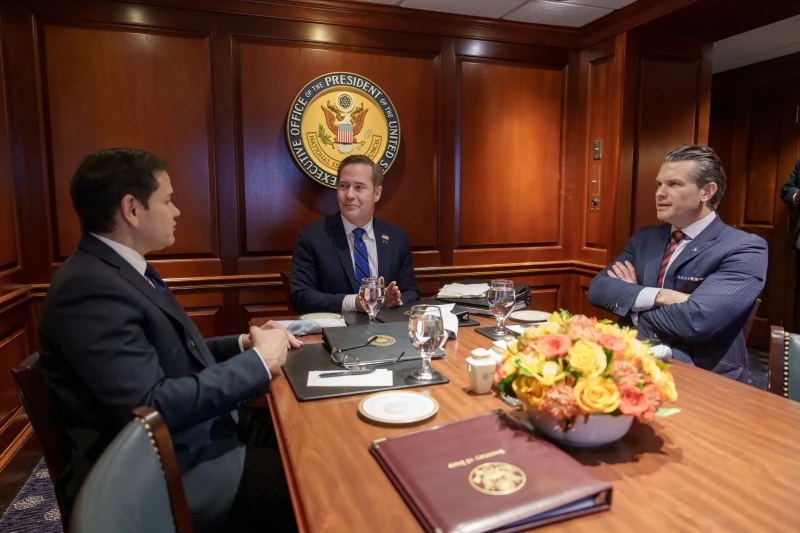
U.S. Secretary of War Pete Hegseth (at right) is shown here during a meeting with U.S. Secretary of State Marco Rubio (at left) and then National Security Advisor Mike Waltz (at center). / Credit: The White House, Public domain, via Wikimedia Commons

CNA Staff, Dec 17, 2025 / 20:05 pm (CNA).

U.S. Secretary of War Pete Hegseth announced that he has issued a directive aimed at reforming the military’s Chaplain Corps, beginning with the elimination of the U.S. Army's current Spiritual Fitness Guide.

In a video post, Hegseth described a “real problem” facing the nation’s military forces: “the weakening of our Chaplain corps” that has “been going on for far too long.”

“In an atmosphere of political correctness and secular humanism, chaplains have been minimized, viewed by many as therapists. instead of ministers,” he said. “Faith and virtue were traded for self help and self care.”

Hegseth said that “chaplains are intended to be the spiritual and moral backbone of our nation's forces,” recalling that at the outset of the American Revolution, General George Washington, in one of his first acts as commander of the Continental Army, established the Chaplain Corps because he saw the need for “the blessing and protection of heaven…especially in times of public distress and danger.”

“For about 200 years, the Chaplain Corps continued its role as the spiritual leader of our service members. serving our men and women in times of hardship, and ministering to their souls,” he said.

In what he described as an “ongoing war on warriors” in recent years, Hegseth said the role of chaplains “has been degraded.”

He cited the current Army Spiritual Fitness Guide, which he says mentions God only once and has “zero” references to virtue, relying instead “on New Age notions, saying that the soldier’s spirit consists of consciousness, creativity, and connection.”

According to the guide, Hegseth said, about “82% of the military are religious, yet, ironically, [the guide] alienates our war fighters of faith by pushing secular humanism. In short, it's unacceptable and unserious. So we're tossing it.”

“Our chaplains are chaplains, not emotional support officers,” he said.

According to Hegseth, the reforms will be “a top down cultural shift, putting spiritual well-being on the same footing as mental and physical health.”

He said initial reforms will result in the removal of training materials that “have no place in the War Department” as well as the streamlining of religious affiliation coding practices, with more changes in the coming weeks and months.

“We're going to restore the esteemed position of chaplains as moral anchors for our fighting force,” said Hegseth. Quoting the 1956 army chaplain's manual, Hegseth said: “‘The chaplain is the pastor and the shepherd of the souls entrusted to his care.’”

“This is a high and sacred calling,” he continued, “but this only works if our shepherds are actually given the freedom to boldly guide and care for their flock.”

Original Source:

https://www.catholicnewsagency.com/news/268543/pentagon-chief-announces-reforms-to-us-military-s-chaplain-corps