(RNS) — If you blinked, you missed it. There are many amazing moments in the new film “Nuremberg,” starring Russell Crowe as Hermann Göring, who served as second-in-command to Hitler, and Rami Malek as United States Army psychiatrist Douglas Kelley. But I am referring to a moment so quick and so incidental that it would go over the heads of most of the film’s viewers.
It might be one of the most important Jewish moments in recent cinema.
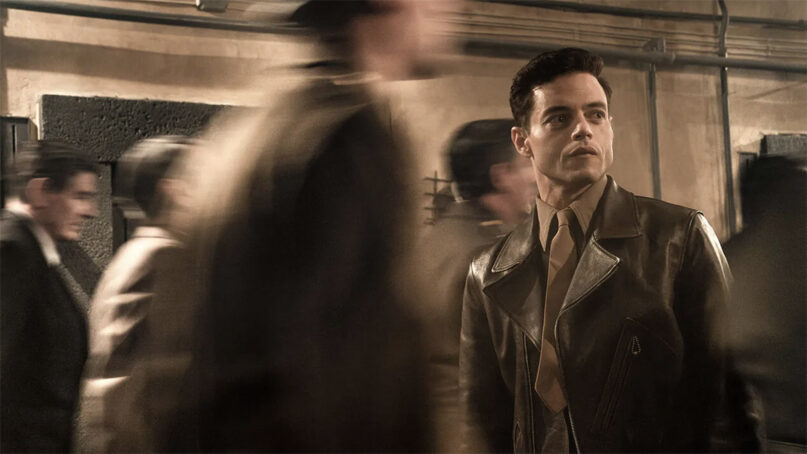
“Nuremberg” tells the story of the famous Nuremberg trials of Nazi officials through the eyes of Major Kelley, the psychiatrist assigned to evaluate Göring’s mental fitness. Kelley brings information back to the prosecutors to help with their case.
Malek is taut, haunted and intense. He can see into the human psyche, but he cannot escape what he finds there.
Crowe’s Göring is mesmerizing — brilliant, manipulative, self-justifying and terrifying in his charm. The film humanizes him, showing him in all his complexity, and some viewers will find that offensive. The movie becomes a psychological chess match, with Kelley trying to understand what makes evil tick, and Göring trying to seduce him into believing that evil does not exist or that it is relative or that it is always subject to the temptation of whataboutism.
But the moment that lingers for me does not involve Göring, but Julius Streicher, the publisher of Der Stürmer, the Nazi propaganda newspaper. He was the Nazi regime’s chief pornographer of antisemitism. He did not merely hate Jews; he made Jew-hatred into an art form of unprecedented vulgarity. He provided the literature and the visual images for the hate machine.
Streicher’s hands did not shed blood, nor did they pull the levers at the gas chambers. But, in moral terms, he might have been the guiltiest of all.
On Oct. 16, 1946, Streicher ascended the gallows. He had refused to get dressed for his execution. His jailers could have dragged him to the gallows in his underwear — a humiliation he surely deserved, especially when you consider that the Nazi victims were killed in various stages of undress.
But Kelley insists Streicher be dressed. He said that we cannot negotiate away, nor negate, even the dignity of a monster. To deny him that dignity would be to surrender our own.
As the executioner placed the noose around Streicher’s neck, the Nazi leader cried out: “Purimfest 1946!”
What was going on there? We are in the middle of Hanukkah now, but that moment in the film pushes us ahead into early spring.

Streicher knew about Judaism. His knowledge became his tool of contempt. He was invoking the Jewish holiday of Purim. He referred to the end of the biblical Book of Esther. After the collapse of Haman’s genocidal scheme, he is hanged along with his 10 sons. There is a tradition that the names of Haman’s sons are chanted in one breath because they are not worth more oxygen than that.
The end of the Book of Esther has always been controversial. As history, it does not cut it. Morally, as well, it has its problems because it portrays the Jews of Shushan, Persia, as vengeful in their self-defense against their enemies.
Streicher knew this. On the day after Kristallnacht (Nov. 10, 1938), Streicher gave a speech to more than 100,000 people in Nuremberg. In that speech, he justified the violence against the Jews. Why? The Book of Esther claimed Jews murdered 75,000 Persians in one night.
This, of course, was fiction. But this artist of hatred used it as justification for the murder of Jews.
Streicher knew that 10 Nazi officials were to have been hanged at Nuremberg. And so, in his final breath, he cast himself and the other condemned Nazis as Haman’s sons — victims, in his fevered mind, of Jewish vengeance.
It is a cunning literary analogy. But it does not quite hold up.
The Nuremberg trial took place, deliberately, in the city in which the Nazi racial laws against the Jews were promulgated. Purim was about an attempted genocide against the Jews of Persia. By contrast, the purpose of the Nuremberg trials was that these were crimes against humanity — not solely against the Jewish people.
I write this in the shadow of the horrific attack on Jews at Bondi Beach in Sydney at the beginning of this festival of Hanukkah.

Here is the connection. Streicher’s shriek — “Purimfest!” — reminds us that there will always be people who will try to weaponize the Jewish story and to mock Jewish history.
And yet, even in doing that, he unintentionally affirmed something more powerful: Jewish memory has staying power. Our narratives endure. Our holidays — even and especially the raucous, topsy-turvy ones like Purim — still throb with moral meaning.
This is where the contemporary resonance emerges, almost too clearly. The descendants of Streicher live on Facebook and other social media platforms. Online anti-Jewish hatred has exploded. The internet is Der Stürmer. These miscreants have nothing better to do than to scour the internet for any mention of Jews. Many are bots; others are real. Holocaust denial is back. (Did it ever go away?)
There is also Oct. 7, 2023, denial, and now accusations that the Mossad perpetrated the attack on Bondi Beach. There are also disgusting, often obscene caricatures of Jews online. Artificial intelligence makes it all that much easier.
When I see the anti-Israel and antisemitic jeers on city streets; when I hear reports of screams of “f— the Jews” at subway stations; when there is alleged arson at a Hillel building in San Francisco; when no day passes without a report of an antisemitic incident, many of them aimed at Orthodox Jews — the most visible of us — welcome to Berlin, circa 1936. When I see the obscenity of antisemitism online, I sense that Streicher would feel right at home and that he would be proud.
Streicher spat “Purimfest” as a curse. We receive it as a reminder that the story he tried to steal still belongs to us.
And, especially this week, Hanukkah still belongs to us.
It’s not just the sweet truism of bringing light into darkness, but about being modern Maccabees. It is about standing — up as Jews, out as Jews despite the risks, for Judaism and with fellow Jews and allies.
Fellow Jews, how will you stand during these wretched times? And to my gentile readers, how will you stand with us?
Original Source:
https://religionnews.com/2025/12/19/the-most-frightening-moment-in-nuremberg/