(RNS) — Since the assassination of Turning Point USA founder Charlie Kirk, there has been a debate about who might be his heir. Many have identified a few individuals who might be the next organizer of evangelicals or culture war field general, not to mention a Trump confidant who can shape policy.
Another religion-focused inheritance question hasn’t been asked: What is the future of the Seven Mountains Mandate, the Christian nationalism strategy of which Kirk was the millennial face?
The Seven Mountains Mandate calls for Christians to take back seven areas of our culture, recapturing institutions such as education, business and entertainment, among others. My recent book about Kirk and the mandate explores how in the last five years, he expanded Turning Point into each mountain — from creating a media arm called Frontlines to door-knocking through Turning Point Action. The organization has gone far beyond its student roots and is indispensable for the mandate movement.
Kirk became the heir of the mandate, started by two college ministry leaders in 1975, after those who passed it down to him started aging, although they still sustain large followings. They include now-retired megachurch pastor Rob McCoy, who first introduced the mandate to Kirk, and Ché Ahn, the global apostolic network founder now running for governor of California.
Before Kirk was killed in September, the mandate was expanding in the United States. The religion scholar Paul Djupe discovered in a 2023 survey that 20% of American adults and 30% of American Christian adults sampled believed in the mandate. By January 2024, that figure for Christians grew to 41%, according to his research.
The mandate is not merely an American phenomenon. Dominion theology is spread by U.S.-based Christian media to nations around the world. African and Latin American megachurches in particular have been at the forefront of practicing it. Anywhere charismatic teachings and Pentecostalism have spread, the mandate has not been too far behind. South Korea’s growing network of megachurches is also a good example. It is no coincidence that McCoy and Kirk traveled to that country a week before the latter was killed.
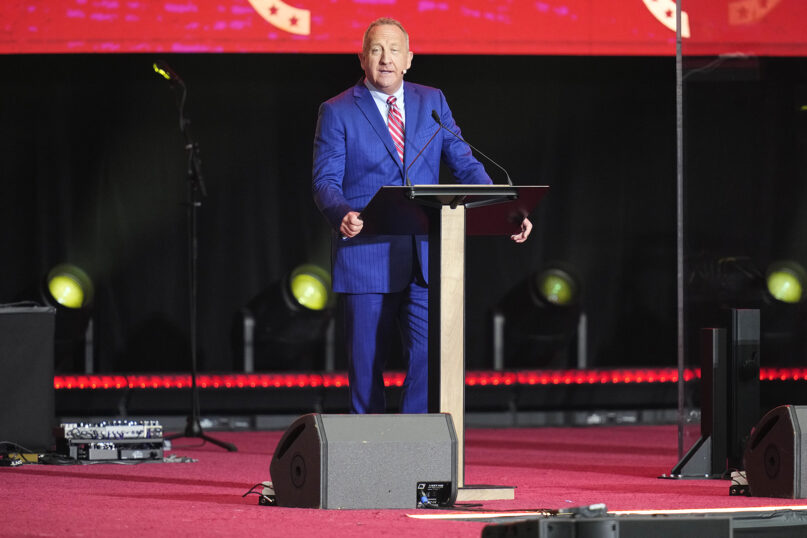
In the U.S., Turning Point remains the center of the mandate’s rise. While it is not the only organization that espouses the mandate, it certainly is the most impactful because it is the only group that aims to affect all seven areas of culture at the same time — a dream of one of the forefathers, Peter Wagner, who helped push the mandate into a more aggressive spiritual warfare stance in the 2000s.
Because of the power of Turning Point, any answer to the question of the mandate’s future must also include the future of the organization Kirk founded in a garage in 2012, after he graduated from high school. It has certainly grown since Kirk’s death. Its leaders have reported a doubling in the number of chapters. And several GOP governors have announced partnerships with Turning Point to have chapters in every high school in their state.
If one considers the memorials, honors, appreciations and other actions directed at Kirk since his death through the lens of the mandate, one sees examples across the seven areas. Churches created AI Kirk. Sports stars attended his funeral. Local governments are renaming roads. There is Kirk artwork, and a Kirk commemorative gun.
Since his death, Turning Point has leaned into the culture war even more, framing its assassinated founder as a martyr for Christianity. It has repeated the mantra of faith, family and freedom, which while only three words, encompass many of the seven cultural institutions.
Turning Point’s mission statement has changed over the years as it has expanded into Christian nationalism. This new version is trying to introduce the organization to millions who are just now coming to know of its existence due to Kirk’s death. At this moment when so many new people are embracing Turning Point, and by association, its embrace of the mandate, the organization has morphed the mandate like someone using a muted color to attract as many buyers as possible to a “flipped house.”

It’s important to note that Turning Point has never directly identified itself with the mandate. The mandate comes with much baggage to evangelicals, let alone secular Americans. This lesson will undoubtedly be heeded by others who embrace the mandate. As scholars have written more and more on Christian nationalism, its advocates have tried to play down its extreme goals. The same will continue to happen with the mandate.
Yet the mandate itself is not an organization. Its history shows a variety of people who debated its scope and purpose. As many have pointed out, the metaphor of the mountains didn’t come to be until the turn of the millennium. And even then it took a few years for that to become the singular focus.
In 2023, evangelical preacher Lance Wallnau introduced an eighth mountain, one he says now is actually the most important or “first” mountain to conquer — the mountain of me. “Before the seven that shape culture, I now talk about how each of us has a mountain within ourselves to conquer,” his website says.
This could be seen as another marketing pitch by the man whose mandate merchandise is central to his ministry. But seen in the context of Kirk’s death and increased attention on the mandate’s extremism, it may be better to read it as a way to return to an emphasis on the individual — not the nation that has dominated the mandate since Wallnau popularized the mountains.
Or perhaps, leave the nationalism to Turning Point as the heir.
(Matthew Boedy is a professor at the University of North Georgia who has been writing about Turning Point USA for several years. His new book on the organization is published by Westminster John Knox Press. The views expressed in this commentary do not necessarily reflect those of Religion News Service.)
Original Source:
https://religionnews.com/2025/12/19/who-inherits-the-seven-mountains-mandate-after-charlie-kirk/