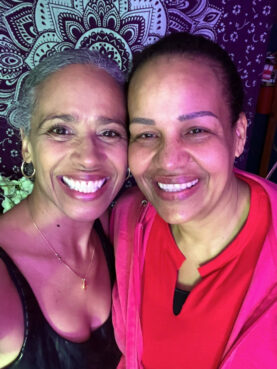
(RNS) — At the New York City yoga studios she frequented in the 2010s, Rosana Rodriguez sometimes found herself the only Latina in the room. “I felt really intimidated,” said the 58-year-old native New Yorker. Predominantly white studios and expensive monthly fees gave her and others in her community the impression that wellness spaces “weren’t for them.”
But the practice of yoga itself, Rodriguez said, saved her life. It was a consistent stress-reduction technique after an abusive relationship and losing her job.
During yoga nidra — or guided meditation in the Savasana posture, often at the end of class — Rodriguez caught herself translating what her teacher said into Spanish, sparking a “revelation.” “I wanted to bring this level of healing to my community,” she said.
Rodriguez soon founded Yogiando NYC, the first Spanish-English bilingual studio in the Washington Heights neighborhood of Manhattan, which has a majority Hispanic population. Offering weekly $10 yin yoga classes at Yogiando, which is a made-up word to mean “doing yoga,” since 2017, Rodriguez said the space became a hub of solace where Spanish-speakers could share their anxieties about anything from immigration to family to their jobs with one another.
“One of the things that I have prided myself in creating for this community is a safe space,” she said. “The closing meditation is that I’m saying to them, ‘You are held and protected.’ I’m teaching them how to be aware, how to listen to their body, how to breathe. Many of these women have told me, ‘I do these breathing exercises every day, and they’ve helped me.’ They’ve told me how yoga has changed their life.”
As Yogiando NYC has done, increasing language accessibility in spiritual wellness spaces across the country has opened up meditation and yoga to more diverse American populations. For Spanish-speaking practitioners like Rodriguez, offering these kinds of classes is crucial to the spiritual-wellness movement in being able to respond to growing mental health concerns as anti-immigrant sentiments and federal actions surge in a country where Spanish is the second-most-spoken language.
Xiomara Arauz, originally from Panama, teaches meditation and yoga in Spanish in Denver through the Art of Living, a global humanitarian organization founded by Indian guru Sri Sri Ravi Shankar. Arauz and a handful of other instructors across the country have also taught online and in-person Spanish instruction of the Sudarshan Kriya, or SKY breathing technique, to hundreds since the COVID-19 pandemic.
“Our community is definitely experiencing heightened levels of stress, insecurity, uncertainty, anxiety and fear,” Arauz told RNS. “If the class is in Spanish and everybody speaks Spanish, people feel more safe being in that environment, feeling like they’re understood or they’re accepted here. They feel a lot better when they leave through the doors of the yoga studio than when they came in.”
Particularly in meditative practices, Arauz said, it is “a different kind of comfort” to practice in one’s native tongue, as the work “is more internal, more subtle.” And her “warm and friendly” personality is able to “come alive” as an instructor in Spanish.
“There is a nuance that I think makes a difference when you are going into these deeper states of relaxation and your conscious mind is not trying to translate,” she said. “There is no resistance in the mind to be doing something else other than absorbing it. They’re able to relax a lot more, be more there, be more present.”
Diana Winston, a mindfulness teacher and director of UCLA Mindful — an education and research center that provides science-backed mindfulness instruction to schools, hospitals and corporate offices — said the center’s Mindful App offers instruction in 19 languages, including a separate Spanish-only feature for California’s large non-English-speaking population. She said the organization is committed to “radical accessibility” to remove language, economic and religious barriers from mindfulness practices.
“It’s a very scary time for a lot of people in this country,” she said. “I’m very worried about the most vulnerable populations, for people who are in some ways being targeted. And I feel like anything that can help support their mental health and well-being, since that’s what mindfulness really does, that would be a fantastic thing to be able to offer.
“And my secret wish,” she added, “the people who could really use mindfulness, who are making these horrible decisions, might transform themselves, too. What if somebody moved from a place of being stuck in seeing people as other, and hatred and violence, and began to meditate and had more compassion in their heart? That would be incredible.”
Still, barriers exist to getting Spanish speakers to the studios, sometimes based on an idea that yoga and meditation conflict with their Christian faith, practitioners said. Though the last few decades have seen a seismic growth of these Indian practices in secular contexts, often far removed from their Hindu and Buddhist religious roots, some still feel reluctant, said Rodriguez, who refrains from using Sanskrit terms, or the meditative sound “Om,” in her classes.
Marisol Alvarez, a 60-year-old student at Yogiando from Santo Domingo, Dominican Republic, said she has been told that she shouldn’t be doing yoga, despite the physical, mental and even spiritual benefits she found in the practice.
“They said, ‘The priests don’t want you to practice, it’s not of God,'” she told RNS in Spanish. “But I’m healing. God wants me to heal. It’s very big how [yoga] has helped me with my faith, connecting with the universe, with the divine higher power.”
Alvarez has brought her daughter, her mother and people she meets on the street into yoga classes. And the studio’s community of women — who have now traveled and shared their dreams with each other — is “filled with so much love,” she said.
“There are times that I’ve arrived at the class feeling like I couldn’t breathe,” she said. “But I breathed.”
Original Source: