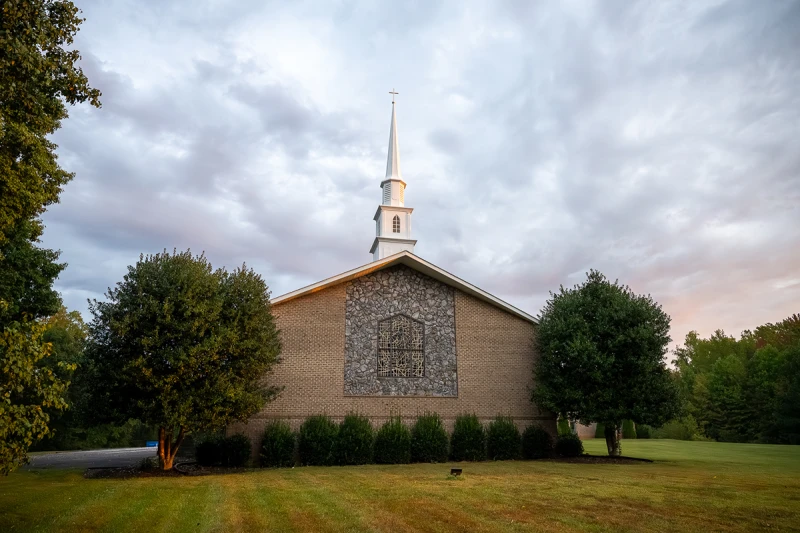
 After delaying restrictions on the Traditional Latin Mass for three months, Bishop Michael Martin said in a Sept. 26, 2025, letter that the Chapel of the Little Flower in the St. Therese Parish in Mooresville, North Carolina, which was recently renovated by the diocese and can seat just over 350 people, will have two Masses each Sunday and on holy days of obligation, / Credit: Diocese of Charlotte
CNA Staff, Dec 23, 2025 / 16:55 pm (CNA).
Priests as well as the lay faithful are voicing criticisms after Bishop Michael Martin of the Diocese of Charlotte, North Carolina, issued a pastoral letter last week prohibiting the use of altar rails and kneelers in the reception of Communion in the diocese.
In the Dec. 17 letter, Martin said that by Jan. 16, 2026, the use of altar rails, kneelers, and prie-dieus (movable kneelers) will no longer be permitted in the diocese, and any “temporary or movable fixtures used for kneeling for the reception of Communion” must be removed.
In the letter, Martin said while an “individual member of the faithful” is free to kneel to receive and should not be denied Communion, the “normative posture for all the faithful in the United States is standing,” per guidelines from the U.S. bishops.
In May, a leaked draft of a letter detailed Martin’s intended reforms of traditional practices in the diocese. In the letter, the bishop said that because “there is no mention in the conciliar documents, the reform of the liturgy, or current liturgical documents concerning the use of altar rails or kneelers for the distribution of holy Communion, they are not to be employed in the Diocese of Charlotte.”
Also in the May letter, Martin said it was “simply absurd” to suggest that “kneeling is more reverent than standing.”
Martin said in his Dec.17 letter that it is his “intention to continue to facilitate ‘peace and unity’ in our liturgies.”
A Charlotte priest who spoke to CNA on the condition of anonymity said of Martin’s “heavy-handed” approach to reform: “Everybody’s had it.”
“If the priests of the diocese were asked for a vote of no confidence, a vast majority would vote that way,” he said.
“Unfortunately, Bishop Martin’s style of leadership has been a source of division for the diocese since his arrival and there does not seem to be any course correction after many appeals. It has been painful for many across the diocese,” he continued.
“Why is kneeling a problem? Why go to such lengths to force these changes?” he asked. Receiving communion is “the most intimate moment of the week for people, who are receiving their God. Why go through all this bad PR? I don’t understand it.”
“It’s going to be a train wreck,” he continued, speaking of the continued opposition to the bishop’s reforms.
He told CNA he is hopeful the matter will be addressed at the upcoming consistory of cardinals in Rome.
A letter by an anonymous canon lawyer also began circulating last week throughout the Charlotte Diocese in response to Martin’s Dec. 17 letter.
In the anonymous letter, Martin is accused of ignoring the role of synodality in his decision-making. He is also accused of ignoring the feedback of his presbyteral council.
Writing to Martin, the letter-writer told him that the “decision to prohibit altar rails and aids to kneeling relies on your own preference rather than the law or the tradition of the Church.”
Matthew Hazell, a British liturgy scholar, told the National Catholic Register, CNA’s sister news partner, in May that Martin’s perspective was consistent with what Pope Benedict XVI famously described as a “hermeneutic of discontinuity and rupture.”
“Rather than allow the novus ordo to be celebrated in a manner in keeping with its own rubrics and with the Church’s tradition, Bishop Martin seems to see it as an entirely new creation that cannot even be seen to have anything in common with what came before,” Hazell told the Register.
Parishes that kneel reportedly provide lion’s share of vocations
According to Brian Williams, an advocate for Charlotte’s Traditional Latin Mass community, of the diocese’s 44 seminarians, “at least 75% are from parishes where kneeling has been the practice to receive holy Communion.”
Williams said his small parish, where kneeling is the norm, has produced seven seminarians recently.
He told CNA that the ”mega parishes that have embraced these liturgical changes” have provided “maybe two of the 44 seminarians even though they account for tens of thousands of families.”
One of the largest Catholic parishes in the country, St. Matthew Catholic Church, does not have altar rails. Willliams said there is “one seminarian from there right now, and not more than six men ordained from there in its entire history.”
“They do a lot of great things, but they’re not providing vocations,” Williams said.
In September, despite a great deal of pushback, Martin canceled the Traditional Latin Mass in all but one small chapel that is not large enough to house the diocese’s burgeoning Latin Mass community.
He initially tried to cancel the Mass several months earlier than the timeline set by his predecessor, Bishop Peter Jugis, but decided in the summer to allow the Mass to continue.
“It falls to every member of the body of Christ to facilitate unity in our celebrations. These norms for our diocese move us together toward the Church’s vision for the fuller and more active participation of the faithful, especially emphasized by our Holy Father, Pope Leo XIV, at the beginning of his Petrine ministry,” Martin wrote in the December letter.
In the May letter, Martin described how priestly vestments with too much lace or decoration would be prohibited in the diocese. That letter also decried the use of Latin in any Masses other than ones in which most of the attendees understand Latin, such as “a specific gathering of scholars, clergy, or those trained in classical music.”
Martin said pastors who incorporate Latin into their Masses are not being “pastorally sensitive,” writing that “the faithful’s full, conscious, and active participation is hindered wherever Latin is employed.”
“Most of our faithful do not understand and will never comprehend the Latin language, especially those on the periphery. It is fallacious to think that if we employ Latin more frequently, the faithful will get used to it and finally understand it,” he claimed.
When Martin concelebrated the Mass with several other bishops this summer at a parish that traditionally kneels at an altar rail to receive, per his direction, Communion was distributed in front of the altar rail to discourage parishioners from kneeling.
Nevertheless, a video showed parishioners kneeling anyway, many of them elderly women who needed assistance standing up after receiving.
The Diocese of Charlotte declined multiple requests for comment.
Original Source: