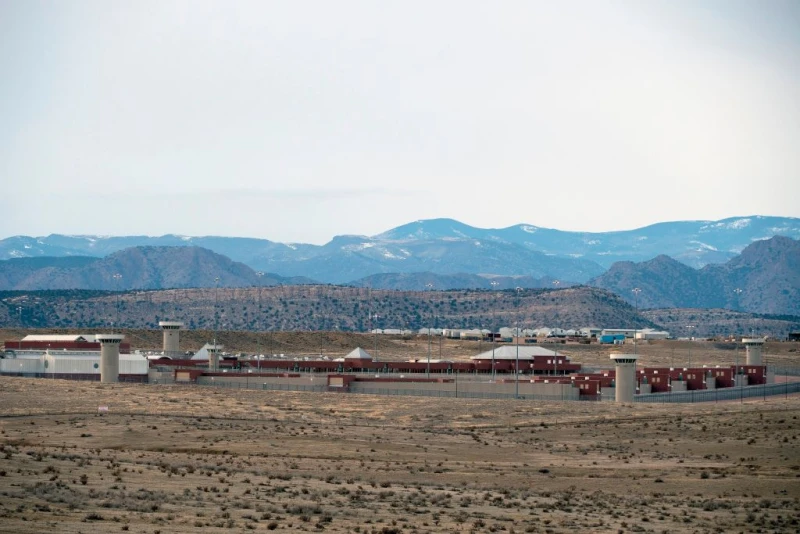
 A view of the United States Penitentiary Administrative Maximum Facility, also known as the ADX or “Supermax” prison in Florence, Colorado. The facility has been dubbed the “Alcatraz of the Rockies” because of its remote location and harsh security measures. / Credit: JASON CONNOLLY/AFP via Getty Images
CNA Staff, Oct 13, 2025 / 06:00 am (CNA).
A foreign-born Muslim inmate currently incarcerated in the U.S.’s most severely restrictive prison complex is asking the government to require the prison to accommodate his religious practices under a key federal statute, highlighting the far-reaching and comprehensive nature of religious freedom rules in the United States.
U.S. District Judge Philip Brimmer in a Sept. 25 ruling agreed that Mostafa Kamel Mostafa had demonstrated that prison officials at the maximum facility had “substantially burdened the exercise of his religion” by failing to install a special cleaner in one of his cells.
The prison, a “supermax” facility in Colorado commonly known as ADX Florence and colloquially as the “Alcatraz of the Rockies,” is famous for its near-total state of lockdown.
Housing some of the most dangerous inmates in the U.S. penitentiary system, it features poured concrete cells in which prisoners are confined for most of the day as well as high-level security protocols that include motion detectors, pressure pads, and pits used for exercise.
Mostafa was sentenced to life in prison in 2015 for his role in a deadly hostage-taking scheme in 1998 and other terrorist activities. He is incarcerated in the “H-unit” of ADX Florence, its most secure wing.
Formerly an imam at a U.K. mosque, Mostafa follows Islamic rules regarding prayer, including a mandate to “make himself clean and presentable before praying.” With both his arms amputated above the elbow, he requires some accommodations to that end, including a bidet in his cell toilet.
Mostafa has had two cells adapted for his disabilities; the prison has installed a bidet in one but not the other. Brimmer in his ruling found that “until [the prison] install[s] a bidet in both of Mr. Mostafa’s cells,” the prisoner has a claim to a burden on his religious exercise.
‘Everybody has access to the fundamentals’
Though the dispute has made its way to U.S. district court, it may be moot before it goes any further, as prison officials have explicitly stated that they are “in the process” of installing a bidet in Mostafa’s second cell.
Yet the case underscores just how extensively the principles of religious liberty have been applied in the United States, up to and including accommodating modifications to the prison cell toilet of a foreign-born terrorist.
Robert Destro, a professor of law at The Catholic University of America’s Columbus School of Law and the former federal assistant secretary of state for democracy, human rights, and labor, said in an interview that religious liberty cases arise regularly within prison populations.
Mostafa brought the case in part under the federal Religious Freedom Restoration Act (RFRA), a Clinton-era law that restricts how and under what conditions the U.S. government can impose burdens upon U.S. religious liberty.
Destro said RFRA is similar in some ways to the Americans with Disabilities Act, a 1990 federal law that requires “reasonable accommodations” in hiring and business practices for disabled people.
“In a way, RFRA is a little like the ADA,” he said. “It wants to make sure that everybody has access to the fundamentals. Just because you’ve been sentenced to prison because you did something bad, or stupid, or both, doesn’t mean that you lose your First Amendment rights.”
The dispute in prison cases, Destro said, is usually “how much the prison should defer to the warden and to prison policies” and to what extent it’s obligated to accommodate a religious belief.
In Mostafa’s case, “it seems like a fairly simple answer,” he said.
“The guy has a disability,” he pointed out. “There’s no question about his faith. [And] there’s no way that somebody with no arms and access to a stream of water is going to, you know, burn down the prison. There’s no tangible security threat.”
The federal government explicitly states that neither the national nor state governments may “impose a substantial burden on the religious exercise of a person residing in or confined to an institution,” barring concerns of a “compelling governmental interest” carried out in the “least restrictive means” possible.
That language is virtually identical to the text of RFRA. Destro said the principle is “a lot less cosmic than it looks.”
“The design of RFRA … was to shift the burden over to the government to say, why is this a big burden for you?” he said. The government only gets a “free pass,” he said, if it can show that an abrogation of religious liberty “has to do with health, safety, or some other very limited security issues.”
Further religious liberty expansions for prisoners could be on the horizon. The Supreme Court earlier this year said it would decide whether prisoners can sue individual prison workers — rather than merely the government itself — over violations of federal religious freedom law.
Destro acknowledged that Mostafa’s fight at ADX Florence would likely be rendered moot by the government’s simply modifying his prison cell as requested. Still, he said, it often makes more sense for a government to quickly acquiesce to a prisoner’s reasonable request rather than fight it.
“If you know you’re going to get sued on RFRA — just like getting sued under the ADA — why don’t you just make the accommodations and save the money on the lawsuit?” he said. “For the amount of money it’s going to cost you to put in a bidet, it’s cheaper than having a lawyer go to court.”
“For the money you’ve spent defending the suit, you could’ve put the thing in and been done with it!” he said with a laugh. “That’s not always the right answer. Sometimes there is a question of principle involved. But I don’t see one here.”
Original Source: