VATICAN CITY (RNS) — As Israel and Hamas signed a ceasefire agreement that observers hope will finally bring peace to the beleaguered region, the Catholic Church is faced with reestablishing weakened trust with the Jewish community.
Despite Pope Leo XIV’s intention to rekindle the somewhat dimmed relationship between the Jewish and Catholic faiths, a recent incident suggests that issues and misunderstandings still remain.
The latest event concerned Leo’s right-hand man, Vatican Secretary of State Cardinal Pietro Parolin, who in an interview with the Vatican newspaper l’Osservatore Romano, published on Oct. 7 to mark the anniversary of Hamas’ attack that began the 2-year-old war, criticized Israel’s retaliation in Gaza, calling it “a massacre.”
While saying the Hamas attack — killing about 1,200 people in Israel and taking 251 hostages — was “inhuman and indefensible,” Parolin said “even legitimate defense must respect the principle of proportionality.” He argued that “it is unacceptable and unjustifiable to reduce human beings to mere ‘collateral damage.’” The cardinal also praised protesters who demonstrated their opposition to the war in Gaza and called for an end to the “chain of hatred,” condemning discrimination against Jews and Palestinians.
Last November, Parolin was criticized for similar comments on the war, and 400 Jewish leaders wrote to then-Pope Francis asking for a clearer condemnation of Hamas.
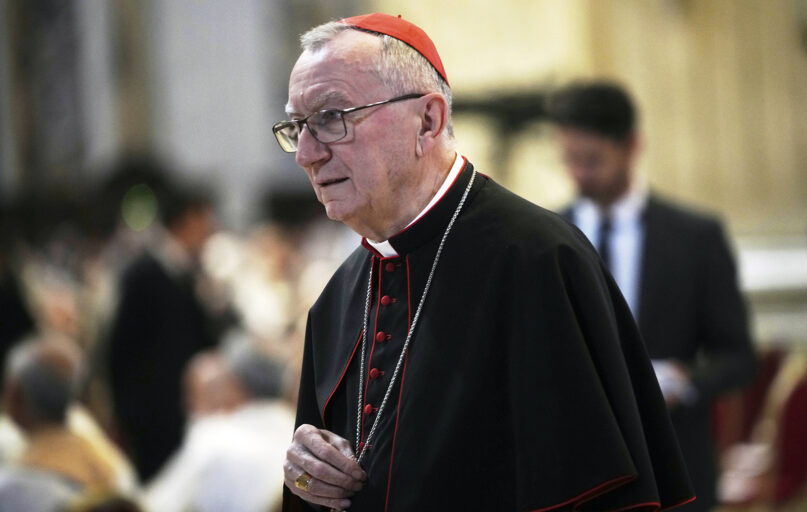
Parolin’s latest words were also met with resistance by Jewish leaders and institutions, including the Israeli Embassy to the Holy See. In a note published by the embassy, Israeli officials criticized Parolin for using the term “massacre” to describe both the Oct. 7, 2023, attack by Hamas and Israeli military action in Gaza.
“There is no moral equivalence between a democratic state that protects its citizens and a terrorist organization intent on killing them,” the note read. “We hope that future statements will reflect this important distinction.”
According to the embassy, the cardinal’s words also “risked undermining efforts to put an end to the war in Gaza and combat growing antisemitism” by focusing its criticism on Israel instead of on Hamas terrorists.
“It is time to enter the post-Gaza War period, during which we should also have conversations on how language choice in statements about Israel has been disturbing from time to time,” said Rabbi Noam Marans, director of interreligious affairs at the American Jewish Committee, a United States-based advocacy group that supports Israel’s right to exist, opposes antisemitism and promotes interreligious dialogue.
Asked by journalists on Wednesday (Oct. 8) about Parolin’s remarks, Pope Leo answered in support of the cardinal. “The Cardinal Parolin expressed the position of the Holy See very well,” he said, but he declined to comment further on the issue.
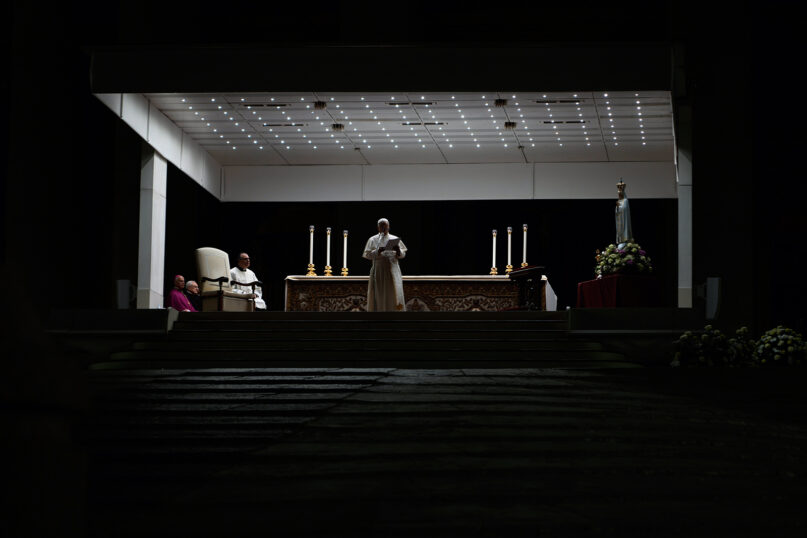
Parolin also clarified that his remarks were intended as “a call for peace” and that he doesn’t “believe there is any moral equivalence between the two situations,” speaking to journalists on Friday. He described the U.S.-sponsored ceasefire agreement as “the most difficult part because the devil is in the details.”
Leo inherited a complicated state of Catholic-Jewish relations from his predecessor Pope Francis. Under Francis’ tenure in 2015, the Holy See established formal relations with Palestine. And in 2024, the Vatican creche, or Nativity scene, showed the baby Jesus wrapped in the traditional Palestinian black and white scarf, the kaffiyeh, and the pope asked whether the international community should investigate whether Israel was committing genocide in Gaza.
Pope Francis split Vatican diplomacy into two channels: the official Holy See offices for foreign relations, led by Parolin and Archbishop Paul Gallagher, and an informal channel that included key prelates and the lay Catholic movement of St. Egidio, focused on social service.
It remains to be seen how Leo will approach this split Holy See diplomacy. From Oct. 26-28, the Vatican will host a major summit organized by St. Egidio called “Daring Peace.” Its attendance will include European rabbis; Sheikh Ahmed al-Tayeb, the grand imam of Al-Azhar; and hundreds of religious representatives from 35 countries. Leo is expected to attend alongside the Italian president, Sergio Mattarella.
In a letter sent to AJC signed the day of his inauguration as pope on May 8, Leo pledged to strengthen dialogue between Jews and Catholics. On the same day, he sent a letter to the chief rabbi of Rome, Riccardo Di Segni, in which he committed himself to continuing and strengthening the dialogue and cooperation of the church with the Jewish people.
Leo said that “the relationship with the Jewish community as such has improved a little” during his fledgling papacy and that there has already been “a small rapprochement,” speaking to Vatican journalist Elise Allen of Crux last month. The pope also said it’s important to “make some distinctions” between the Jewish community and the government of Israel but underlined “the roots of our Christianity are in the Jewish religion.”
“There is much to say, and much to do,” he concluded.
Marans, however, was critical of Leo’s effort to separate the Jewish community from the state of Israel.
“We appreciate the positive spirit that Pope Leo has reinvigorated in Catholic-Jewish relations,” he told Religion News Service in a phone interview. “But now, after the release of the hostages and perhaps the beginning of a peace movement, it’s important to have serious, candid conversations between Jewish and Vatican leadership about the centrality of the state of Israel to Jewish identity in the 21st century.”
Marans pointed to this year’s 60th anniversary of the church document “Nostra Aetate” (In Our Time), which established Catholic-Jewish dialogue and repudiated antisemitism, as an opportunity to address some of the remaining tensions. “There are issues, but we are talking — and that is a transformation of history,” he said.
Original Source: