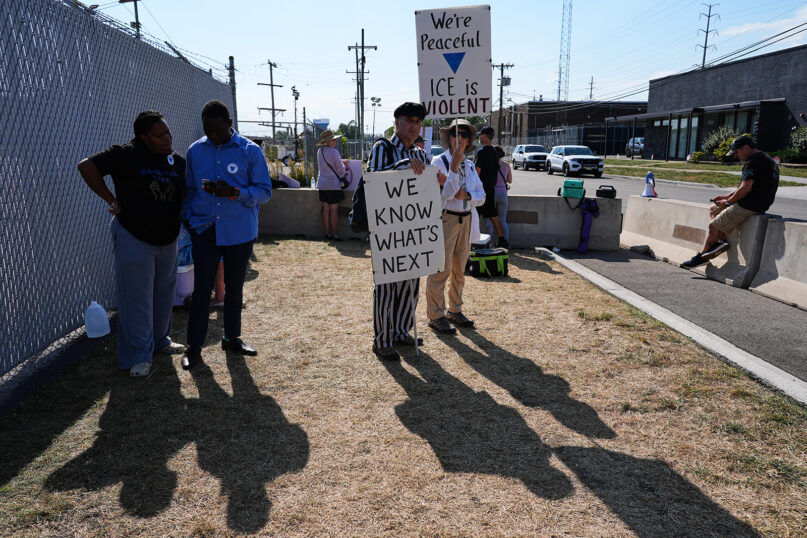
(RNS) — Every Friday for the past 19 years, a group of Catholics has prayed the rosary outside a U.S. Immigration and Customs Enforcement detention facility in Broadview, Illinois, forming a small circle for mutual support and warmth. The rotating band of lay leaders, nuns and priests had largely cordial interactions with ICE agents, participants say: Priests and others were sometimes allowed to climb aboard buses and pray with detainees as they left the site to be deported abroad.
But according to the Rev. Brendan Curran, ICE’s demeanor began to change earlier this year. Then things shifted dramatically roughly two months ago, when masked ICE agents at the facility began violently dispersing protesters, even religious leaders.
“(There’s) a physical need to step away from the space we occupied for almost 19 years for our own safety, the safety around us and the safety of those we accompanied,” said Curran, a Dominican priest and co-founder of Priests for Justice for Immigrants. He said his religious freedom, along with others, has been met with intimidation and “untoward harm” at the hands of federal officials.
Operation Midway Blitz, part of the Trump administration’s broader mass deportation effort, began in early September in Chicago, home to the third-largest archdiocese in the country. Catholics in the city, many of them immigrants, have been particularly impacted by roving ICE agents: Priests have warned parishioners to take caution when leaving worship and led special Masses to mourn a man shot and killed by ICE agents.
Against that backdrop, everyday parishioners and leaders, ranging from Illinois’ Sen. Dick Durbin and Pope Leo XIV himself, have been standing up for immigrants, claiming their faith demands they do so.
Soon after ICE agents began appearing on the streets of Chicago, the Coalition for Spiritual and Public Leadership organized a “people’s Mass” outside the Great Lakes Naval Station, a military base in North Chicago, Illinois, that had been designated a staging location for ICE operations in the region.
“We felt that we need to do something prophetic in the moment to push back against the planned militarization and planned campaign of deportations that was going to unfold in our city and state,” said Michael Okinczyc-Cruz, head of the coalition.
His group organized an even larger event on Saturday (Oct. 11) at St. Eulalia Parish in Maywood, Illinois, west of Chicago’s downtown. About a thousand people packed the church to hear speeches from religious leaders and political figures, including Durbin, a Democrat and a Catholic.
In his speech, Durbin said someone in the crowd had given him a rosary from Lithuania, the country his mother emigrated from in 1911. Immigration, he explained, is a part of his American story — and so is the Catholic faith.
“The reality is this,” said Durbin, “people are living in fear of government policy. Their only hope is for friends and fellow Americans to stand up for them and to stand up for the values that fit this nation.”
He added: “What you bring to this debate is more than I can bring as a politician: You bring prayers, you bring faith, you bring your hearts and souls.”
Durbin had recently declined a lifetime achievement award offered to him by Cardinal Blase Cupich, the archbishop of Chicago, amid backlash from some conservative U.S. bishops frustrated by the senator’s support for abortion rights. Leo, a Chicago native, weighed into the matter after a reporter asked him about the debate, saying a politician’s entire career should be taken into account and that “pro-life” should include support for immigrants.
“Someone who says I’m against abortion but I’m in agreement with the inhuman treatment of immigrants in the United States, I don’t know if that’s pro-life,” Leo said.
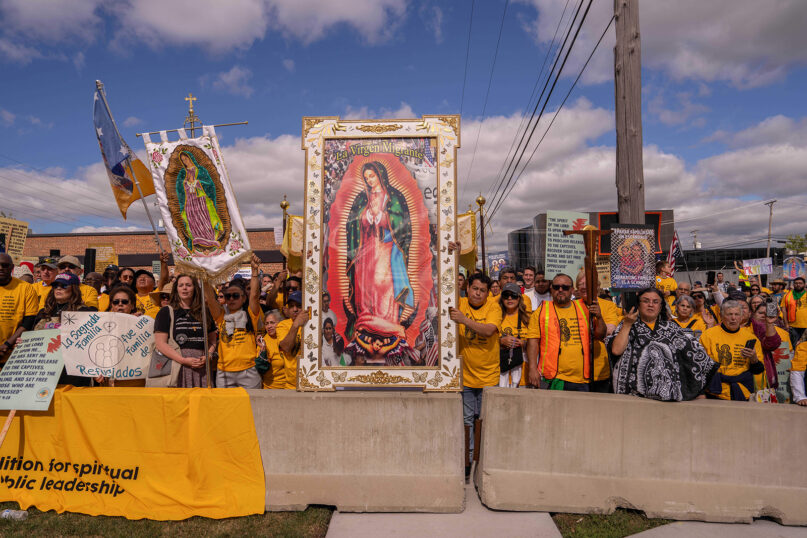
After the event ended, hundreds processed a little over a mile from the church to the Broadview ICE facility while singing, praying and carrying a massive icon of Our Lady of Guadalupe. There, a delegation of three Catholic priests, three nuns and leaders of the Coalition for Spiritual and Public Leadership approached a line of state police standing outside the facility. Holding Communion bread in a large golden monstrance, they asked if they could offer Communion to detainees inside.
“Protesters started screaming, ‘Let them in, let them in,’” recalled Okinczyc-Cruz. “Our choir started singing ‘Pan de Vida’ … a Communion song. The chorus picked up, and it was so loud, so loud and so beautiful.”
A local state police officer relayed the offer via telephone to U.S. Department of Homeland Security officials inside. Seconds later, officials called back: they declined.
Sister Jeremy Midura, a Felician sister who was a member of the delegation, lamented the plight of those detained in the facility. “Now these sisters and brothers who have been seized from their dining room tables have also been denied a presence at the Eucharistic table,” Midura said in an email. “Our brothers and sisters have become ‘The Disappeared.’”
A spokesperson said the archdiocese was “not a partner” for the event, but in a statement on Tuesday Cupich said that “keeping the nation safe and respecting human dignity are not mutually exclusive.” Her referred to tactics used by ICE and other federal agents in Chicago as “unnecessarily aggressive,” and that they “seem to be intended to terrorize and cause chaos.”
Saturday’s Eucharistic procession came a day after a similar Communion vigil outside the Broadview facility led by mainline Protestant clergy who have been protesting there for weeks. They, too, were denied from bringing Communion to detainees, prompting protesters to chant: “We are the body of Christ, the body of Christ is detained. We are the body of Christ, the body of Christ will be free.”
Locals say concern about detentions or harassment at the hands of masked ICE agents has become a constant among immigrants in the city. According to NBC Chicago, a priest was finishing morning Mass at St. Jerome Catholic Church over the weekend when word reached him that ICE agents were active near the church. The priest, speaking in Spanish, urged parishioners to take caution as they leave. Soon after, locals rushed down to the church and formed a human chain, helping guide parishioners home.
“I can tell you stories you would actually make your heart break — of people being plucked off the street, coming out of daily Mass and being stopped and blocked in by two ICE vehicles and demanded to show their papers,” said Curran.
Among the more somber moments Curran has experienced in recent weeks was helping lead a Mass for Silverio Villegas-Gonzalez, who was shot and killed as ICE agents tried to arrest him shortly after the 38-year-old dropped off his children at school and day care. DHS has alleged that Villegas-Gonzalez “dragged” an ICE agent “a significant distance” as he tried to flee in his car and that an officer opened fire out of fear “for his own life and broader public safety.” Local authorities and activists have disputed this characterization, saying that footage of the incident paints a different picture.
“It’s sad and tragic to witness this unbelievable manipulation of story and actual data to suit the agenda of certain folks on border policy,” Curran said. “It was a very hostile situation, and to go and accuse this guy — that he was threatening to kill ICE agents — could be no further from the truth.”
In a temporary restraining order issued last week, a federal judge, citing Curran and the prayer circle at the Broadview ICE facility, ruled that DHS likely infringed on the religious liberty of faith-based demonstrators. The order bars violent actions against journalists and demonstrators outside of extreme circumstances and requires federal agents to wear personal identification.
The judge was also responding in part to a DHS officer shooting a Presbyterian minister, the Rev. David Black, in the head with a pepper balls. The Rev. Abby Holcombe, a United Methodist pastor who was part of the Protestant demonstration at Broadview, said she has been struck with rubber bullets while protesting at the facility over the past few weeks.
Holcombe said she has been moved by the recent surge in support from religious leaders of all faiths. While her group and the Catholic demonstrators were initially unaware they were organizing similar actions, Holcombe said, she celebrated the shared concern for immigrants. “I do hear a lot of people saying: This is the moment. If you’re going to put yourself in harm’s way, this is it,” Holcombe said, referring to faith leaders. “People are going to ask where the clergy were, and you need to be able to say you were where Jesus would be.”
Curran agreed. “As a person of faith, as a leader of faith, to not speak of it is simply unethical — and sinful,” he said.
Original Source:
https://religionnews.com/2025/10/14/as-ice-rocks-chicago-catholics-respond-with-prayer-and-protest/