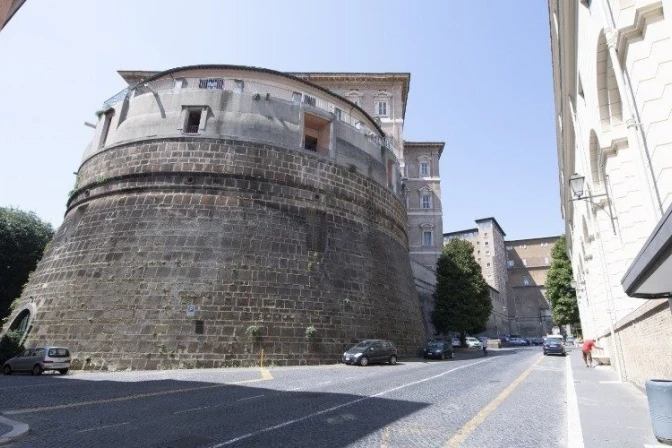
 The Institute for Works of Religion (IOR), popularly known as the Vatican Bank. / Credit: Vatican Media
Vatican City, Oct 15, 2025 / 07:00 am (CNA).
Last week, Pope Leo XIV introduced a significant reform to the financial architecture of the Holy See.
With the motu proprio Coniuncta Cura, (“Shared Responsibility”) the Holy Father revoked the exclusive right that the Institute for Works of Religion (IOR by its Italian acronym) — popularly known as the “Vatican Bank” — had until then for investment management, opening the door to the use of other foreign financial intermediaries if deemed more efficient or appropriate.
The new regulations do not seek to remove investments from the Vatican purview but rather to open the possibility of management to accredited financial intermediaries.
“If there is a sum to be invested, it was previously done only through the IOR; but now it can also be done through the APSA [Administration of the Patrimony of the Apostolic See]. This does not mean that investments will be made outside [of the Vatican] but rather that external financial organizations can step in to assist the Vatican,” Mimmo Muolo, an expert on Holy See finances and a journalist for the Italian Bishops’ Conference’s newspaper, Avvenire, told ACI Prensa, CNA’s Spanish-language news partner.
Pope Leo XIV — who has practical experience in financial management as superior of the Order of St. Augustine — “wanted to apply the economic principle of diversification in the Vatican,” Muolo noted.
Reactivating the Vatican’s other economic-financial lung
This decision effectively means “reactivating the Vatican’s other economic-financial lung,” he explained. The APSA, in fact, is the body responsible for managing the Vatican’s real estate assets, which total some 2,400 apartments, most of them located in Rome and Castel Gandolfo. In addition, there are another 600 units rented to businesses or used as offices.
The expert explained that, in reality, the IOR — a small financial institution with just over 100 employees — “is not a bank” but rather “a large investment fund that has made it possible to channel financial resources.”
“The true Vatican bank is APSA, the Administration of the Patrimony of the Apostolic See, which manages both the real estate assets — the Vatican apartments and palaces — and the securities, shares, and financial resources,” he pointed out.
The core of the reform, Muolo pointed out, is pragmatic: ensuring the economic sustainability of the Holy See, whose operation requires a significant staffing structure.
“You have to keep in mind,” he explained, “that between the Holy See and the Vatican City State, which are legally distinct but connected, there are about 5,000 employees.”
“Just guaranteeing the monthly salary of those 5,000 workers requires quite a large amount of resources. This amount also comes from the profits from the investments that have been made to date,” he noted.
Reorganizing to improve performance
Muolo interprets the pope’s decision as an attempt to reorganize management and is based on the “determination to maximize and improve performance.”
“Previously, there was a monopoly regime, with the IOR as the sole actor doing everything. Now, however, the stimulus will also come from the outside because instead of being carried away by inertia, new avenues, new partners, and new solutions will be sought,” he explained.
The expert believes this decision by Pope Leo will stimulate “a certain internal competition between APSA and the IOR to find the best solutions and increase revenue.”
The measure, which repeals the Rescriptum ex Audientia promulgated by Pope Francis in August 2022, represents a change of direction in Vatican financial policy.
The Argentine pontiff had centralized all fund and asset management in the IOR and APSA, forcing the Curia institutions to transfer their resources to accounts managed by these bodies: “We know well that the internal needs for the functioning of the Holy See have increased but resources have not. Moreover, during the COVID years, there was also a major crisis in revenues.”
“That’s why I believe Pope Leo is moving in this direction: seeking new vehicles, new financial operators who can, while always respecting the Holy See’s rules on ethical investments, increase revenues,” he added.
No scandal in reversing Pope Francis’ reform
Finally, Muolo emphasized the realistic and evolving nature of the reform, which he considers a reasonable correction of the framework established by Francis: “Not all reforms that are implemented necessarily produce the expected results,” he said.
“If a reform doesn’t work, it’s good to change it. And I think Pope Leo did not act solely out of his own personal will. He probably received reports, saw accounting records, consulted with experts in the field, and deemed it appropriate to slightly correct the course set by Pope Francis. I don’t see anything scandalous in this: It’s normal that over time, reforms are made to reforms,” he noted.
This story was first published by ACI Prensa, CNA’s Spanish-language news partner. It has been translated and adapted by CNA.
Original Source: