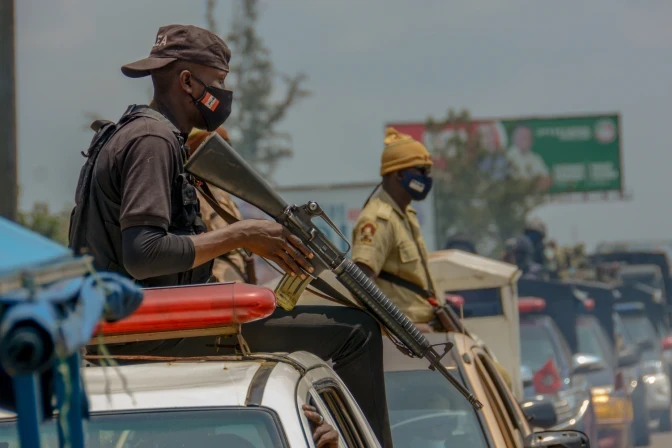
 Nigerian security officers during a military operation ahead of the gubernatorial elections in Benin City, Edo, Nigeria, on Sept. 17, 2020. / Credit: Oluwafemi Dawodu/Shutterstock
Washington, D.C. Newsroom, Oct 16, 2025 / 13:18 pm (CNA).
Christian leaders delivered a letter to President Donald Trump on Oct. 15 urging him to redesignate Nigeria as a country of particular concern on the U.S. government’s international religious freedom watch list.
“We fervently urge you to redesignate Nigeria as a ‘country of particular concern’ (CPC) under the International Religious Freedom [IRF] Act, as you did in your first term,” the letter states. “The last several years have seen a burgeoning of violent attacks specifically targeting rural Christians in the country’s Middle Belt, while the government in Abuja barely lifts a finger to protect them.”
The letter’s signatories included San Francisco Archbishop Salvatore Cordileone; Nina Shea, Hudson Institute senior fellow and director for the Center for Religious Freedom; Kelsey Reinhardt, CatholicVote president and CEO; Robert Royal, editor-in-chief of The Catholic Thing; and Luke Moon, executive director of the Philos Project.
“The Nigerian government is directly violating religious freedom by enforcing Islamic blasphemy laws that carry the death penalty and harsh prison sentences against citizens of various religions,” the letter continued. “It also demonstrably tolerates relentless aggression uniquely against Christian farming families by militant Fulani Muslim herders, who appear intent on forcibly Islamizing the Middle Belt.”
In a statement to CNA on Monday, Shea said the Nigerian government “refuses to enforce the law against Fulani militants who are relentlessly and systematically invading rural Christian areas in the Middle Belt and massacring and driving out the civilians while crying the jihadi war cry “Allahu Akbar.”
“Many Middle Belt Christian leaders are reporting that this is a concerted land grab from Christian communities in order to forcibly Islamicize Nigeria,” she added. The letter describes the Fulani herdsmen as “the biggest threat facing Nigeria’s Christians.”
The letter called attention to “innocent Muslims and Christians alike” who have been “brutally victimized by Boko Haram and other Islamic State and al-Qaeda-linked terror groups seeking religious and political domination within that country.”
Citing research from various groups, the letter noted that 52,000 Christians have been killed and over 20,000 churches attacked and destroyed since 2009. In addition, it said, thousands of Christians have been murdered and raped in 2025, and “over 100 Christian pastors and Catholic priests have been taken hostage for ransom.”
“We are concerned that your administration may be considering listing Nigeria on the IRF Act’s ‘Special Watch List’ instead of designating it as a CPC,” the letter said, noting the decision, likely influenced by the “misconception” that a CPC designation requires the U.S. to sanction Nigeria, would be a mistake.
“In fact, the IRF Act does not mandate automatic sanctions and, moreover, provides for a sanctions waiver and cites a range of other possible policy responses,” it stated.
“We believe that, after nearly five years of simply ‘watching’ the arrest of individuals on harsh blasphemy charges and the relentless massacre and persecution of defenseless Christians solely for their faith, assigning only Special Watch List status would be a weak and legally inadequate response,” the letter concluded. “Such a move would dishonor religious freedom as a core pillar of U.S. foreign policy and further reinforce the previous administration’s downgrade and sidelining of the targeted killing of Christians.”
In November 2021, the Biden administration, through then-Secretary of State Antony Blinken, removed Nigeria from the list of countries of particular concern.
Original Source: