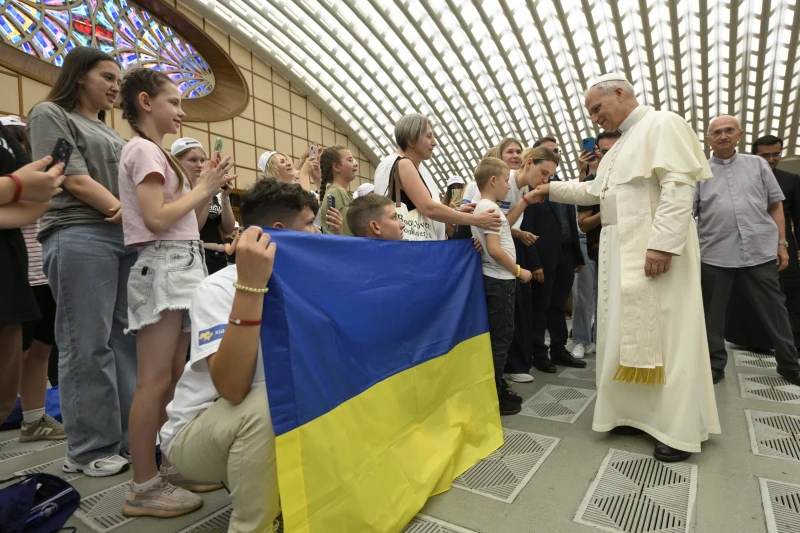
 Pope Leo XIV meets with Ukrainian children who were welcomed by Caritas Italy during the summer on July 3, 2025, at the Vatican. / Credit: Vatican Media
CNA Staff, Nov 26, 2025 / 06:00 am (CNA).
On Friday at the Vatican, Pope Leo XIV met with U.S. Sen. Amy Klobuchar, D-Minnesota, and a delegation of Ukrainian mothers, wives, and teenagers forcibly taken to Russia during the war. The group discussed the ongoing efforts being made to secure the return of civilians to Ukraine, particularly children.
At the forefront of the work of repatriation and recovery of Ukrainian children swept up in the country’s war with Russia is Caritas Ukraine, which has prioritized the reintegration of these children, according to Liliia Chulitska, an information expert with Caritas Ukraine.
Caritas Ukraine is made up of cooperating organizations and operates as part of the international network Caritas Internationalis, the social ministry of the Ukrainian Greek Catholic Church. It has been implementing humanitarian, social, and recovery programs throughout Ukraine for over 30 years, with a primary focus on humanitarian assistance in more than 15 regions of Ukraine.
Chulitska explained that when it comes to the repatriation of Ukrainian children, Caritas Ukraine cooperates with Ukraine’s Ombudsman’s Office once children are returned to Ukraine and, as a service provider, assesses the children’s needs and provides direct assistance.
Bring Kids Back UA Task Force said it has recorded more than 19,000 cases of unlawful deportations and forced transfers of Ukrainian children. The children’s welfare organization, Save the Children, reported the same number, while a report from the Yale School of Public Health in September said the number of children could be as high as 35,000.
A U.N.-backed investigation in 2023 accused Russia of war crimes for its forced transfers and deportation of Ukrainian children in areas it controlled, but Russia has denied committing these crimes.
The plight of Ukrainian children
There are various circumstances by which Ukrainian children have ended up in Russia or in Russia-controlled territory separated from their families and communities.
The Yale report identified “more than 8,400 children who have been systematically relocated to at least 57 facilities — including 13 facilities in Belarus and 43 facilities in Russia and Russia-occupied territory.” The report further accuses Russia of targeting “vulnerable groups of children for deportation, including orphans, children with disabilities, children from low-income families, and children with parents in the military.”
A joint report by the Regional Center for Human Rights, the Ukrainian Child Rights Network, and the Voices of Children Charitable Foundation, with the support of Partnership Fund for a Resilient Ukraine, claims that the Russian Federation “has consistently implemented a policy of eradicating the Ukrainian identity of children from the occupied territories.”
The report further states that “deportations, forcible transfer, separation from parents, transfer to Russian families, imposition of citizenship, political indoctrination, Russification, and militarization are the tools used to compel Ukrainian children to become enemies of their own nation.”
Russia has denied these allegations and justified the transfer of children as “humanitarian evacuations for the children’s safety.” The Russian government has also denied accusations of war crimes, even as the International Criminal Court (ICC) issued arrest warrants for Russian President Vladimir Putin and his commissioner for children’s rights, Maria Lvova-Belova, in 2023.
When they arrive home
Last month, U.S. First Lady Melania Trump announced that after ongoing conversations with Putin about repatriating Ukrainian children caught up in the war, “some have been returned to their families with more to be reunited soon.”
While locating and returning a Ukrainian child generally requires a highly coordinated effort on the part of many parties, after a child returns the main work Caritas Ukraine focuses on is the adaptation and psychological recovery of the child, according to Chulitska. “This is the task of our case managers and psychologists,” she said.
A project specialist meets the child and their accompanying person at the border and they travel together to Kyiv, where a meeting is held at the Child Protection Center with representatives of the Coordination Center for the Development of Family Education and Child Care.
A case manager then draws up a needs assessment report, and a psychologist conducts a consultation. A plan is then developed for the entire support period to meet the child’s basic needs and resolve any legal issues through documentation. If necessary, children undergo a medical examination.
After that, the child goes to his or her place of residence and is provided with basic necessities. To catch up on the child’s education, tutors are hired if necessary.
Chulitska said the team of specialists maintains constant contact with the family, provides guidance on social issues, and offers psychological support. Monitoring visits are conducted regularly.
This period lasts from three to six months in accordance with international standards, and after the support period ends, the local child welfare service continues to monitor the family to ensure they receive support as needed.
According to a Bring Kids Back white paper issued in October 2024: “Effective reintegration requires the close collaboration of many state institutions, child protection organizations, and international actors. A central element is coordination.”
As of Nov. 21, according to Bring Kids Back, 1,835 сhildren have “returned from deportation, forced transfers, or temporarily occupied territories.”
Caritas Ukraine said it has provided assistance to some of these children and that it has also assisted at least 11 children since the war broke out who are victims of human trafficking.
Caritas operates through an extensive network of more than 49 local organizations and over 300 active parish assistance centers. The network’s strategic goals are to “promote the restoration of people’s dignified lives, facilitate the integration of victims into communities, strengthen the social protection system, and contribute to the development of a peaceful and just society.”
Original Source: