(The Conversation) — When you picture Santa Claus, a white, bearded, overweight and jolly man who dashes around delivering gifts to children during the Christmas season probably comes to mind. Yet, not everyone who dons the red suit fits this stereotype.
That’s what Bethany Cockburn, Borbala Csillag and I learned when we teamed up to study professional Santas. For our study, we looked into how these professional Santas were able to “be” Santa, even if they didn’t fully fit the image.
As we explained in a forthcoming article in the Academy of Management Journal, many who do this work don’t see it as just a job – it’s a calling. For some professional Santas, it’s especially important that they look and feel like Santa to experience that sense of purpose in their work.
We surveyed 849 professional Santas who live across the U.S. and interviewed 53 of them, collecting data between 2018 and 2021. We identified three types of professional Santas: prototypical (64%), semi-prototypical (23%) and nonprototypical (13%).
Prototypical Santas look the part. They are white and overweight, have real beards and express confidence that they are the right fit.
Semi-prototypical Santas looked the part, too, but felt like they weren’t quite suitable for a range of reasons. They might be introverted or use a fake beard.
Nonprototypical Santas had characteristics at odds with the stereotype. They might be nonwhite, female or gay, or have a physical disability.
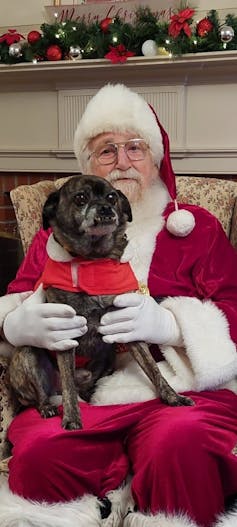
Many Santas see their work, whether paid or volunteer, as a calling.
Photo by Gwyn Sussman
Whereas prototypical Santas could easily slide into the Santa role, the process was more complex for the others.
Semi-prototypical Santas did things like come up with stories they’d tell themselves or share with children to explain away their fake beards. Nonprototypical Santas had values aligned with the Santa image, such as being peaceful, loving and kind. But they still made a big effort to look like what people expect when they visit a Santa.
“Should it be a difference if you’re a Jewish Santa Claus or a Catholic Santa Claus?” asked an atheist professional Santa we called “Santa Aquila.” “No. You’re Santa Claus. What do you do? You’re not even supposed to preach anything.”
Another Santa whom we called “Santa Lynx” hid that she was female in part by flattening her chest.
Why it matters
While anyone can take a turn being their neighborhood potluck’s Santa, the one you meet at the mall probably attended some combination of Santa schools, webinars and training.
For instance, the Charles W. Howard Santa Claus School was founded in 1937 and conducts an annual Santa training each year. National networks also exist, such as the Fraternal Order of Real Bearded Santas, which says it has 1,000 members, – and the IBRBS, formerly known as the International Brotherhood of Real Bearded Santas, offering meetups and professional support.

Actor B.J. Averell, dressed as Santa Claus, attends a toy drive for struggling Bay Area families in Burlingame, Calif., in December 2024.
Tayfun Coskun/Anadolu via Getty Images
There are also local organizations, such as the Lone Star Santas network in Texas.
Although most professional Santas are paid for their work, many do this voluntarily.
It’s not uncommon for there to be some sort of expectation around who should have a particular occupation. Pilots tend to be male, most schoolteachers are female, and salespeople are often seen as extroverted.
But that doesn’t mean that women can’t be pilots, men can’t be teachers or that introverts can’t work in sales.
What’s next
I’m now looking at how broader institutional environments, current events and social movements can shape how people experience their callings and find meaning at work.
The Research Brief is a short take on interesting academic work.
(Christina Hymer, Assistant Professor of Management and Entrepreneurship, University of Tennessee. The views expressed in this commentary do not necessarily reflect those of Religion News Service.)

Original Source:
https://religionnews.com/2025/11/26/what-makes-a-true-santa-is-inside-and-comes-with-the-red-suit/