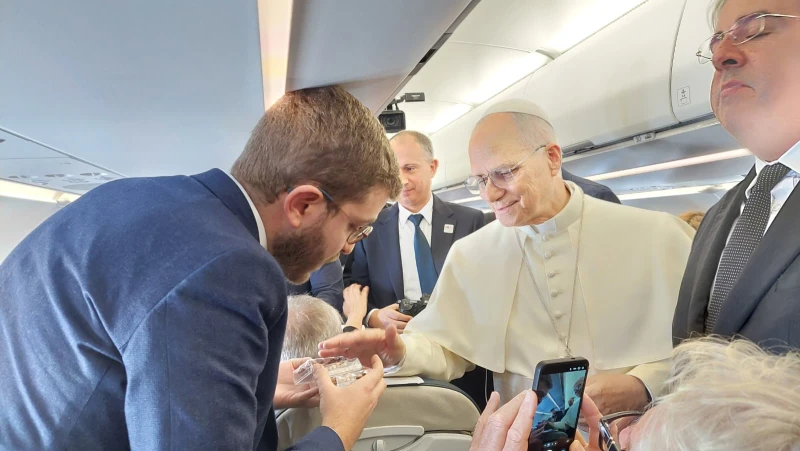
 Pope Leo XIV blesses rosaries for EWTN News' Elias Turk aboard the papal plane to Ankara, Turkey, on Nov. 27, 2025. / Credit: Courtesy Elias Turk of EWTN News.
Vatican City, Nov 27, 2025 / 04:57 am (CNA).
Pope Leo XIV arrived in Turkey Thursday on his first international apostolic journey. The wide-ranging trip — spanning historic ecumenical encounters, deeply symbolic gestures of prayer, and pastoral visits to Christian communities under pressure — is expected to highlight the pope’s priorities of unity, peace, and encouragement across a region marked by both ancient faith and present suffering.
During his flight from Rome, the pope told reporters that he hoped his trip would be an occasion to "proclaim how important peace is throughout the world, and to invite all people to come together, to search for greater unity, greater harmony, and to look for the ways that all men and women can truly be brothers and sisters."
He also wished American reporters in particular a Happy Thanksgiving.
The papal plane arrived in Turkey’s capital, Ankara, around 12:30 pm local time. Upon arrival, the pope was scheduled to visit the Atatürk Mausoleum, built in honor of Mustafa Kemal Atatürk, founder and first president of the Turkish Republic. He will then travel to the Presidential Palace for a meeting with President Recep Tayyip Erdoğan and an address to authorities, civil society representatives, and the diplomatic corps. The pope will not remain overnight in Ankara but will continue by air to Istanbul the same day.
Ecumenically focused visit
The visit to Turkey centers on the 1,700th anniversary of the First Council of Nicaea. The pope will participate in an ecumenical prayer service in Iznik, the site of the historic council that articulated Christian teaching on the nature of Christ and affirmed the Nicene Creed. The council also issued disciplinary norms and established a common date for Easter.
During his stay, the pope will take part in several ceremonies and is expected to sign a joint declaration with Ecumenical Patriarch Bartholomew I of Constantinople. He will also visit Istanbul’s Sultan Ahmed Mosque.
A notable omission from the pope’s itinerary is Hagia Sophia, the Byzantine church-turned-mosque that the Turkish government designated a museum open to all faiths in the 20th century. Pope Francis visited the monument in 2014, on the last papal visit to Turkey, but said he was “deeply pained” when the government turned it back into a mosque six years later. Patriarch Bartholomew also protested the change.
Pope Leo’s visit carries particular significance for Turkey’s small Christian community, which looks to the pope for support and encouragement. The motto for the visit is “One Lord, one faith, one baptism.” The Catholic community has witnessed several attacks in past decades, such as the killing of Father Andrea Santoro in Trabzon in 2006 and the assassination of the Apostolic Vicar of Anatolia, Bishop Luigi Padovese, in 2010. In 2024, two people attacked Santa Maria Church in Istanbul’s Sariyer district during Holy Mass, leading to the death of one person attending the service. The Islamic State claimed responsibility for the last attack.
Christians have also been facing, like the rest of the population, the economic consequences of severe inflation in the Turkish lira, the national currency, in recent years. They have likewise endured the devastating effects of the earthquake that shook southern Turkey in February 2023.
A message of peace for Lebanon
After Turkey, the pope will travel to Lebanon. Speaking to journalists last month, he said he would have there “the opportunity to proclaim once again the message of peace in the Middle East, in a country that has suffered so much.”
Leo’s itinerary in Lebanon highlights both the nation’s deep Christian roots and its recent trauma. The pope will visit the tomb of St. Charbel, a revered Maronite saint, in Annaya, meet with young people outside the Maronite Patriarchate in Bkerke, and spend time in silent prayer at the site of the 2020 Beirut port explosion, which killed more than 236 people and injured over 7,000, according to Human Rights Watch.
Lebanon’s Christian community has endured years of hardship — from the 2019 economic collapse to the 2020 blast, as well as ongoing clashes between Israel and Hezbollah since October 2023. Though weakened by emigration and crisis, Christians remain central to the nation’s political and social life: the president, army commander, and central bank governor must all be Maronite Catholics, and Parliament is evenly divided between Christians and Muslims.
Many Lebanese Christians have left the country in search of stability and economic opportunity. For those who remain, the pope’s presence is widely seen as a sign of hope, particularly during the 2025 Jubilee Year of Hope.
Original Source: