Religions Around The World

In the early morning hours, monks can be seen walking on their alms round in Kanchanaburi, Thailand
Showing humility and detachment from worldly goods, the monk walks slowly and only stops if he is called. Standing quietly, with his bowl open, the local Buddhists give him rice, or flowers, or an envelope containing money.  In return, the monks bless the local Buddhists and wish them a long and fruitful life.
Christians Celebrate Good Friday
Enacting the crucifixion of Jesus Christ in St. Mary's Church in Secunderabad, India. Only 2.3% of India's population is Christian. 
Ancient interior mosaic in the Church of the Holy Saviour in Chora
The Church of the Holy Saviour in Istanbul, Turkey is a medieval Byzantine Greek Orthodox church.
Dome of the Rock located in the Old City of Jerusalem
The site's great significance for Muslims derives from traditions connecting it to the creation of the world and to the belief that the Prophet Muhammad's Night Journey to heaven started from the rock at the center of the structure.
Holi Festival in Mathura, India
Holi is a Hindu festival that marks the end of winter. Also known as the “festival of colors”,  Holi is primarily observed in South Asia but has spread across the world in celebration of love and the changing of the seasons.
Jewish father and daughter pray at the Wailing Wall in Jerusalem, Israel.
Known in Hebrew as the Western Wall, it is one of the holiest sites in the world. The description, "place of weeping", originated from the Jewish practice of mourning the destruction of the Temple and praying for its rebuilding at the site of the Western Wall.
People praying in Mengjia Longshan Temple in Taipei, Taiwan
The temple is dedicated to both Taoism and Buddhism.
People praying in the Grand Mosque in Ulu Cami
This is the most important mosque in Bursa, Turkey and a landmark of early Ottoman architecture built in 1399.
Savior Transfiguration Cathedral of the Savior Monastery of St. Euthymius
Located in Suzdal, Russia, this is a church rite of sanctification of apples and grapes in honor of the Feast of the Transfiguration of the Lord.
Fushimi Inari Shrine is located in Kyoto, Japan
It is famous for its thousands of vermilion torii gates, which straddle a network of trails behind its main buildings. Fushimi Inari is the most important Shinto shrine dedicated to Inari, the Shinto god of rice.
Ladles at the purification fountain in the Hakone Shrine
Located in Hakone, Japan, this shrine is a Japanese Shinto shrine.  At the purification fountain, ritual washings are performed by individuals when they visit a shrine. This ritual symbolizes the inner purity necessary for a truly human and spiritual life.
Hanging Gardens of Haifa are garden terraces around the Shrine of the Báb on Mount Carmel in Haifa, Israel
They are one of the most visited tourist attractions in Israel. The Shrine of the Báb is where the remains of the Báb, founder of the Bábí Faith and forerunner of Bahá'u'lláh in the Bahá'í Faith, have been buried; it is considered to be the second holiest place on Earth for Bahá'ís.
Pilgrims praying at the Pool of the Nectar of Immortality and Golden Temple
Located in Amritsar, India, the Golden Temple is one of the most revered spiritual sites of Sikhism. It is a place of worship for men and women from all walks of life and all religions to worship God equally. Over 100,000 people visit the shrine daily.
Entrance gateway of Sik Sik Yuen Wong Tai Sin Temple Kowloon
Located in Hong Kong, China, the temple is dedicated to Wong Tai Sin, or the Great Immortal Wong. The Taoist temple is famed for the many prayers answered: "What you request is what you get" via a practice called kau cim.
Christian women worship at a church in Bois Neus, Haiti.
Haiti's population is 94.8 percent Christian, primarily Catholic. This makes them one of the most heavily Christian countries in the world.

Was Squanto Catholic? What we know about this hero of the first Thanksgiving

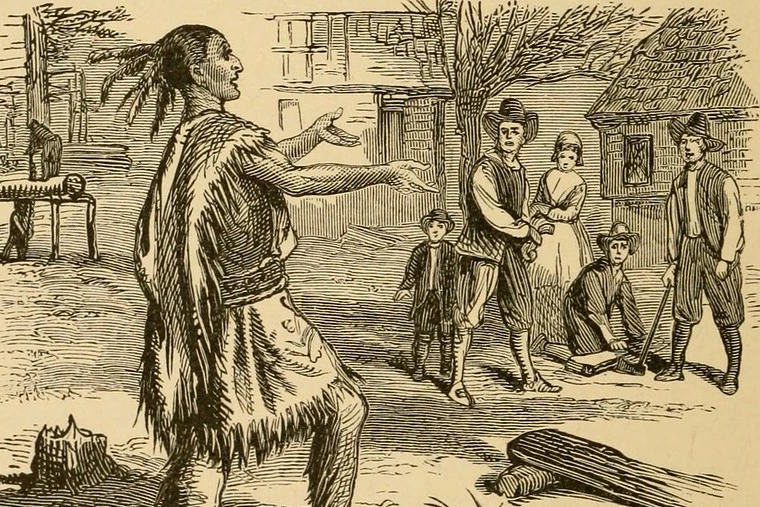
Image from page 155 of “Young Folks’ History of the United States” (1903). / Credit: Public domain

St. Louis, Missouri, Nov 27, 2025 / 11:00 am (CNA).

In 1621, lacking both the skills and the resources necessary to survive in the harsh territory of New England, European pilgrims encountered a miracle: a Native American who not only spoke English but who also used his skills and knowledge to help them adapt to their environment and survive the brutal winter.

This was Squanto, a man who occupies a special place in the hearts of many people who celebrate Thanksgiving because of his willingness and ability to help the newcomers to his land.

Squanto’s full name was Tisquantum, and he was a member of the Patuxet tribe, which lived in and around modern-day Plymouth, Massachusetts. He was probably born around 1585 in the area that is now Boston.

Little is known about Tisquantum’s early life, but what is known is that he was abducted from his homeland as a slave by an Englishman, Thomas Hunt, in 1614. He ended up in Malaga, Spain, where a group of Franciscans bought him in order to free him. It is apparently from these Franciscans that he received baptism and became Catholic, though it is not clear to what extent he was catechized and practiced his new faith.

Damien Costello, a Catholic historian and theologian, told CNA that the historical record portrays “a very skillful agent” in Tisquantum who was able to change his situation and engage with European culture. He was able to find employment as a translator in England and later convinced a wealthy financier to fund an expedition back to his homeland.

When Tisquantum finally made it back to where his tribe lived in present-day Massachusetts, his life took a tragic turn. He discovered that his entire tribe, while he was in Europe, had been wiped out by disease — he was the sole survivor.

The Pilgrims arrived in New England in 1620. They were far from the first Europeans to set foot on those shores — this was many years after Jesuit missionaries had started missionary activity in the area but hadn’t settled. When the Pilgrims arrived in what had once been Patuxet territory, the empty land made a good place to settle. Tisquantum, no doubt mourning the loss of his people, was nevertheless able to deftly reinvent himself as an intermediary between the Pilgrims and Native leaders.

In March 1621, the chief of the Wampanoag confederation, Massasoit, went to meet with the Pilgrims and brought Tisquantum along to translate. After negotiations fell apart, Tisquantum stayed with the Pilgrims and helped to facilitate what we now know as the first Thanksgiving — a meal between the Pilgrims and the Natives of the area. Tisquantum died the next year, in 1622.

So, was Tisquantum a Catholic? Costello says it is likely he was baptized and thus, theologically, he was indeed a Catholic. Native American culture was very spiritual, and Costello said he doesn’t think it unlikely that Tisquantum saw his baptism as a positive spiritual experience.

“Catholicism was a crucial ingredient in Squanto’s resiliency, the regenerative principle that gave spiritual power to sustain the disjunction of being a global citizen in a world forever turned upside down,” Costello later wrote in an article for U.S. Catholic.

As to whether Tisquantum continued to practice his Catholic faith for the rest of his life, there’s little evidence to say for sure. In a very real sense, God only knows.

This story was adapted from an episode of Catholic News Agency’s award-winning storytelling podcast, CNA Newsroom, and first published on Nov. 24, 2022. You can listen to that episode here.

Original Source:

https://www.catholicnewsagency.com/news/252901/was-squanto-catholic-what-we-know-about-this-hero-of-the-first-thanksgiving