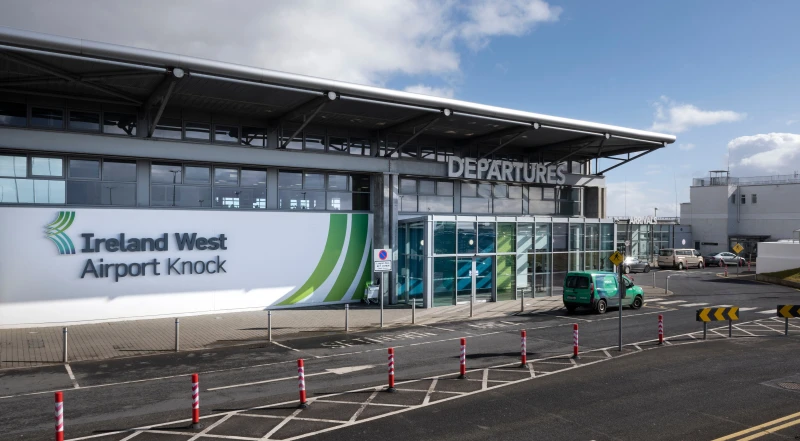
 Ireland West Airport in Knock, Ireland. / Credit: Photo courtesy of Ireand West Airport Knock
Dublin, Ireland, Nov 29, 2025 / 06:00 am (CNA).
This year marks the 40th anniversary of the operation of Ireland West Airport in Knock as it records its highest-ever annual passenger numbers since three inaugural Rome-bound Aer Lingus flights departed in 1985. The airport owes its existence and success to the vision, ambition, and drive of Monsignor James Horan, Knock’s parish priest.
During his apostolic visit in 1979, Pope John Paul II traveled to the Knock Shrine, which he described as “the goal of my journey to Ireland,“ to mark its centenary. For Horan, the delight that the pope was coming to Knock was tempered with regret that there was no airport into which he could fly.
Tom Neary, a volunteer at the shrine for 40 years, told CNA that his close friend — Horan — once said to him: “I’ll tell you one thing, if the pope comes again, we’ll have an airport and he will be able to fly in.”
Neary added: “I didn’t take him too seriously when he said that; that was the kind of thinking the man had.”
The dream was realized when Pope Francis landed at Knock airport on Sunday, Aug. 26, 2018, as part of the World Meeting of Families. The pope had a particular devotion to St. Joseph, who was present in the apparition with Our Lady at Knock, which added to its appeal for him. He prayed at the shrine, recited the Angelus with the faithful, and offered prayers for abuse victims.

According to Neary, Horan was always fascinated by airports. “If he was at Dublin Airport, he would go upstairs to have a good look at the planes arriving and departing,” he said. “He was always looking ahead into the future. He was kind of a visionary, and he was never happy unless he was doing something to help people. He loved country people in particular because he was one of them.”
In the early 1980s, Ireland was quite poor and lagged behind other countries economically. Emigration and unemployment rates were spiraling, and even for those who had jobs wages were low.
Despite the economic situation and skepticism from Irish media and politicians, Horan pressed ahead with his plans, securing 10 million Irish pounds (about $13 million) from the then-Irish premier, Taoiseach Charles Haughey, who subsequently formally opened the new airport five years later.
There was a shortfall of 4 million Irish pounds ($5.2 million) at one stage due to a general election and a change in government. To cover this funding gap, Horan organized a “jumbo quiz” — a large-scale lottery that he traveled across several countries, including Australia and the United States, to promote.
Neary explained: “For the jumbo quiz, we had to go for very big prizes, and strangely enough, nobody refused us a prize.”
“Once the 10 million [Irish pounds] was spent, the work stopped, the authorities didn’t want to start up again,” he said. “They stopped it, actually, on two occasions. Now, that was a desperate thing to have done, and even though everything was compliant, they just didn’t want the development at all.”
The jumbo quiz offered a stunning array of prizes including cars, houses, cattle, sites for houses, heating oil (which attracted huge interest), and a lot of money.
“It worked, it completed the runway and a terminal building, the first building that was put up there, and was it not for that jumbo quiz the airport would never have come into being because it was dead and buried, as far as the government was concerned,” Neary said. “Now it has the full support of government. It gets grants from the EU Regional Airport grants. It’s doing extremely well.”
The travel and exertions took their toll on Horan’s health, and he died shortly after the airport’s completion. For people coming to Knock airport now, one of the first things they see is an impressive statue of Horan.

Noel Jennings, who now works at Sligo Regional Airport, was a Knock parishioner who grew up knowing Horan.
“He was a larger-than-life character,” Jennings told CNA. “Back when the airport was celebrating its 25-year anniversary, Monsignor Horan wasn’t being mentioned that much and I felt that he had been lost among that generation, not many people knew of his contribution. I felt that something had to be done to mark his contribution and to remind people coming to the airport of the driving force behind it.”
Together with other individuals who knew Horan, Noel set about establishing a committee to raise the 70,000 euros (about $80,600) needed to erect a permanent statue. And, as with earlier appeals and despite the strained economic situation, it was a success. A statue of Horan now greets people using the airport.
While the statue is a visible tribute to Horan, a tangible and practical economic legacy is the growth of the airport, the number of destinations, the volume of passengers, and the regularity of flights.
Donal Healy, head of aviation business development, marketing, and communications at Ireland West Airport, explained to CNA how the airport currently services 22 destinations in the summer and 11 in the winter. Over 950,000 passengers will have used the airport in 2025 — over 100,000 more than the previous year.
“A key presence since 1989 is Ryanair, who has had 12 million passengers use the airport. London traffic accounts for 400,000 passengers annually. The airport now provides employment for over 200 people, with a knock-on effect for local businesses and community,” Healy said.
He added: “On a practical level the presence of the airport enables members of the Irish diaspora with a means to travel directly back to visit relatives in the heart of the west of Ireland, maintaining valuable family, parish, and community contacts.”

The days of large-volume pilgrimage charter flights are gone, but Knock Shrine still welcomes 1.5 million visitors every year, many using the airport.
These lasting benefits of economic sustainability, employment, inward investment, and the continuing appeal of the Knock Shrine are a lasting testimony to Horan’s vision, his faith in the local people, the local business community, the people of Ireland, and most of all, his faith in God.
Original Source: