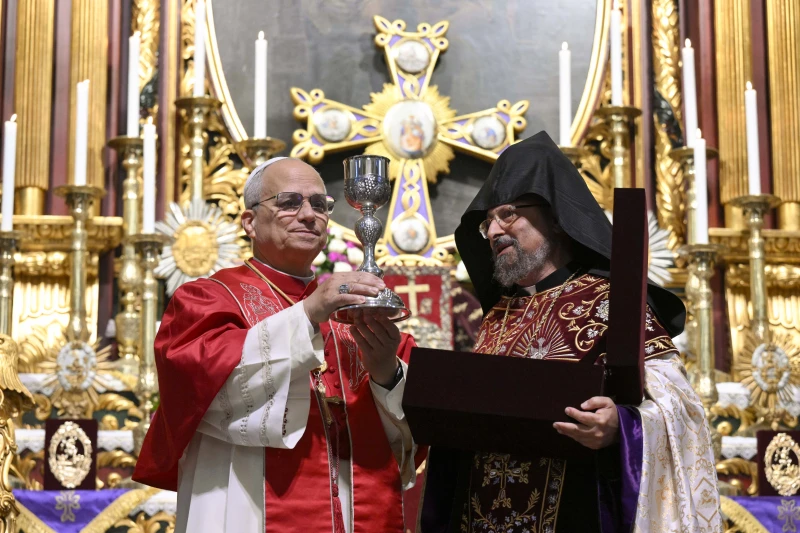
 Pope Leo XIV with Armenian Patriarch Sahak II Mashalian at the Armenian Patriarchate of Constantinople in Istanbul, Turkey, on November 30, 2025. / Vatican Media
Istanbul, Turkey, Nov 30, 2025 / 04:50 am (CNA).
Pope Leo XIV dedicated the final morning of his visit to Turkey on Sunday to strengthening ties with the Armenian Apostolic Church, thanking God for “the courageous Christian witness of the Armenian people throughout history, often amid tragic circumstances.”
The pope addressed the faithful at the Armenian Apostolic Cathedral in Istanbul, highlighting the deepening relationship between the Catholic Church and the Armenian Apostolic Church and recalling key milestones in their modern ecumenical journey.
The visit to the cathedral, seat of the Armenian Patriarchate of Constantinople, formed part of a day marked by prayer, dialogue, and reflection as the pope concluded the Turkey leg of his first international apostolic journey, which continues next in Lebanon.
Armenians are one of Turkey’s oldest Christian communities, with roots stretching back to the early centuries of Christianity. Their history includes periods of flourishing as well as profound suffering, especially the mass deportations and killings under the Ottoman empire in 1915, which Pope Francis termed a genocide. Today, a small Armenian minority remains in Turkey, centered largely in Istanbul, where the Armenian Patriarchate continues to serve as their spiritual and cultural anchor.
Relations between the Catholic and Armenian Apostolic Churches have grown steadily in recent decades. In 1967, Catholicos Khoren I became the first primate of an Oriental Orthodox Church to visit the bishop of Rome, then Paul VI. Three years later, Catholicos Vasken I and Paul VI signed the first joint declaration between their Churches, urging Christians “to rediscover themselves as brothers and sisters in Christ with a view to fostering unity.”
While the Armenian Patriarchate of Constantinople is autonomous in its internal governance, it recognizes the spiritual primacy of the Catholicos of All Armenians in Echmiadzin. The cathedral remains a central spiritual home for Turkey’s Armenian community.
Marking the 1700th anniversary of the First Council of Nicaea, the pope stressed the unifying force of the Nicene Creed. “We must draw from this shared apostolic faith in order to recover the unity that existed in the early centuries between the Church of Rome and the ancient Oriental Churches,” he said. Full communion, he added, “does not imply absorption or domination, but rather an exchange of the gifts received by our Churches from the Holy Spirit.”
Pope Leo also honored Armenian saints, especially the 12th-century Catholicos and poet Nerses IV Shnorhali. “May the example of Saint Nerses inspire us and his prayer strengthen us on the path to full communion,” he said, noting the recent commemoration of the 850th anniversary of Shnorhali’s death.
Patriarch Sahak II Mashalian welcomed the pope to the cathedral for a program that included prayer, liturgical chanting, a welcome address, the pope’s remarks, an exchange of gifts, a blessing, and a final hymn. The pope concluded the visit by blessing a commemorative plaque at the cathedral entrance.
Liturgy with Bartholomew
Later in the day, Pope Leo XIV moved to the Orthodox Patriarchal Church of Saint George for the Divine Liturgy of the feast of Saint Andrew, patron of the Ecumenical Patriarchate and of Turkey. He addressed the faithful, acknowledging unresolved tensions between Christian Churches. “There are still obstacles preventing us from achieving full communion. Nevertheless, we must not relent in striving towards unity,” he said, urging all Orthodox Churches to participate actively in this effort.
The pope also addressed global challenges, calling Christians to be peacemakers amid war and unrest. “Peace must be sought through prayer, penance, contemplation and nurturing a living relationship with the Lord,” he said. He appealed for renewed care for creation, warning that the ecological crisis demands “spiritual, personal and communal conversion.”
Speaking about technology, he encouraged Catholics and Orthodox to cooperate “in promoting their responsible use… ensuring their benefits are not reserved to a small number of people or the interests of a privileged few.”
He ended with a broad call to collaboration: “All Christians, the members of other religious traditions, and all men and women of good will can cooperate harmoniously in working together for the common good.”
After the liturgy, Pope Leo XIV gave an ecumenical blessing with Ecumenical Patriarch Bartholomew I. The two were scheduled to have lunch before a farewell ceremony for the pope at Atatürk Airport. He was then scheduled to depart for Lebanon, continuing a journey marked by efforts to deepen Christian unity and renew the shared responsibility flowing from the Nicene faith.
Original Source: