WASHINGTON (RNS) — Shortly after joining Senate colleagues in midweek voting for a review of an environmental standard, Sen. Raphael Warnock sat in his Hart Senate Building office and talked about prayer and policy.
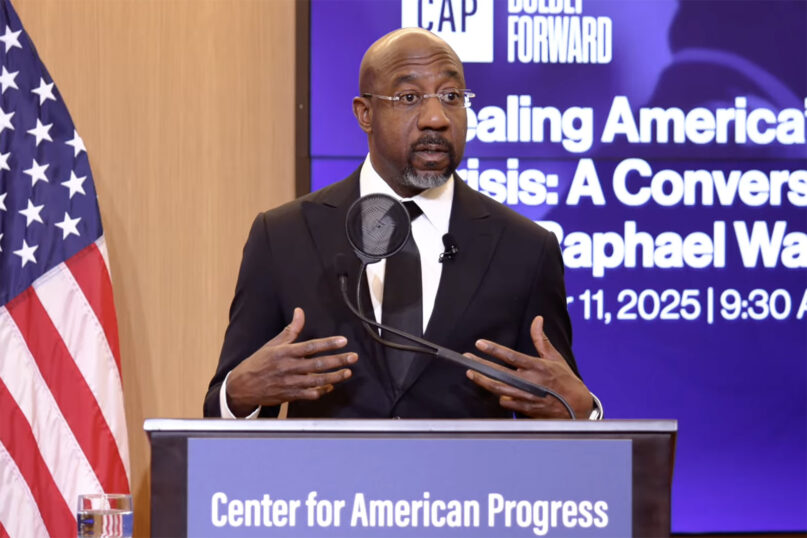
The senior pastor of Atlanta’s Ebenezer Baptist Church recently declared that the U.S. is in the midst of a “spiritual crisis,” a topic he discussed at the Center for American Progress, a liberal think tank, and in the pulpit from which the Rev. Martin Luther King Jr. used to preach.
Warnock, a Democrat, said prayer undergirds his policy efforts to address the troubles he sees across Georgia and the rest of the country. Though he seldom gets to the weekly Senate Prayer Breakfast on Wednesdays, his private prayer time is a regular part of his schedule. It’s enhanced by reading the writing of Christian mystic Howard Thurman and praying with “a couple of prayer partners.”
“I have a very strong prayer life, and it is specially activated early in the morning before the noise of the world gets started,” he said in an interview Wednesday (Jan. 7). “It anchors my agenda and holds at bay the distractions.”
Warnock, 56, talked with Religion News Service about why he thinks there’s a spiritual crisis in America, what can be done about it and how he’s discussed aspects of it with his young children.
The interview was edited for length and clarity.
In your speech last month to the Center for American Progress, you spoke about how Democrats, Republicans and independents all feel that the American dream is slipping away. Is that the essence of what you believe is a spiritual crisis?
As I often say, I’m not just a senator who used to be a pastor. I’m a pastor in the Senate, and I am deeply concerned about the spiritual health of our country, the state of the covenant that we have with one another as an American people. I think the health of that covenant, that bond, is reflected in the capacity of ordinary people to live lives of human thriving. And so if people are hungry in the wealthiest nation on the planet, if people can’t get health care in a nation that is the wealthiest in human history and the most technologically advanced, if the prospects of a child’s outcome is based on their parents’ income, so that we could almost chart the likelihood of their lifespan based on their ZIP code, that’s a public policy problem. But it’s also a moral crisis.
RELATED: From Senate subcommittee to Easter sermon: Raphael Warnock on life as a pastor-politician
You speak about this covenant with one another not being held up. And you said in your sermon at Ebenezer on Sunday that our nation is “spiritually sick.” So how can that be overcome? What specifically can be done?
I think those of us who are people of faith need to lead the way in helping the nation to understand that meeting people’s physical needs is a spiritual project. And I think that is particularly important in this moment because some of the loudest and meanest voices in America, the most regressive voices in our country that blame the poor for their condition, are Christian voices, and that isn’t just my opinion, there’s data to show that, which says there’s something wrong with our theology. There’s something wrong with our view of what the faith actually means, and so that too is part of the spiritual crisis that I point to as a pastor who serves in the Senate in a moment in which the politics of xenophobia and rendering people the adversary because they’re different, hold sway, and much of it is supported by religious voices in our country.
You said in your speech that “My faith is not a weapon”—
It’s not a weapon. It’s a bridge.
— But you also said that President Trump’s rise to power indicated the nation is “in the throes of a deep spiritual crisis.” How does that criticism lead to a way forward, given that the president responded to your remarks by saying you are “using Religion to try and divide the Country”?
Sadly, I’m not surprised by his response. Donald Trump is the most gifted at dividing the country of any politician, perhaps in American history, certainly in my lifetime. He has a knack, just a deft ability, to divide us. And so that’s what I was calling out. I stand on what I said, and I’m holding him accountable, which is part of our grand democratic tradition.
You said in your remarks that the necessary spiritual work for these times requires not just public rhetoric, but public policy, and you suggest working together on projects like building houses and assisting in elder care and child care. Are you calling on churches, houses of worship, states, federal government? Who are you saying needs to do that?
I’m calling on all of us. But let me be really clear: The church cannot do at scale what government can do. And it is unrealistic and unfair to call on the faith community to do that. We all pay taxes. The democracy is the high and collective expression of our covenant and commitment to one another, and the only way to address that — the private sector has a role, the faith community has a role — but we’re not going to be able to tackle our housing crisis without the weight and robust strength of the federal government, and part of that work also is getting the government to incentivize local municipalities to remove some of these old covenants, a lot of them rooted in Jim Crow segregation, that make it nearly impossible to create the kind of housing that we need.
We are now in an election year and there are disparate ways that faith is portrayed — such as how President Trump’s Cabinet members and some Christian leaders view the actions of ICE agents in American cities either as justified or immoral. What do you think faith in general, and Christianity in particular, means to the average voter? And what do you hope it would mean?
Let me speak to the direct issue that you raised. When you see these boots on the ground in our American streets, agents of government landing in Black Hawk helicopters and rappelling down an apartment building in an American city like Chicago, and a president who makes no bones about distinguishing between blue cities and red cities as he decides where to deploy these forces, he is trying to convince us that we are at war with one another. So for me, faith has an important role here, and it is as basic as that question that the lawyer asked Jesus: “And who is my neighbor?”
Do you sometimes have theological debates with your colleagues in the Senate or the House? Are there backroom discussions where you say “That’s not what the Scripture says”?
We should have more of those discussions. It’s come up in a speech that I gave. We were in the midst of the debate right before the passage of the (One) Big Beautiful Bill (Act) — allegedly beautiful — largest transfer of wealth in American history. What’s beautiful about that? I said, I’ve been thinking about those of us in this body who consider ourselves people of the book. And I said in that speech that I recognize that none of us owns the truth, but when I look at some of the policies of my colleagues, I have to ask myself, are we reading the same book?
You mentioned your concern about the next generation as you discussed the spiritual crisis. Are there any of those challenges that you discuss with your children, and what do you tell them about that?
My children are 9 and 7. As I would pray with them every night, they have now memorized the Lord’s Prayer. I recognize they don’t know what it all means, and that’s fine. I think it’s just important for them to memorize it now. It’s sweet listening to them say, “Give us this day our daily bread,” and I pray for the day they’ll know what that’s about.
I wrote a children’s book for my children and for everybody else’s children called “Leo’s Lunch Box.” It’s a story about food insecurity, and it’s a story about taking care of your neighbor. And it reminds us that if we feed each other, everybody gets to eat. So that’s the way in which I’m talking to my kids about my values as a person of faith.
RELATED: Raphael Warnock says his Senate colleagues sometimes ask, ‘Rev, pray for me
Original Source: