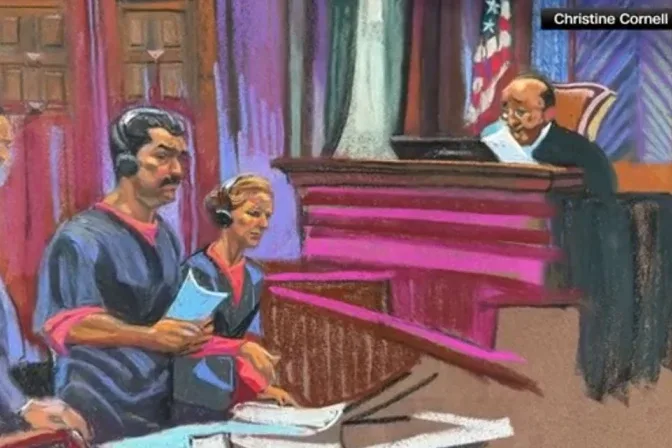
 Artist’s sketch of Nicolás Maduro and Cilia Flores at the New York courthouse where they appeared Jan. 5, 2025. Photos and videos are prohibited, hence this illustration, but journalists are allowed to be present. | Credit: CNN
Jan 8, 2026 / 18:10 pm (CNA).
Arturo McFields, former Nicaraguan ambassador to the Organization of American States (OAS), stated that, following the capture of Nicolás Maduro, “winds of hope are blowing” for Venezuela, Nicaragua, and Cuba.
“At this moment, it’s impossible not to share the joy of the Venezuelan people, the hope for a new day, although it’s complex because democracy is not easy, but hope has strongly resurged among Venezuelans, Nicaraguans, and Cubans, the hope that no dictatorship is eternal, and today that hope is more alive than ever,” the exiled former diplomat told ACI Prensa, CNA’s Spanish-language news partner, on Jan. 6.
“We are seeing right now, in real time, how the powerful figures who thought they were gods or demigods are now brought to their knees and dressed in prison uniforms,” McFields said in reference to Maduro’s appearance this week in New York, where he pleaded not guilty.
Maduro has been accused of narcoterrorism conspiracy, conspiracy to import cocaine, possession of machine guns and destructive devices, and conspiracy to possess machine guns and destructive devices against the United States.
After stating that the most important thing for a people is their faith in God, the former ambassador emphasized that “all these earthly gods, these Baals, are transient, and we are seeing this in real time. That is a very important message, a very important message of hope for the people of Nicaragua as well, because we know that one day we will see justice, not only divine justice, but in some way even earthly justice.”
Dictatorships are not eternal
“A very important message to consider is that dictatorships are not eternal: We have the dictatorship of the socialist bloc, which lasted more than 70 years. Then we have Syria, more than 50 years. Then we have the dictatorship of Evo Morales [in Bolivia] and the socialist movement, more than 20 years. And each and every one of them eventually fell, and now we are seeing the collapse in Venezuela of more than 26 years of 21st-century socialism, Chavismo, and Maduroism,” McFields continued.
The former ambassador was referring to the socialist political and economic policies of former presidents Hugo Chávez and his successor Maduro.
Great empires like the Roman one, McFields pointed out, “or great dictatorships, fall, and some are more complex, like the socialist dictatorship or the dictatorship in Syria, or the Roman Empire itself, which fell. So, if all those great regimes fell, how could a simpler and less sophisticated regime like Nicaragua’s not fall?”
International law must change to confront ‘criminal dictatorships’
“Under international law, it’s not legal to invade a country, nor is what Maduro was doing legal,” Nicaraguan researcher Martha Patricia Molina, author of the report “Nicaragua: A Persecuted Church,” told ACI Prensa. Her latest report documented that more than 16,500 religious processions were banned by the dictatorship and nearly 1,000 attacks were carried out against Catholics.
“The domestic law of several countries establishes that when someone needs help because they are in imminent danger, you can enter a house without authorization to save the person who needs help. In international law, it’s not like that,” the author continued, addressing those who criticize the Jan. 3 U.S. military intervention during which Maduro was captured in Caracas.
“I believe that international laws are not suited to the criminal dictatorships of Venezuela, Cuba, and Nicaragua but rather to countries that respect the rule of law. Current international laws must change and adapt to reality to allow this type of intervention against perpetrators of crimes against humanity,” she emphasized.
In her opinion, an intervention in Nicaragua, like the one the United States carried out in Venezuela, would not happen because “we are not a country of interest to the international community.”
Tyrants feign courage but live in fear
“The one who is most afraid is the most powerful. Tyrants feign courage and present themselves as high and mighty and aggressive, but they live constantly threatened by fear and turn others, even those in their own inner circle, into rivals or enemies to be eliminated. And they don’t hesitate to do so when they see their power threatened,” said Silvio Báez, the exiled auxiliary bishop of Managua, Nicaragua, in his Sunday, Jan. 4, homily for the Mass for the Epiphany of the Lord.
Speaking about the capture of Maduro, but without mentioning him by name, the bishop emphasized that “this is the world of the powerful and of tyrants. [King] Herod and his court personify the dark world of power, where everything is justified and anything goes: calculation, cynicism, lies, cruelty, contempt for life. However, and you will agree with me, ancient history, let’s think of Herod, and recent history, let’s think about what happened yesterday, teaches us that all tyrants pass away, all of them, and end up condemned by God and by history.”
Regarding the Three Wise Men who came to adore the newborn baby Jesus, the Nicaraguan prelate said this act of adoration “transforms us and gives us strength, because only God is to be worshipped; it gives us the strength never to kneel down or be subservient to any idol or power of this world.”
This story was first published by ACI Prensa, CNA’s Spanish-language news partner. It has been translated and adapted by CNA.
Original Source: