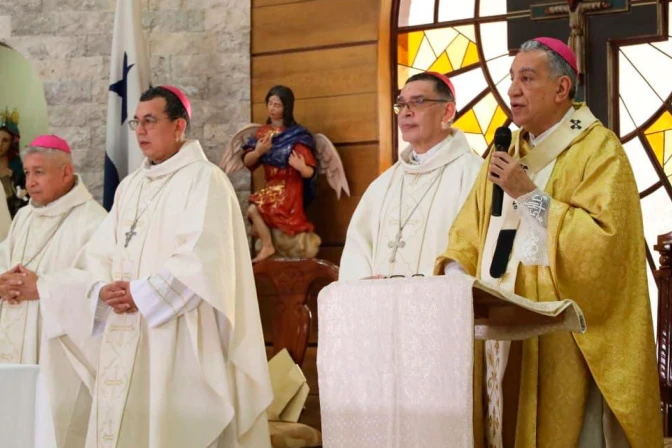
 Bishops of Panama at a Mass during their 224th ordinary assembly. | Credit: Panamanian Bishops’ Conference
Jan 12, 2026 / 18:41 pm (CNA).
The Catholic bishops in Panama addressed the “urgent need to give ourselves a new constitution” in a message following the 224th ordinary assembly of bishops, which took place this week.
“It’s not just a matter of reforming texts but about renewing consensus, strengthening democratic institutions, guaranteeing social justice, and ensuring that the country’s legal framework is in line with the times we live in and those to come,” the prelates stated after their assembly, which was held from Jan. 5–8.
“Embracing the legacy of Jan. 9 [1964] requires a clear-sighted understanding of the challenges of the present time. Among them is the urgent need to give ourselves a new constitution that responds realistically and with a vision for the future to the aspirations of the Panamanian people,” the prelates stated.
On Jan. 9, 1964, a group of Panamanian students attempted to raise the Panamanian flag in the Panama Canal Zone, then under U.S. control, which sparked violent clashes with U.S. troops, leaving 21 dead and leading to the rupture of diplomatic relations. This event paved the way for the negotiations that ultimately returned control of the canal to Panama.
In their statement, the bishops noted that the sacrifice of these young people “reminds us that sovereignty is not inherited passively but is defended with conviction, unity, and generous dedication.”
Poverty that cries out to heaven
“The poor cannot wait. These are not just numbers or statistics; they are people with faces and stories. They are children, elderly people, women, young people, and entire communities whose dignity is violated every day. And we cannot remain indifferent either,” the bishops stated.
The bishops also emphasized the importance of caring for the environment and reaffirmed their “pastoral support for our brothers and sisters in Río Indio, and for those who must make decisions, so that discernment and decisions guarantee a decent life and secure land, without exclusions or impositions.”
In that area of the country, the Panama Canal Authority (ACP by its Spanish acronym) is developing a large project to build a new reservoir to ensure water for the canal, which has generated opposition from local communities that will be flooded and relocated. The ACP promises compensation and a better standard of living, however.
The Panamanian bishops also expressed their “deep concern over the increase in violence that is becoming normalized in daily life” and emphasized that “no form of violence is acceptable, because it denies the dignity of the human person, created in the image and likeness of God, and is radically opposed to the Gospel of life and peace.”
They urged “that the justice system act responsibly and effectively, guaranteeing the real protection of victims and unrestricted respect for life.”
Solidarity with Venezuela
The bishops reiterated their “closeness and solidarity with the Church and the Venezuelan people. You are not alone. And in communion with the successor of Peter, we affirm that ‘the good of the beloved Venezuelan people must prevail above any other consideration and lead to overcoming violence and embarking on paths of justice and peace, guaranteeing the country’s sovereignty, ensuring the rule of law enshrined in the constitution, and respecting the human and civil rights of all.”
“We unite in prayer so that the Lord may grant that nation the gift of reconciliation, harmony, and a future of cooperation, stability, and peace,” they emphasized.
This story was first published by ACI Prensa, CNA’s Spanish-language news partner. It has been translated and adapted by CNA.
Original Source:
https://www.catholicnewsagency.com/news/269029/catholic-church-in-panama-calls-for-new-constitution