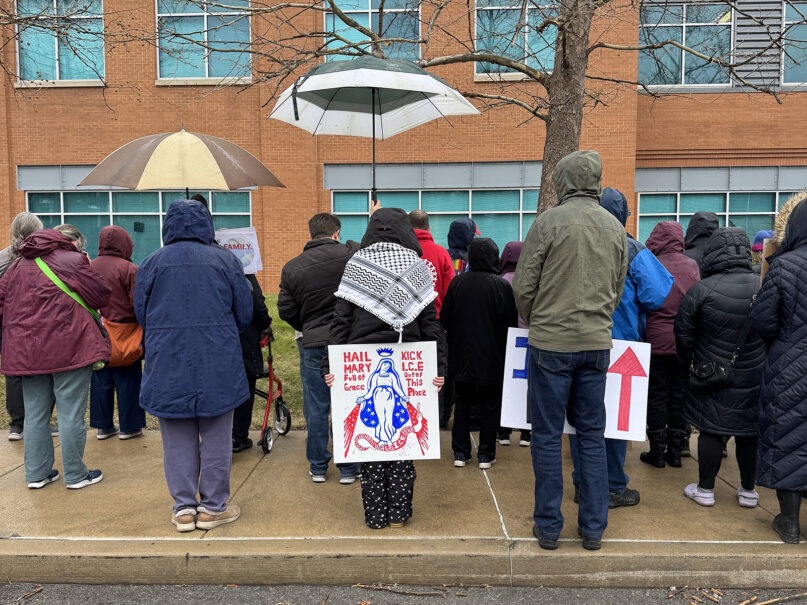
PITTSBURGH (RNS) — On an unseasonably warm, drizzly Friday morning in early January, nearly 200 people of faith stood outside the U.S. Immigration and Customs Enforcement field office in Pittsburgh’s South Side neighborhood, singing religious songs and praying. Some wore yarmulkes, and others wore clerical collars and held posters depicting Mary, Jesus’ mother, being detained by ICE agents. One sign read: “Who Would Jesus Deport?”
“I’m here because Renee Good cannot be here, and her mother and daughter are weeping,” said the Rev. De Neice Welch, executive director of the Pennsylvania Interfaith Impact Network, referring to the woman killed a few days earlier by an ICE agent in Minneapolis. “I’m here because my faith drives me, my God compels me, and my Scriptures remind me that where the Spirit of the Lord is, there is liberty.”
In between verses of “This Little Light of Mine” and “Lift Every Voice and Sing,” the Rev. Dave Swanson, a pastor at Pittsburgh Mennonite Church, reminded attendees that Good was killed less than a mile from where George Floyd was killed by police in 2020.
“We reclaim that ground as holy ground,” he said, reading from the liturgy written for that day’s vigil.
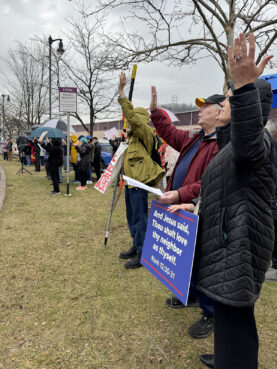
The interfaith group began hosting these kinds of vigils weekly as part of a larger effort that has emerged throughout the Pittsburgh region to support immigrants and refugees and peacefully resist ICE’s efforts, after the Trump administration began enacting its mass deportation agenda last year. From Jewish synagogues to Quaker meeting houses, faith groups across the city have been organizing trainings, observing actions of ICE agents, advocating for policy changes and allocating resources for immigrants of all documentation statuses. These collaborations represent the latest and perhaps most robust chapter in a long history of pro-immigrant faith efforts in the city. While these religious groups disagree on many matters of belief, they’re united by the conviction that caring for neighbors is an irrefutable faith imperative, some of their leaders told RNS.
“No matter what our faith tradition is, what we come together on is an understanding of the inherent dignity of every human being created in the divine image that is therefore worthy of protection, thriving and respect,” said Rabbi Amy Bardack of Pittsburgh’s Dor Hadash, a Reconstructionist Jewish congregation.
That unity was palpable at Friday’s vigil. Near the hourlong event’s conclusion, participants raised their arms to receive a blessing, then turned and faced ICE officers posted outside. They ended their time in silent prayer, both for those detained in the building and for the ICE agents.
At least 810 people have been sent to the field office’s holding cells between the beginning of last year and mid-October, according to reporting from the Pittsburgh Post-Gazette. In June, ICE lifted a holding limit, allowing detainees to be held in cells for more than 12 hours. Two months later, faith groups began holding vigils outside the offices on Friday mornings.
“Every week, it is a different constellation of people of all sorts of persuasions, but we certainly come together on this,” said Roberta Zolkoski, a member of a creation care group at the Catholic parish St. Teresa of Kolkata, which serves a growing Latino population in Pittsburgh’s Beechview neighborhood. “Not only do you have to deal with the news that is so demoralizing, but you can respond in a way that actually is life giving.”
What began as a group of 45 or so people holding weekly vigils has become an interfaith coalition of “anywhere from 60 to over 100” gathering each Friday, said Sister Barbara Finch, one of the vigil organizers who is a member of the Sisters of St. Joseph of Baden and also is involved with Pax Christi, a Catholic peace organization. “And it keeps growing.”
The Rev. Darlene Figgs, associate pastor of Bidwell Presbyterian Church on Pittsburgh’s North Side, told RNS that mistreatment of immigrants across the country has required people of faith to come together, regardless of other disagreements.
“We’re living in a system that is so broken, that has been broken for years, and we need to fix it,” Figgs said. “To do that, we have to become partners with people that we may never have partnered with. We can’t just stay in our little bubbles anymore. We are way past that, and so I don’t have to agree with you, but I need to work with you.”
Figgs is also the leader of the religious leaders caucus of the Pennsylvania Interfaith Impact Network. The grassroots, interfaith group recently launched an immigration justice task force that is advocating for undocumented immigrants to be able to obtain driver’s licenses, for the city to require ICE agents to show IDs and not wear masks and for all municipalities within Allegheny County to stop cooperating with ICE. The task force plans to meet with elected officials to push for these goals.
“We need the vigils and the prayers, the fellowship and the protesting, the health of individuals, the money, the care and compassion, and we also need systemic change,” observed Bardack, who is vice president of the Pennsylvania Interfaith Impact Network.
Bardack’s congregation is one of several faith groups in Pittsburgh that has long provided hands-on resettlement aid to refugees in the city. But since the Trump administration gutted federal funds for refugee resettlement and set a record-low refugee admissions target reserved largely for white South Africans, local faith groups have faced uncertainty for how to support their immigrant neighbors.
Amid such unpredictability, some Pittsburgh faith groups are offering trainings or pooling resources to help immigrant families. A group of local Quakers, for example, is hosting a community discussion on Martin Luther King Jr. Day on how to be nonviolent peacemakers. East Liberty Presbyterian Church is offering zoom sessions this month training people to speak to their congressional representatives about immigration concerns. And Mary, Queen of Peace, a Catholic parish, is planning an event in late January where church representatives can discuss how to fund social service needs for immigrants and refugees in the community.
These efforts complement the work of organizations like Casa San José, a member of the Pennsylvania Interfaith Impact Network, founded in 2013 by Sister Janice Vanderneck of the Sisters of St. Joseph, which has been coordinating a rapid response team to observe and record ICE raids and raise funds for bail bonds and legal expenses. Last summer, Pittsburgh’s Public Source reported the group had trained more than 250 volunteers to document ICE raids and arrests and to accompany people at risk of detainment. Many of those trainings are held in churches.
“We want to change policies that are unjust, and you can only do that by putting yourself out there,” Finch said. “It’s so hard to get an interfaith, ecumenical group of people to work together on something, and this has just blossomed.”
Original Source: