(RNS) — You probably know that song by Billy Joel:
“We didn’t start the fire
It was always burning since the world’s been turning
We didn’t start the fire
No, we didn’t light it
But we tried to fight it … “
We Jews didn’t light it, but our history has been a long chronicle of trying to fight it.
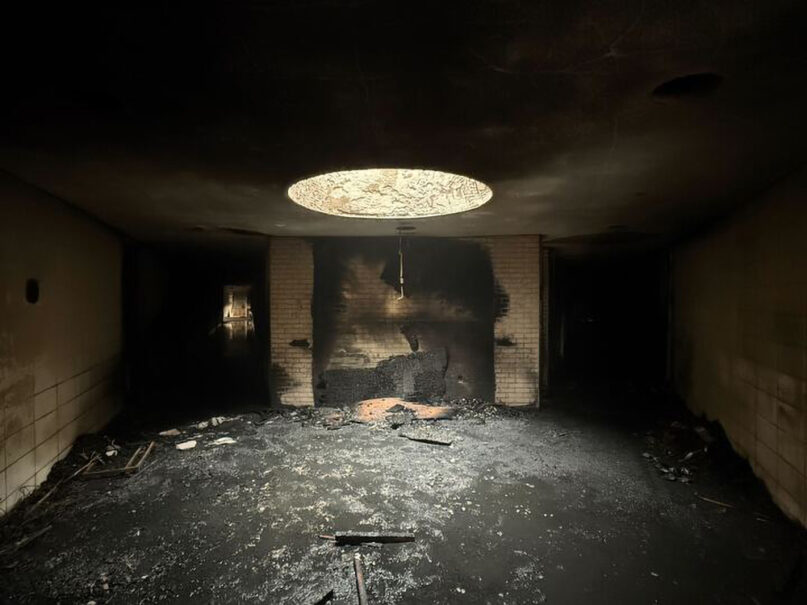
Last Shabbat morning (Jan. 10), an arsonist set fire to the historic Beth Israel Congregation in Jackson, Mississippi. By the time the flames were extinguished, much of the building was damaged. The fire tore through the synagogue library and administrative spaces, according to The Associated Press, burning two Torah scrolls as well as other sacred objects. A scroll rescued from the Holocaust remained unharmed. The synagogue — first built in 1867, and one of the oldest Jewish congregations in the state — will not be able to function as a house of worship for the foreseeable future.
Those who know American Jewish history experienced a flashback. On Sept. 18, 1967, white supremacists bombed that same synagogue in Jackson in retaliation for the civil rights activism of its rabbi, Perry Nussbaum. Rabbi Nussbaum was a visible ally of Black leaders in Jackson, including activist Medgar Evers, and his moral courage made him a target. Shortly thereafter, attackers bombed Nussbaum’s home as well. He survived. The synagogue building was rebuilt.
Stephen Spencer Pittman has been charged with the crime. His Instagram account shared antisemitic content the day of the attack. He did not deny what he did, according to authorities. On the contrary, he reportedly reveled in it. He justified the crime by citing the synagogue’s Jewish identity and referred to it as “the synagogue of Satan.”
Those words matter, and they are not random. They are not modern. They are ancient, loaded and lethal.
The phrase appears twice in the New Testament in the Book of Revelation (2:9 and 3:9). In its original context, it was likely part of an internal Jewish dispute within the first century, when early Jesus followers were struggling to define themselves in relation to the broader Jewish community.
But once Christianity separated from Judaism and became a dominant religion, those words took on a terrifying afterlife. By late antiquity, the church fathers were already using language that cast Jews as spiritually blind, rejected by God and aligned with evil. The church father Jerome would proclaim: “If it is expedient to hate any people and to detest any nation, I have a notable hatred for the circumcised; even now they persecute our Lord Jesus Christ in the synagogues of Satan.”
It was not enough for Jews to simply have retained their ancient faith. The church had to imagine them as enemies of God and in league with Satan. With chilling predictability, those teachings gave way to irrational accusations and violence — for example, Crusaders on their way to liberate the Holy Land killed Jews in the Rhineland; conspiracies that Jews kidnap and kill children; accusations that Jews destroy Communion wafers; allegations they poison wells and spread plague.
That was the Middle Ages, we thought. Not in America.
Here, the Jew hatred would be softer, more genteel, most often coming with the smile of social antisemitism. Elite clubs, hotels, universities, neighborhoods and professions excluded Jews. As Pamela Nadell writes in her new book on the subject, antisemitism is, in fact, an American tradition. It has always been with us, sometimes polite, sometimes lethal, often lying dormant like an autoimmune disease, flaring up when fear, desperation and social change demand a scapegoat.
In 1972, in a meeting with President Richard Nixon, evangelist Billy Graham suggested there were “two kinds of Jews”: the “remnant of God’s people” and the “synagogue of Satan.” The latter of those Jews that Graham describes are in league with the devil and “have a strange brilliance about them” that’s behind “all your religious deceptions,” he said, according to an Oval Office tape.
So, when someone sets fire to a synagogue and gleefully invokes the “synagogue of Satan,” that person is drawing from a theological script that has justified violence for centuries. Which leads us to wonder: Is it possible that the arson suspect had heard the phrase “synagogue of Satan” in church?
The truth is, what I’m describing here — unpacking the “synagogue of Satan” and providing an assessment of what those words mean and have meant — should be acknowledged by Christian clergy, theologians and public figures. Perhaps they will. Perhaps this Sunday, Christian pulpits will have the fire of moral and religious outrage. Christian theological antisemitism is a Christian problem, and it needs a Christian voice.
So, too, do we need public figures to speak on it. Yes, we have heard from some politicians. (President Donald Trump, where are you?) But what about celebrities — those ones who do not hesitate a nanosecond to condemn Israel, often wearing tuxes and gorgeous gowns when doing so? Where are the viral posts, the statements of solidarity, the righteous anger? A synagogue burned in America. The justification was naked religious hatred.
The Jewish community of Jackson will rebuild. It will take time, money and resolve. But there is something else that we must rebuild: moral clarity and a community of decency.
Last Shabbat morning, as the stench of the Jackson fire still permeated nostrils, the Torah portion described Moses standing in awe before a bush that burnt, but was not consumed. Fire has followed Jews through history. So has survival. The bush still burns. But it will not be consumed.
The flames of hatred don’t stop. A year ago, the Pasadena Jewish Temple and Center lost its synagogue to the brutal California fires. That should have been sufficient trauma. But this past Sunday, a day after Jackson, haters defiled the site with anti-Zionist graffiti scrawled on an exterior wall.
We didn’t start the fire of antisemitism, but we need help in fighting it.
Original Source:
https://religionnews.com/2026/01/13/the-jackson-synagogue-fire-began-centuries-ago/