Religions Around The World

In the early morning hours, monks can be seen walking on their alms round in Kanchanaburi, Thailand
Showing humility and detachment from worldly goods, the monk walks slowly and only stops if he is called. Standing quietly, with his bowl open, the local Buddhists give him rice, or flowers, or an envelope containing money.  In return, the monks bless the local Buddhists and wish them a long and fruitful life.
Christians Celebrate Good Friday
Enacting the crucifixion of Jesus Christ in St. Mary's Church in Secunderabad, India. Only 2.3% of India's population is Christian. 
Ancient interior mosaic in the Church of the Holy Saviour in Chora
The Church of the Holy Saviour in Istanbul, Turkey is a medieval Byzantine Greek Orthodox church.
Dome of the Rock located in the Old City of Jerusalem
The site's great significance for Muslims derives from traditions connecting it to the creation of the world and to the belief that the Prophet Muhammad's Night Journey to heaven started from the rock at the center of the structure.
Holi Festival in Mathura, India
Holi is a Hindu festival that marks the end of winter. Also known as the “festival of colors”,  Holi is primarily observed in South Asia but has spread across the world in celebration of love and the changing of the seasons.
Jewish father and daughter pray at the Wailing Wall in Jerusalem, Israel.
Known in Hebrew as the Western Wall, it is one of the holiest sites in the world. The description, "place of weeping", originated from the Jewish practice of mourning the destruction of the Temple and praying for its rebuilding at the site of the Western Wall.
People praying in Mengjia Longshan Temple in Taipei, Taiwan
The temple is dedicated to both Taoism and Buddhism.
People praying in the Grand Mosque in Ulu Cami
This is the most important mosque in Bursa, Turkey and a landmark of early Ottoman architecture built in 1399.
Savior Transfiguration Cathedral of the Savior Monastery of St. Euthymius
Located in Suzdal, Russia, this is a church rite of sanctification of apples and grapes in honor of the Feast of the Transfiguration of the Lord.
Fushimi Inari Shrine is located in Kyoto, Japan
It is famous for its thousands of vermilion torii gates, which straddle a network of trails behind its main buildings. Fushimi Inari is the most important Shinto shrine dedicated to Inari, the Shinto god of rice.
Ladles at the purification fountain in the Hakone Shrine
Located in Hakone, Japan, this shrine is a Japanese Shinto shrine.  At the purification fountain, ritual washings are performed by individuals when they visit a shrine. This ritual symbolizes the inner purity necessary for a truly human and spiritual life.
Hanging Gardens of Haifa are garden terraces around the Shrine of the Báb on Mount Carmel in Haifa, Israel
They are one of the most visited tourist attractions in Israel. The Shrine of the Báb is where the remains of the Báb, founder of the Bábí Faith and forerunner of Bahá'u'lláh in the Bahá'í Faith, have been buried; it is considered to be the second holiest place on Earth for Bahá'ís.
Pilgrims praying at the Pool of the Nectar of Immortality and Golden Temple
Located in Amritsar, India, the Golden Temple is one of the most revered spiritual sites of Sikhism. It is a place of worship for men and women from all walks of life and all religions to worship God equally. Over 100,000 people visit the shrine daily.
Entrance gateway of Sik Sik Yuen Wong Tai Sin Temple Kowloon
Located in Hong Kong, China, the temple is dedicated to Wong Tai Sin, or the Great Immortal Wong. The Taoist temple is famed for the many prayers answered: "What you request is what you get" via a practice called kau cim.
Christian women worship at a church in Bois Neus, Haiti.
Haiti's population is 94.8 percent Christian, primarily Catholic. This makes them one of the most heavily Christian countries in the world.

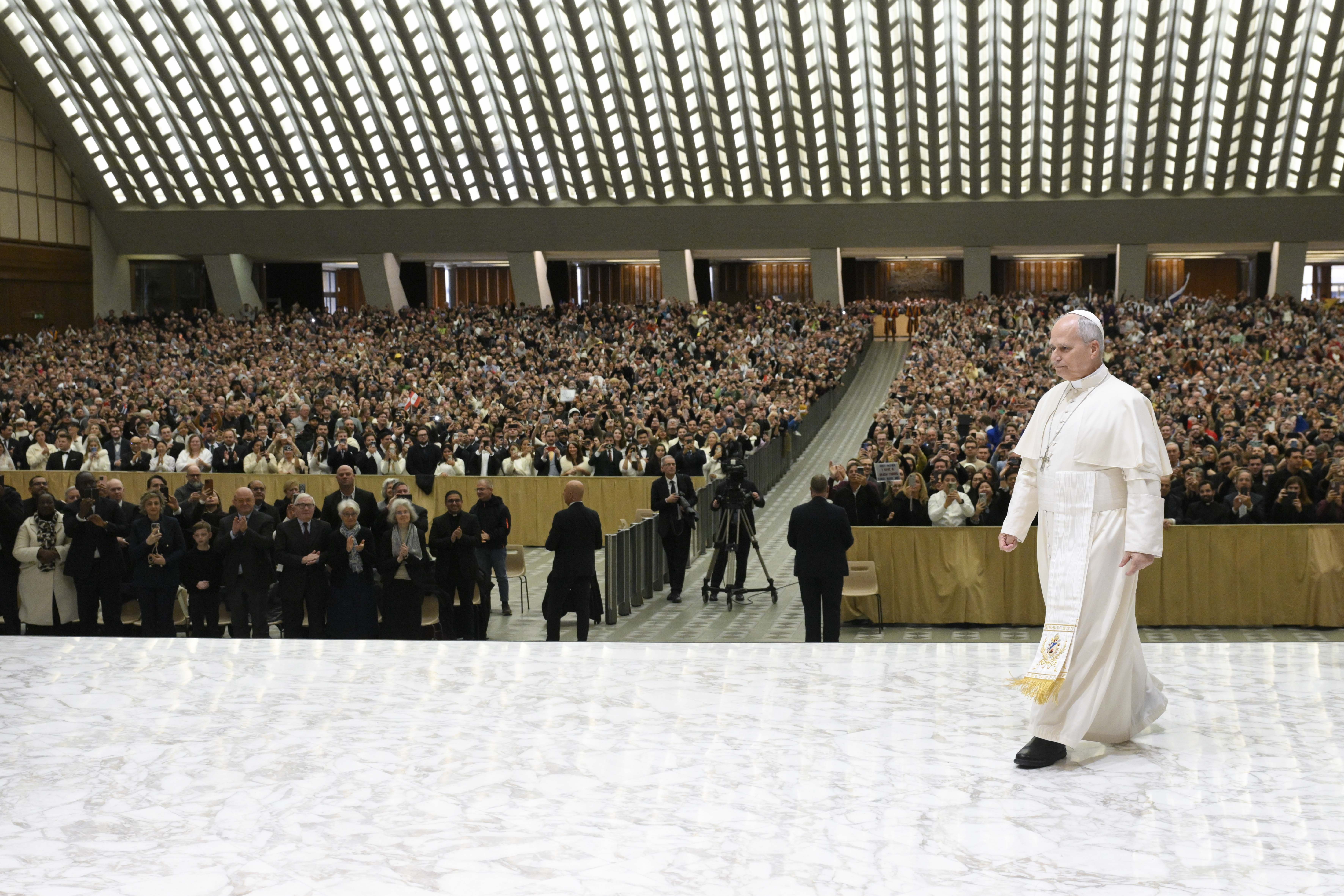
Pope Leo XIV urges making time ‘to speak with God’

Pope Leo XIV gives the first general audience of 2026 in the Vatican's Paul VI Hall on Jan. 7, 2026. Credit: Vatican Media.

Jan 14, 2026 / 06:20 am (CNA).

Pope Leo XIV urged Christians Wednesday to set aside time in their daily lives to speak with God in prayer and warned about the harm to one's relationship with him when this is ignored.

“Time dedicated to prayer, meditation and reflection cannot be lacking in the Christian’s day and week,” the pontiff said during the catechesis at his general audience in the Vatican's Paul VI Hall Jan. 14.

The pope devoted the second week of his series of teachings on the documents of the Second Vatican Council to a closer examination of the dogmatic constitution “Dei Verbum,” dedicated to divine revelation.

Pointing to the document, he highlighted listening and dialogue with God as foundations of a Christian life.

“From this perspective, the first attitude to cultivate is listening, so that the divine Word may penetrate our minds and our hearts; at the same time, we are required to speak with God, not to communicate to him what he already knows, but to reveal ourselves to ourselves,” Leo said.

The Holy Father also drew on the human experience of friendship to warn about the dangers of neglecting one’s spiritual life: “Our experience tells us that friendships can come to an end through a dramatic gesture of rupture, or because of a series of daily acts of neglect that erode the relationship until it is lost.”

“If Jesus calls us to be friends, let us not leave this call unheeded. Let us welcome it, let us take care of this relationship, and we will discover that friendship with God is our salvation,” he said.

The pope insisted that this living relationship with God is cultivated above all through prayer, understood as an authentic friendship with the Lord.

This experience, he explained, is achieved first of all in liturgical and community prayer, “in which we do not decide what to hear from the Word of God, but it is he himself who speaks to us through the Church.” It is also achieved in personal prayer, which takes place “in the interiority of the heart and mind,” and which should form part of every believer’s day and week.

‘Only when we speak with God can we also speak about him’

The pontiff stressed that only from a personal relationship with God is it possible to bear authentic witness to the faith: “Only when we speak with God can we also speak about him.”

Referring to the dogmatic constitution Dei Verbum, promulgated by St. Pope Paul VI in 1965, Leo emphasized that Christian revelation is grounded in a living and personal dialogue between God and humanity. Through this dialogue, God reveals himself as an ally who invites each person into a true relationship of friendship.

The pope noted that divine revelation has a profoundly dialogical character, proper to the experience of friendship: it does not tolerate silence, but is nourished by the exchange of true words capable of creating communion.

Leo XIV also distinguished between “words” and “chatter,” explaining that the latter remains on the surface and does not create authentic relationships. In genuine relationships, he said, words do not serve merely to exchange information, but to reveal who we are and to establish a deep bond with the other.

This article was originally published by ACI Prensa, CNA's Spanish-language news partner. It has been translated and adapted by CNA.

Original Source:

https://www.catholicnewsagency.com/news/269071/pope-leo-xiv-urges-making-time-to-speak-with-god