MAKURDI, Nigeria (RNS) — When gunfire echoed through villages near her home last month, Grace Tyohemba silenced her phone and waited for the night to pass. Living as a Christian in Nigeria’s central Benue state had taught her caution: lower her voice, skip church services, pray indoors.
Makurdi, where she lives, is the capital of Benue state in north-central Nigeria, a fertile farming region along the Benue River that has repeatedly been hit by attacks blamed on Islamist militants and armed groups.
Days later, Tyohemba’s phone buzzed with unexpected news.
Friends told her that U.S. forces, working with Nigeria’s military, had carried out airstrikes on Dec. 25 on camps linked to the Islamic State group in the Muslim-majority Sokoto state, in northwestern Nigeria. President Donald Trump called the strikes “a Christmas present.”
Speaking to a reporter by phone, Tyohemba said the announcement stirred something unfamiliar: cautious hope.
“Maybe we can breathe again,” she said. “Maybe we can worship without hiding.”
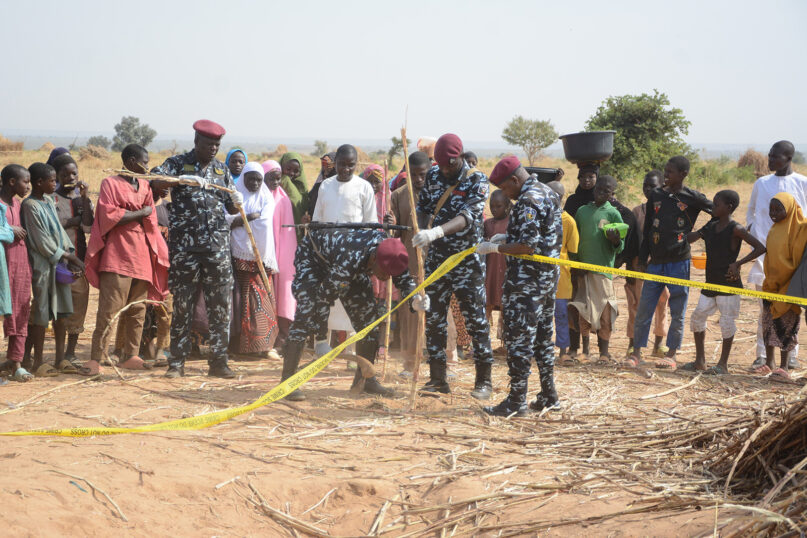
Across northern and central Nigeria, Christian leaders say the recent U.S. strikes feel like long-delayed recognition of suffering that many believe the world has ignored for decades. For them, the action is not about geopolitics but survival — the chance to attend church openly, send children to school and identify publicly as Christian without fear.
The strikes followed months of increasingly blunt statements by Trump, who began publicly raising concerns about Christian persecution in Nigeria in early October. By the end of the month, he had redesignated Nigeria as a “country of particular concern” for religious freedom violations and warned of possible military action.
After the Dec. 25 strike, Trump said U.S. forces had responded to what he described as the “slaughtering of Christians,” adding that militants had been warned there would be consequences.
Nigeria is widely considered one of the most dangerous countries in the world for Christians. The International Society for Civil Liberties and Rule of Law, a religious-violence watchdog group, reports that more than 7,000 Christians were killed and an additional 7,800 abducted because of their faith in the first seven months of 2025 alone.
The Observatory for Religious Freedom in Africa says nearly 56,000 people died in broader ethnic and religious violence between October 2019 and September 2023, with Christians disproportionately affected.
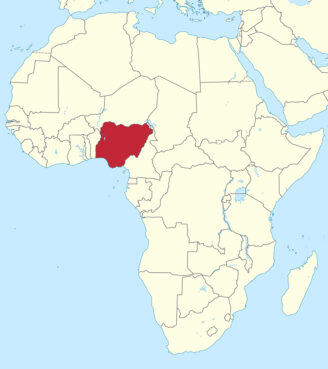
Attacks have been blamed on a mix of extremist groups, criminal gangs and long-running conflicts over land and resources, dynamics that often overlap in Nigeria’s north and Middle Belt.
Nigeria’s government has disputed the claim that Christians are more at risk than other groups, with Foreign Minister Yusuf Maitama Tuggar telling the BBC that “terrorism kills indiscriminately, affecting Muslims and Christians alike,” while analysts note the majority of victims from Boko Haram and Islamic State militants have been Muslims.
After the strikes were confirmed, Bishop Emmanuel Adetoyese Badejo of the Catholic Diocese of Oyo in southwestern Nigeria said the way the operation was presented mattered as much as the action itself.
He described the strikes as a joint U.S.-Nigeria effort welcomed by Nigerian authorities, a framing he said could help reduce the politicization that has undermined previous security responses.
In Nigeria’s polarized political climate, Badejo said, nearly every move by authorities is filtered through ethnic and religious suspicion. Emphasizing cooperation, he said, may help avoid backlash.
While Nigeria’s government has rejected claims that Christians face genocide, Badejo noted that it has also sought international assistance to stem widespread insecurity, particularly in the north.
He said the strikes could serve as a warning to militant groups that the government’s approach is shifting. Though still early, he added, many Nigerians — Christians and Muslims — view the action as a potentially hopeful step toward addressing terrorism and banditry that have defied solutions for more than 15 years.
In the capital, Abuja, the Rev. Patrick Alumuku, director of social communications for the Catholic Archdiocese, described the strikes as a moment of rare reassurance.
He said hearing the news underscored that violence in Nigeria is no longer being ignored beyond its borders.
“For victims, it sends a message that their suffering is known, and that someone cares,” he said.
Alumuku said the collaboration between Nigerian security agencies and Washington suggests a willingness to confront what many Nigerians believe lies at the root of the violence. While officials often describe attacks as banditry or criminality, he said communities experience them as targeted and ideological.
Outside Makurdi, Pastor Emmanuel Ochefu leads a small Pentecostal church that has repeatedly shut its doors because of threats and attacks. In a phone interview with RNS, he said the strikes brought rare relief to pastors who have buried congregants and watched entire communities flee.
For years, he said, openly identifying as Christian has felt dangerous. Parents feared sending children to school. Worship services were shortened or canceled. Many churches closed entirely.
Ochefu urged continued international pressure, saying sustained action could allow churches to reopen and families to resume normal routines.
“Freedom to worship is all we are asking for,” he said. “Not politics, just peace.”
Security analysts caution that airstrikes alone cannot resolve Nigeria’s complex crisis, which combines extremist violence, weak governance, land disputes and deep poverty.
Peter Akachukwu, a Lagos-based security analyst, said lasting improvement would require stronger civilian protection, accountability within security forces and long-term investment in affected regions.
Still, for people like Tyohemba in Makurdi, the strikes have already shifted something intangible.
On Christmas Day, she attended a small prayer gathering for the first time in months. The doors were closed, but the hymns were louder than usual.
“It is fragile hope,” she said. “But after so many years of fear, even that feels like a blessing.”
Original Source: