MINNEAPOLIS (RNS) — As the Rev. Ashley Horan turned the corner onto a residential street, adjusting the heat in her small sedan to stave off cold air blustering in from the open windows, she pointed to a man strolling along the sidewalk. Dangling around his neck were a whistle and what appeared to be a small camera. He smiled warmly as she waved.
“This is a patroller,” Horan said. “There’s people all over the place.”
By way of example, Horan pointed out another observer on a different block, stopping to loan the person her whistle. Two more, young women, stood huddled together on the next. An older man in a yellow reflective vest stood on yet another corner, pacing back and forth as he took drags from a cigarette.
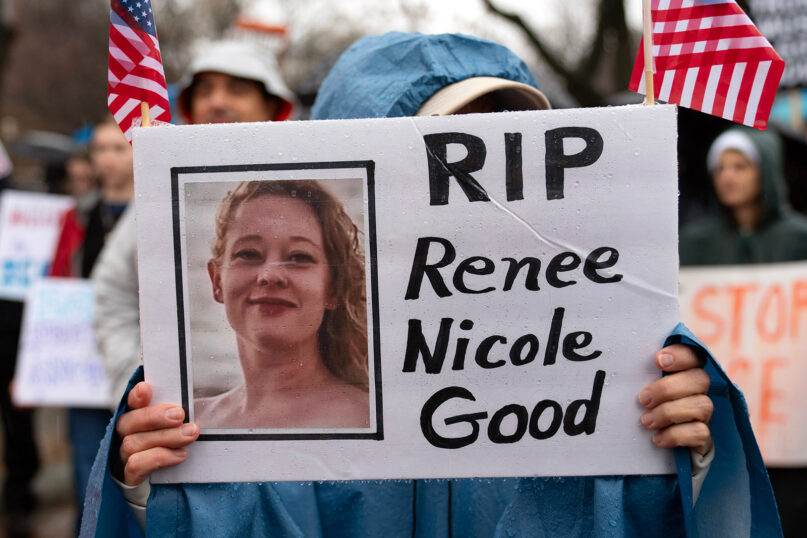
All of them, she said, were keeping an eye out for any of the thousands of Immigration and Customs Enforcement agents that have flooded into the Twin Cities as part of “Operation Metro Surge,” one of the Trump administration’s targeted immigration enforcement campaigns. As she paused at an intersection, RNS asked how often she encounters federal agents in Minneapolis’ Central neighborhood — the same neighborhood where Renee Good was killed by an ICE agent less than a week before.
Horan started to answer — “They’re here, all the time, everywhere,” she began — but was almost immediately interrupted: A cacophony of honking and whistle bleats erupted from down the street, the telltale sound of volunteers signaling the presence of ICE to the community.
As a column of cars passed directly in front of Horan, she looped around the block to meet the caravan, revving the car’s tiny engine.

It was barely 10 minutes into Horan’s first driving shift as an ICE observer, an activity that was once largely reserved for a subset of advocates seeking to resist President Donald Trump’s mass deportation efforts across the country. But in Minneapolis, where Good was shot while reportedly operating as an observer, monitoring Department of Homeland Security agents has become so common that Horan and others say organizers have struggled to manage the influx of volunteers.
The Trump administration has insisted Good’s killing was an act of self-defense by the ICE officer, accusing the 37-year-old mother of weaponizing her vehicle to commit an act of “domestic terrorism.” The administration has also launched an investigation into Good’s ties to activist groups that protest the president’s mass deportation efforts.
But the ranks of ICE observers in Minneapolis are vast, and include many religious leaders like Horan, who lives less than a block from where Good was killed. The pastor had rushed to the scene shortly after the shooting, where ICE agents fired pepper rounds in Horan’s direction. She remains undeterred.
“At the center of my faith as a Unitarian Universalist are these twin beliefs that every human life has inherent worthiness and dignity, and that we are, whether you like it or not, radically interdependent with each other,” said Horan, who serves as vice president for programs and ministries at the Unitarian Universalist Association.
“Therefore, there’s no option for me: My neighbors are under attack. Our babies are under attack. Each and every life matters, and it is my responsibility to care for my neighbors in this way.”
As she moved to intercept the caravan trailing a suspected ICE agent, a distorted voice rattled up from Horan’s phone, which sat cradled in the car’s cupholder. It was a dispatcher with the neighborhood’s ICE watch Signal group, requesting an update. Horan grabbed the phone and described the caravan, asking if she should join.
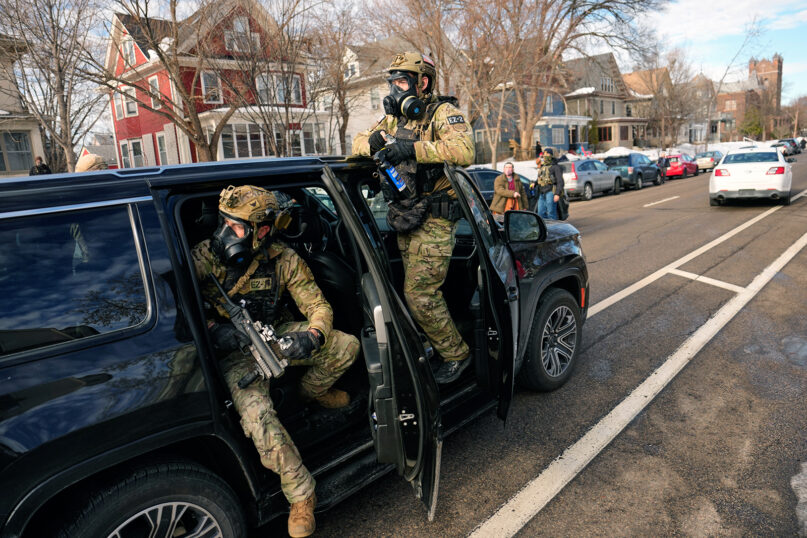
The answer came back quickly: the dispatcher recommended she continue patrolling the area. Horan agreed with the rationale — the car was already tracked by other volunteers, and could be a “runaround,” she said, a decoy strategy activists claim ICE uses to draw observers away from the actual site of planned detentions.
If ICE is resorting to decoys, it appears to be a direct response to an emerging, expansive ecosystem of grassroots pushback to the agency’s activities in neighborhoods across the city. ICE observers — who are also sometimes called constitutional observers, ICE monitors, ICE watchers and ICE verifiers — have been operating in Chicago and other parts of the country since Trump’s mass deportation campaign began. They argue their efforts are entirely within the bounds of the law, and support for the effort has become so plentiful in Minneapolis that organizers are able to hyperlocalize down to the neighborhood level.
Horan said that is especially true for communities like hers, which she said are the frequent target of DHS agents.
“The Central neighborhood is one of the most demographically, racially, socioeconomically and religiously diverse neighborhoods in Minneapolis,” Horan said, gesturing toward the houses lining the street, her hand glancing against her daughter’s summer camp name tags that dangled from the rear-view mirror. “It’s about a third Somali, a third Latino and a third other folks — many white queer folks are here in this neighborhood.”
Horan’s shift, which was only meant to cover a few blocks, involved constant interaction by her with a dispatcher and observers on foot. Operating as a group — and almost always anonymously, in addition to using an encrypted messaging app — the volunteers inspected potential ICE activity and tracked license plates believed to belong to unmarked ICE vehicles.
The level of sophistication, Horan said, is the legacy of activist networks that first emerged after the murder of George Floyd at the hands of a Minneapolis police officer in 2020.
“I think the ability to hyperspecialize and hyperlocalize right now is based on years of figuring out how this kind of thing can work,” she said.
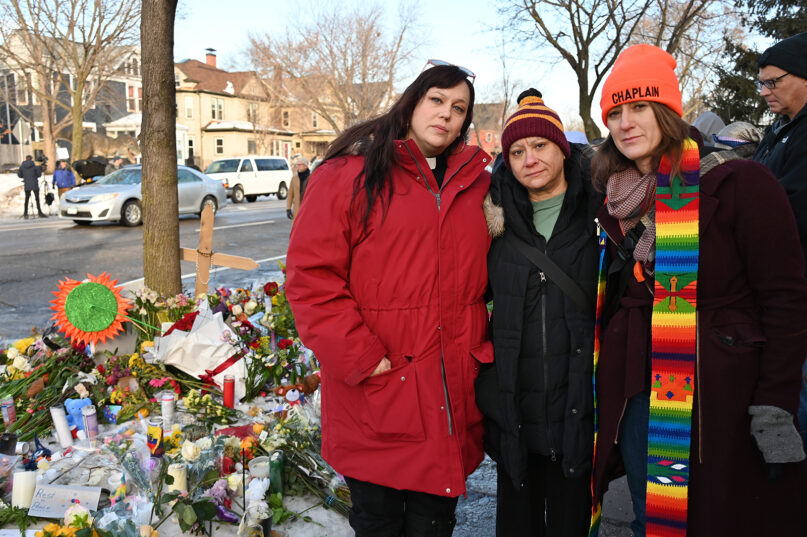
As Horan continued to drive in circles around her neighborhood, she repeatedly passed by the scene of Good’s killing. A sprawling memorial, covered in flowers and signs, has emerged at the site, where mourners frequently stop to pay their respects and reporters are a constant presence.
As she passed, the pastor adjusted her hoodie, as she was not wearing a clerical collar. Horan said that in the past, clerical collars have helped visibly identify clergy and help de-escalate tensions with law enforcement officials, who are often less likely to physically confront faith leaders.
But the dynamic is different with DHS agents, she said. She pointed to viral footage showing the Rev. David Black, a Presbyterian minister, being shot in the head with pepper balls by federal agents last year while praying outside of a DHS facility in Illinois. What’s more, she said, she has experienced similar things herself.
“I had tear gas shot in my direction on the day Renee Good was killed, wearing a visible collar and stole,” Horan said, adding, “There is no line that these people will not cross right now.”
But as she waved to another observer on the sidewalk, Horan argued that religious Americans have encountered danger before, including people in her own religious tradition. She recalled the Rev. James Reeb, a UU minister who was killed in 1965 by white supremacists while participating in the famous civil rights march in Selma, Alabama. But Horan said she has been thinking a lot about Viola Liuzzo, a white woman, Unitarian Universalist and civil rights activist who was shot in the head by Ku Klux Klan members as she was driving activists who were participating in the same march.
“Those folks are very front of mind right now, particularly Viola Liuzzo and the ways in which she feels so similar to Renee Good,” Horan said. “She was a mom, she was somebody who was drawn to just show up in ways that she could, and ended up losing her life because of her convictions.”
Horan added: “Our faith is the thing that cloaks us in protection and hope and conviction that we have to show up in whatever ways we can.”
Horan, who is white, said that while immigrant populations and others targeted by the Trump administration — such as the Somali population, which includes many Muslim Americans — are organizing privately, the most public ICE observers often belong to groups that are less immediately vulnerable to ICE detention.
“I’m incredibly heartened to see a whole lot of white folks out doing this work right now, because we need to take the risks that we can take,” she said.
But as tensions between federal agents and the surrounding community grow, so too has the network of people publicly participating in the pushback effort. Roughly an hour into Horan’s shift, another caravan of cars drove past, with drivers honking and blowing whistles as they followed a suspected ICE vehicle. Leading the group, blowing emphatically into a whistle, was a Black woman wearing a hijab.
It’s that kind of broad-based community response that Horan says has left her inspired. As her roughly two-hour shift ended — during which suspected ICE agents were spotted in her neighborhood at least twice, with reports of other potential agents moving through — she said she likely wouldn’t have volunteered for the shift were it not for the network of neighbors she sees supporting each other every day.
“We’re gonna keep taking care of people who are impacted,” Horan said. “We’re gonna keep getting braver.”
Related Minnesota coverage:
- Faith leaders are denied access to immigration detainees in Minnesota
- On the Sunday after Renee Good’s killing, Minnesotans grieve through worship and song
- In Minneapolis, George Floyd-era faith networks reignite after Renee Good’s killing by ICE
- ‘She could have been any of us’: Faith leaders mourn Renee Good in Minneapolis
- Minneapolis clergy exposed to pepper spray after rushing to scene of deadly ICE shooting
Original Source: