(RNS) — Nearly six decades ago, the Rev. Martin Luther King Jr. stood in the pulpit of Riverside Church in New York City and delivered a most controversial sermon, “Beyond Vietnam: A Time to Break Silence.” In that historic address, he named the “giant triplets” of racism, extreme materialism and militarism as intertwined evils corroding the soul of our nation.
King understood then what we are forced to reckon with today: A nation that continues to prioritize military might over human dignity loses its moral compass.
Today, we have Christian nationalists in the White House, in Congress, in state and local leadership, in our police forces, in Immigration and Customs Enforcement and in positions of power across our communities that would have us believe that God uniquely blesses the people of the United States, and therefore, our violence is a moral duty. When military power is framed as divinely sanctioned — the church has an obligation to speak out as King did.
The U.S. has created two Martin Luther Kings. One is a revolutionary in the way Christ was; the other is a sanitized, color-blind counterfeit. The version most Americans celebrate has been reduced to a single concluding refrain: “I Have a Dream.” This version is safe for textbooks and monuments because it allows the nation to praise King’s hope while ignoring his demands.
The real King was not a passive visionary. He was a radical agitator who called for reparations, challenged the moral legitimacy of the American empire and named whiteness as a system of power sustained by racial ignorance. As scholars like Monroe H. Little and Vincent Harding have long argued, the celebration of King often comes at the cost of his most radical critiques. When we sever the dream from its demands for structural change, we turn Black resistance into spectacle and survival into performance.
King’s clarity feels especially urgent in these first weeks of 2026, as the nation prepares to honor his birthday on Monday (Jan. 19). On Jan. 3, the United States executed “Operation Absolute Resolve,” a military raid in Caracas, Venezuela, that President Donald Trump is already estimating will engage the U.S. in foreign aggression, if not war, for the long-term future. And on Jan. 7, a masked ICE agent shot a woman to death in her car in Minneapolis — the latest act in a swell of rising violence from an agency that largely used to construct its treacherous work without deaths.
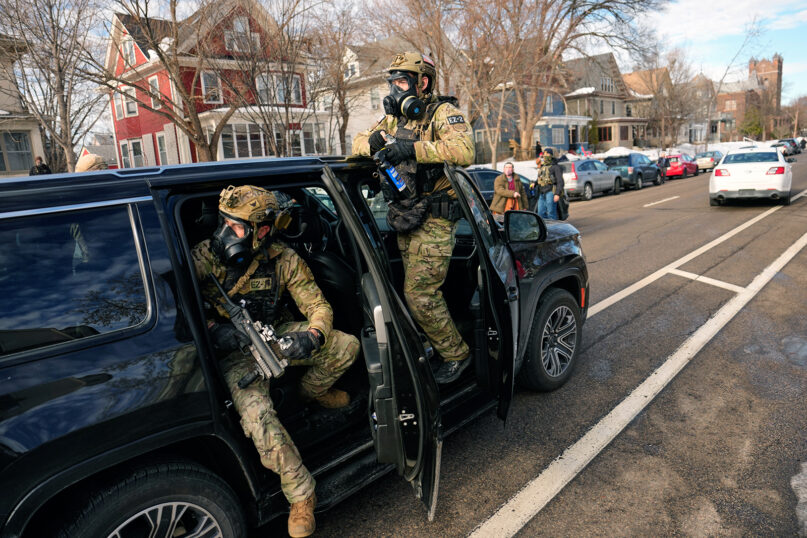
King’s warning against militarism is chillingly resonant. At Riverside, King spoke about Vietnam, but his warning was true of Libya, Iraq and dozens of other countries since. We are experiencing the “cruel irony” King spoke of — watching the poor die in the name of a democracy that remains fragile and contested.
Recent U.S. military and ICE actions — and the rhetoric used to justify them — have reignited concern about the use of force cloaked in moral or even religious certainty. When violence is framed as divinely sanctioned, when national interest is confused with God’s will, then Jesus’ church must speak. King warned us precisely about this danger: a nation that baptizes violence while ignoring its human cost loses its moral compass. There is nothing holy about domination.
In this moment, remembrance without recommitment is a betrayal. We are living in an era where the hard-won gains of the Civil Rights Movement are under renewed threat. Voting rights are being pulverized, history is being distorted and protest is being criminalized. At home and abroad, fear is weaponized, and power quickly seeks moral cover. King’s legacy does not belong to the past. It presses upon us in this present moment.
In his “Letter from Birmingham Jail,” King predicted what might happen to his beloved church if it failed to act as the moral compass of the nation: “If today’s church does not recapture the sacrificial spirit of the early church, it will lose its authenticity, forfeit the loyalty of millions, and be dismissed as an irrelevant social club with no meaning for the twentieth century.”
As two Black faith leaders, we echo King. But this work was never meant to be carried by Black people alone. Black people are tired. We are tired of being asked to save a nation that refuses to listen, and tired of being asked to dream while others benefit from the luxury of delay. The dream was born out of oppression. Dreaming is what oppressed people do when they lack power. Black people are weary of dreaming because everyone eventually wants to wake up to a safe reality. Our dreams were meant to change the world, not entertain it.
If white Christian nationalists continue to hold hostage Jesus’ message in this country, and if we uplift leaders who bless violence and hold sacred the power of Trump over all else, surely our beloved church may become an irrelevant social club — something entirely apart from what Christ calls us to be in the face of injustice.
The arc of the moral universe does not bend on its own — we must produce the pressure to bend the arc. King insisted that justice was conditional, dependent on our willingness to organize and love boldly in the face of fear. Hope, for King — and for Christ — was a disciplined practice subverting the powers that be in the face of empire.
For that reason, on Sunday, Jan. 18, Episcopal Divinity School and Riverside Church will host MLK NOW. This gathering is not a sentimental birthday observance, but a summons to truth and action. Starting with worship at 11 a.m., led by the Rev. Rashad Raymond Moore, and continuing with a major program at 3 p.m., we will lift up King’s radical vision. Joined by voices such as leading theologian and former dean of EDS the Rev. Canon Kelly Brown Douglas and the Very Rev. Lydia Bucklin, we will hear King’s words not as distant echoes, but as living demands.
Come if you are weary of a world shadowed by domination. Come if you are angry at the weaponization of faith. Come to remember that King’s dream was never about slumber — it was about waking up.
The struggle continues. So must we.
(The Rev. Adriene Thorne is senior minister at The Riverside Church in New York City. The Rev. Brandon Thomas Crowley is director of theological education at Episcopal Divinity School and senior pastor of the Historic Myrtle Baptist Church in Newton, Massachusetts. The views expressed in this commentary do not necessarily reflect those of RNS.)
Original Source: